
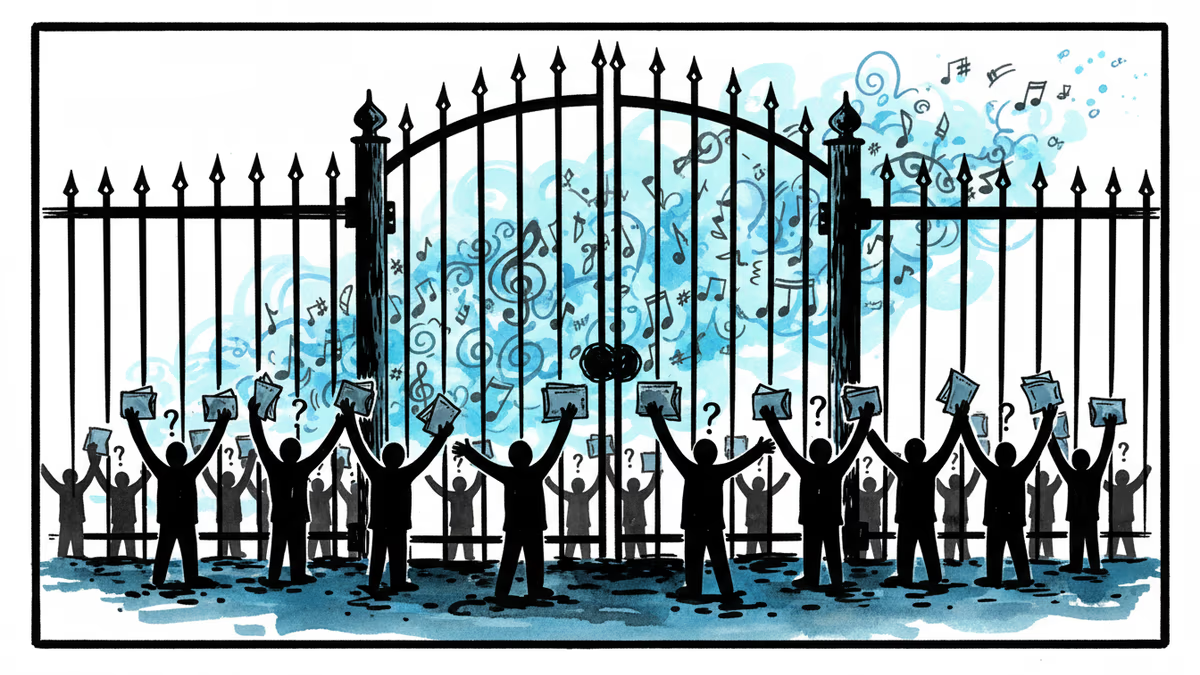
Google Just Paywalled Song Lyrics
Google restricts YouTube Music lyrics to 5 free views before demanding premium subscription. The move signals a broader shift in streaming monetization strategies.
Five Times and You're Out
Google has quietly slipped a paywall around song lyrics on YouTube Music. Free users now get exactly five lyric views before the app demands a premium subscription. Hit that sixth song? Time to pay up.
The restriction, spotted by 9to5Google through a surge in user complaints, appears to be rolling out widely after months of limited testing. The lyrics section still appears when playing songs on free accounts, but opening it now chips away at a precious allotment. "You have [x] views remaining," the app warns with each click.
What's particularly telling? Google hasn't officially announced this change. There's no mention of lyrics being a premium perk on their support pages. It's a stealth monetization move, testing how much users will tolerate before they revolt or subscribe.
The Spotify Playbook
Google isn't pioneering lyric paywalls—it's catching up. Spotify has restricted lyrics behind premium subscriptions in select markets since 2021. Apple Music offers lyrics freely, but then again, it's subscription-only from day one.
The user reaction reveals cultural divides. International users are crying foul about "basic features" being stripped away. Meanwhile, markets where lyrics were always premium (like South Korea's Melon and Genie Music) are shrugging. "Wasn't it always this way?"

This highlights a fascinating tension: what constitutes a "basic" versus "premium" feature varies dramatically by market and user expectations.
The Math Behind the Music
Why lyrics? The economics are brutal. YouTube Music's free tier generates minimal revenue per user through ads, while music licensing costs continue climbing. Every lyric view costs Google money—from licensing deals with publishers to server resources.
The five-view limit isn't arbitrary. It's behavioral psychology at work. Too few views and users abandon the platform entirely. Too many and there's no conversion pressure. Five hits that sweet spot where heavy users feel the pinch but casual listeners barely notice.
Consider the user journey: someone who frequently checks lyrics is deeply engaged with music. They're prime candidates for premium conversion. Google is essentially identifying its most valuable potential subscribers and applying gentle pressure.
The Broader Squeeze
This lyric paywall signals something bigger than YouTube Music. Streaming services across the board are tightening the screws on free tiers. Netflix introduced ad-supported plans. Disney+ raised prices. Twitter paywalled basic features.
The "freemium" model that defined the 2010s is evolving. Companies are discovering that ad revenue alone can't sustain content costs and shareholder expectations. Every "free" feature is now scrutinized for conversion potential.
What's next? Playlist creation limits? Skip restrictions? The line between free and premium is being redrawn across the industry.
Authors
Related Articles
In a post-Google I/O interview, Sundar Pichai acknowledged flawed search results, real AI anxiety, and an AGI timeline that makes the label irrelevant. Here's what he said — and what it means.
Google is building AI agents that search the web proactively, without user prompting. That's not just a product update — it's a fundamental shift in who controls the information you receive.
Google unveiled the 'Googlebook' platform to replace Chromebook and ChromeOS—but revealed zero hardware specs. What's the strategy, and what does it mean for users, manufacturers, and the education market?
After 15 years of fragmented mobile messaging, Apple and Google are rolling out end-to-end encrypted RCS messaging between iPhones and Android devices. Here's what changed, why it took so long, and what it means for your privacy.
In a post-Google I/O interview, Sundar Pichai acknowledged flawed search results, real AI anxiety, and an AGI timeline that makes the label irrelevant. Here's what he said — and what it means.
Google is building AI agents that search the web proactively, without user prompting. That's not just a product update — it's a fundamental shift in who controls the information you receive.
Google unveiled the 'Googlebook' platform to replace Chromebook and ChromeOS—but revealed zero hardware specs. What's the strategy, and what does it mean for users, manufacturers, and the education market?
After 15 years of fragmented mobile messaging, Apple and Google are rolling out end-to-end encrypted RCS messaging between iPhones and Android devices. Here's what changed, why it took so long, and what it means for your privacy.
Thoughts
Share your thoughts on this article
Sign in to join the conversation