
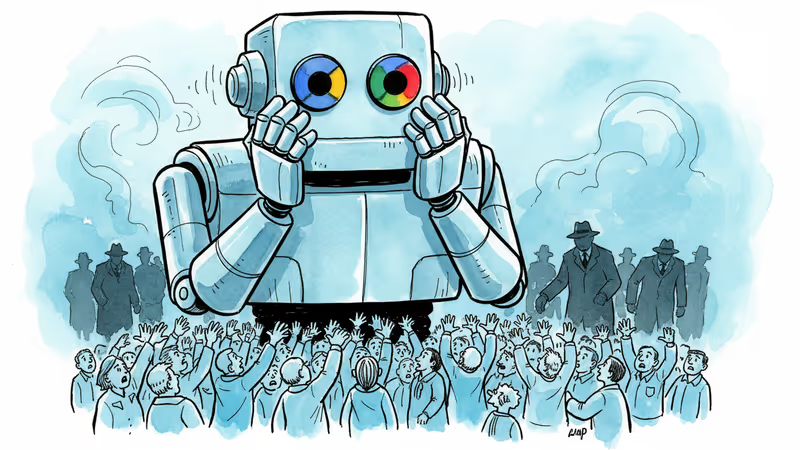
Google AI Employees Demand Safety from ICE Raids
Google DeepMind staff ask leadership for protection from immigration enforcement as Trump's ICE crackdown intensifies. Silicon Valley faces a new dilemma between employee safety and political neutrality.
The message from 3,000Google DeepMind employees to company leadership was simple yet urgent: "What is GDM doing to keep us physically safe from ICE?" This wasn't just a request—it was a stark reminder of the new reality facing Silicon Valley.
Two days after federal agents shot and killed Minneapolis nurse Alex Pretti, a Google DeepMind employee posted an internal message that would expose the growing tension between tech companies and the Trump administration's immigration enforcement. "Immigration status, citizenship, or even the law is not a deterrent against detention, violence, or even death from federal operatives," the message read, demanding concrete safety plans for employees.
The post received more than 20 "plus emoji" reactions from staff, but by Monday evening, no senior Google leaders—including CEO Sundar Pichai or DeepMind CEO Demis Hassabis—had responded. Even internally, sources say, Google's top brass remained silent about Pretti's killing.
Silicon Valley's Silent Treatment
The silence is particularly striking given that Google DeepMind's chief scientist Jeff Dean has been one of the industry's most vocal ICE critics. On Sunday, he called Pretti's shooting "absolutely shameful" in a public X post. Yet this represents a personal stance, not a corporate position.
While Silicon Valley CEOs have largely bent the knee to Trump, their employees are pushing back both internally and externally. At defense tech firm Palantir, which works with ICE, employees have questioned the company's contracts. "In my opinion ICE are the bad guys," one Palantir employee wrote in Slack, according to previous WIRED reporting.
Employees at AI labs that partner with Palantir—including OpenAI, Google, Anthropic, and Meta—have discussed pushing leadership to cut ties with the defense contractor, The New York Times reported.
The Threat Is Real
Concerns about ICE agents entering Google offices aren't theoretical. Another Google DeepMind staffer raised concerns about a federal agent's alleged attempt to enter the company's Cambridge, Massachusetts office last fall. Google's head of security clarified that an "officer arrived at reception without notice" but "was not granted entry because they did not have a warrant and promptly left."

Google declined to comment on the recent employee messages or security concerns.
The company, like many Silicon Valley firms, relies heavily on thousands of highly skilled foreign workers, many on various visa programs. Late last year, Google and Apple advised visa-holding employees not to leave the country after the White House toughened visa applicant vetting.
The CEO Silence
At that time, Silicon Valley leaders weren't shy about defending visa programs that have allowed the US to attract top global talent. But AI executives now appear hesitant to speak out about federal immigration actions.
Beyond Google, top executives from OpenAI, Meta, xAI, Apple, and Amazon have remained publicly silent on ICE activities. Sam Altman addressed the Minnesota incident only in an internal OpenAI message, telling employees that "what's happening with ICE is going too far," according to DealBook.
Anthropic executives proved an exception. "I'm horrified and sad to see what has happened in Minnesota," cofounder and president Daniela Amodei posted on LinkedIn Monday. "What we've been witnessing over the past days is not what America stands for."
The New Battleground
This divide reveals a fundamental tension in today's tech industry. Companies that built their success on global talent now find themselves caught between protecting employees and maintaining political neutrality. The question isn't just about immigration policy—it's about corporate responsibility in an era of aggressive federal enforcement.
The employee message that started this conversation included a prescient observation: "Government agency tactics can change and escalate quite rapidly." With offices across metro areas, the employee asked, "are we prepared?"
As the Trump administration's immigration crackdown intensifies, Silicon Valley faces an uncomfortable reality: staying silent may no longer be an option when employees feel physically threatened at work.
Authors
Related Articles
In a post-Google I/O interview, Sundar Pichai acknowledged flawed search results, real AI anxiety, and an AGI timeline that makes the label irrelevant. Here's what he said — and what it means.
Google is building AI agents that search the web proactively, without user prompting. That's not just a product update — it's a fundamental shift in who controls the information you receive.
Josh D'Amaro took over Disney with a bold Disney Plus vision. Days later, he's in a First Amendment fight with the Trump administration over The View. What does this mean for media freedom?

Google unveiled the 'Googlebook' platform to replace Chromebook and ChromeOS—but revealed zero hardware specs. What's the strategy, and what does it mean for users, manufacturers, and the education market?
In a post-Google I/O interview, Sundar Pichai acknowledged flawed search results, real AI anxiety, and an AGI timeline that makes the label irrelevant. Here's what he said — and what it means.
Google is building AI agents that search the web proactively, without user prompting. That's not just a product update — it's a fundamental shift in who controls the information you receive.
Josh D'Amaro took over Disney with a bold Disney Plus vision. Days later, he's in a First Amendment fight with the Trump administration over The View. What does this mean for media freedom?
Google unveiled the 'Googlebook' platform to replace Chromebook and ChromeOS—but revealed zero hardware specs. What's the strategy, and what does it mean for users, manufacturers, and the education market?
Thoughts
Share your thoughts on this article
Sign in to join the conversation