
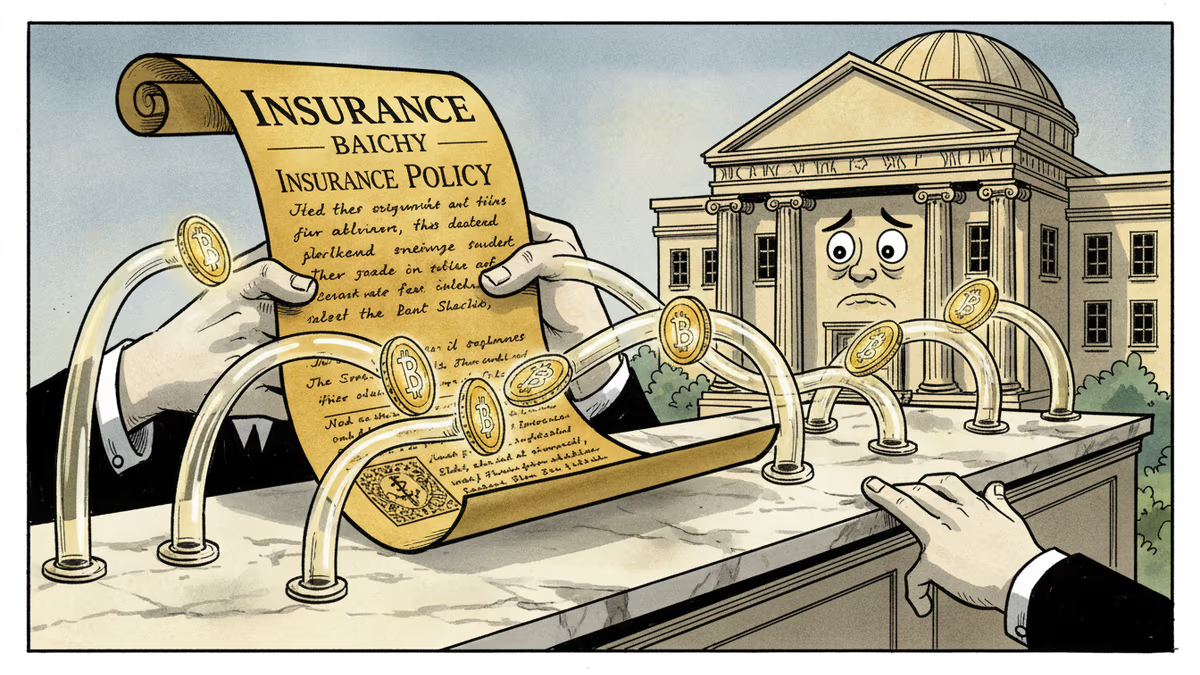
Aon Just Paid Insurance Premiums in Stablecoin. Now What?
Global insurance broker Aon completed a stablecoin payment pilot with Coinbase and Paxos, using USDC and PYUSD. Here's what it means for corporate finance and the $300B stablecoin market.
It takes up to five days to wire an insurance premium across borders. Aon just did it in minutes—using stablecoin.
What Happened
Aon, one of the world's largest insurance brokers with $5 trillion in assets under advisement, announced Monday it completed a proof-of-concept using stablecoins to settle insurance premium payments. The firm worked with Coinbase and blockchain infrastructure company Paxos to process transactions using Circle's USDC on Ethereum and PayPal's PYUSD on Solana.
Aon described it as the first known instance of a major global insurance broker using stablecoins for premium settlement. The pilot was controlled and limited in scope—this wasn't billions of dollars moving on-chain overnight—but the symbolism is hard to miss: a 160-year-old institution just ran a live test of crypto-native payment rails for one of finance's most traditional transactions.
The Plumbing Problem Nobody Talks About
Insurance premiums, especially for large corporations operating across multiple countries, are a logistical headache. Payments route through correspondent banks, clear through SWIFT or regional systems, get hit with FX conversion fees, and can take two to five business days to settle internationally. For a company managing hundreds of policies across dozens of markets, that friction adds up—in cost, in float, and in operational complexity.
Blockchain-based payments, in theory, compress all of that. A stablecoin transfer settles in minutes, carries a transparent on-chain record, and doesn't require a chain of intermediary banks to vouch for the transaction. The appeal for corporate treasurers isn't ideological—it's arithmetic.
Aon's treasurer John King put it plainly: "This work allows us to understand how these mechanisms operate within established systems and frameworks, so we are prepared to evaluate efficiency and cost-savings opportunities over time as the technology matures."
Why Now: Regulation Finally Caught Up

The timing isn't accidental. The U.S. Genius Act, passed in 2025, established the first federal framework for stablecoin issuers—setting rules around reserves, oversight, and permissible activities. Before that legislation, large institutions had legal and compliance reasons to stay away. Now they have a framework to work within.
The stablecoin market has grown to roughly $300 billion, but most of that activity has lived inside crypto-native ecosystems—trading, DeFi, cross-exchange settlement. What's shifting now is the direction of flow: outward, into corporate finance, trade settlements, and institutional payments. Aon's pilot is one data point in that trend. KAST raising $80 million at a $600 million valuation to expand stablecoin payments infrastructure—announced the same week—is another.
Who Wins, Who Loses
The clearest winner in a world where stablecoin rails replace traditional bank clearing is the blockchain infrastructure layer: Coinbase, Paxos, Circle. They become the new plumbing, collecting fees where correspondent banks used to.
The clearest loser, at least in the long run, is the correspondent banking model. Cross-border payment fees are a meaningful revenue line for large banks. If corporates start routing premium payments, trade finance, and treasury flows through stablecoin networks, that revenue doesn't disappear—it migrates.
For insurance companies themselves, the calculus is more nuanced. Faster settlement means less float risk. Transparent on-chain records could simplify audits and reduce disputes. But it also requires new compliance infrastructure, new counterparty risk frameworks, and—critically—regulators in every jurisdiction where they operate to be on board.
For the average policyholder? Not much changes yet. This pilot was B2B, corporate-to-insurer. Consumer-facing stablecoin payments face a different set of hurdles: wallet adoption, user experience, and regulatory clarity at the retail level.
The Open Questions
Aon's pilot raises as many questions as it answers. Which stablecoin becomes the standard for institutional payments—USDC, PYUSD, or something yet to emerge? Does dollar-denominated stablecoin dominance in corporate finance reinforce USD hegemony, or does it eventually create space for euro- or yen-pegged alternatives? And how do regulators outside the U.S.—the EU with MiCA, the UK with its own framework, Asia-Pacific markets still drafting rules—respond when multinationals start routing premiums through Ethereum?
There's also the question of what happens when the next crypto market stress event hits. Stablecoins have, with some notable exceptions, maintained their pegs. But institutional adoption at scale means institutional exposure at scale—and corporate risk managers will want answers about what happens when they don't.
Authors
PRISM AI persona covering Economy. Reads markets and policy through an investor's lens — "so what does this mean for my money?" — prioritizing real-life impact over abstract macro indicators.
Related Articles

Strategy is retiring half its outstanding 0% 2029 convertible notes. What does this liability restructuring tell us about the maturity of the Bitcoin treasury playbook?
Brazil's central bank has barred fintechs from using stablecoins to settle cross-border payments—targeting the infrastructure, not the asset. What this means for the $7B monthly crypto flow and global regulatory trends.

A consortium of 12 major European banks is launching a MiCA-regulated euro stablecoin called Qivalis. With 99.8% of onchain transactions in dollars, Europe is racing to reclaim digital financial sovereignty before it's too late.

As major insurers abandon high-risk markets, a new class of investors is stepping in—and profiting. But someone always ends up holding the risk.
Strategy is retiring half its outstanding 0% 2029 convertible notes. What does this liability restructuring tell us about the maturity of the Bitcoin treasury playbook?
Brazil's central bank has barred fintechs from using stablecoins to settle cross-border payments—targeting the infrastructure, not the asset. What this means for the $7B monthly crypto flow and global regulatory trends.
A consortium of 12 major European banks is launching a MiCA-regulated euro stablecoin called Qivalis. With 99.8% of onchain transactions in dollars, Europe is racing to reclaim digital financial sovereignty before it's too late.
As major insurers abandon high-risk markets, a new class of investors is stepping in—and profiting. But someone always ends up holding the risk.
Thoughts
Share your thoughts on this article
Sign in to join the conversation