
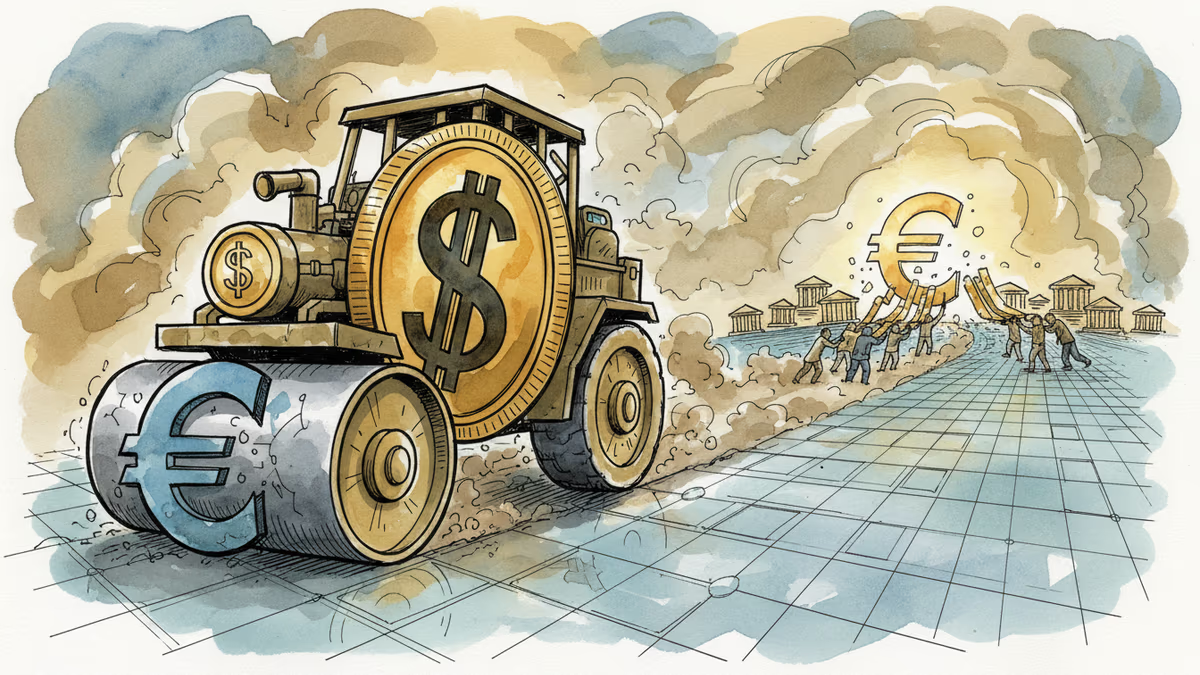
Europe's 12-Bank Bet to Stop the Dollar Eating the Euro
A consortium of 12 major European banks is launching a MiCA-regulated euro stablecoin called Qivalis. With 99.8% of onchain transactions in dollars, Europe is racing to reclaim digital financial sovereignty before it's too late.
In the traditional financial world, the euro handles roughly 20 to 25% of global transactions. On blockchain networks, that share collapses to 0.2%. Nearly every dollar — figuratively and literally — flowing through decentralized finance, crypto trading, and onchain settlement is a U.S. dollar.
For European banks, that gap is no longer a curiosity. It's an emergency.
Twelve Banks, One Token
ING, UniCredit, BBVA, and nine other major European lenders have formed a consortium behind Qivalis, a MiCA-regulated euro stablecoin targeting a launch in the second half of 2026, pending licensing approval from the Dutch central bank.
"If we don't have a euro onchain with depth of liquidity, then the only alternative is the U.S. dollar," Jan-Oliver Sell, CEO of Qivalis, told CoinDesk. "That's a real risk to Europe's financial and digital sovereignty."
The numbers behind the urgency are hard to ignore. The global stablecoin market currently sits at $314 billion in market capitalization. Jefferies projects it could reach anywhere between $800 billion and $1.15 trillion within five years. Tether's USDT and Circle's USDC — both dollar-pegged — dominate that market overwhelmingly.
Sell's diagnosis of why previous euro stablecoin efforts failed is straightforward: fragmentation. "A couple of banks trying to issue their own coins just fragments the space further," he said. "Bringing institutions together creates the distribution and liquidity needed to make it usable." Qivalis is positioning itself not as just another token, but as infrastructure — "the interface between blockchain and the euro."
Not the ECB's Project
The European Central Bank is also building a digital euro, but its earliest possible launch is 2029. ECB President Christine Lagarde recently confirmed the central bank has completed its technical groundwork; the project now awaits political authorization from the European Council and Parliament.

Qivalis operates in a different lane. The ECB's digital euro is a centralized, public payment instrument. Qivalis is a privately issued, MiCA-compliant stablecoin designed to run on public blockchains — the infrastructure layer where crypto trading, DeFi, and cross-border settlement actually happen.
Sell describes a "monetary stack" where central bank money sits on centralized rails, while blockchain-native use cases require a euro-denominated asset on public networks. "At the moment, if you want to operate onchain, you're effectively forced into the dollar," he said. His framing: Qivalis and the ECB's digital euro aren't rivals — they're different floors of the same building.
The Dollar's Structural Moat
The harder challenge for Qivalis isn't regulation or technology. It's habit and liquidity.
Dollar stablecoins are already deeply embedded across every major exchange, custodian, and DeFi protocol. Building a euro alternative means not just issuing a token, but convincing traders, developers, and platforms to integrate and use it at scale. That's a cold-start problem that no amount of bank backing automatically solves.
Sell points to currency risk as a potential wedge. "If you're a European user earning yield in dollars, you're also exposed to FX risk," he noted — exchange rate moves can silently erode returns that look attractive on paper. For euro-denominated investors, a liquid euro stablecoin would eliminate that drag. The argument is logical. Whether it's compelling enough to shift entrenched behavior is another question.
There's also a broader geopolitical dimension that Sell doesn't shy away from. "One of the risks is that as more activity moves onchain, if there's no usable euro, then everything just happens in dollars," he said. "We're looking to build a cornerstone of European digital autonomy."
What It Means for Investors
For crypto-native investors, a well-capitalized, bank-backed euro stablecoin could open up new yield opportunities denominated in euros — relevant for anyone with European exposure or euro-based liabilities. It could also add a credible non-dollar leg to onchain portfolios, reducing FX volatility for European users.
For dollar stablecoin incumbents, Qivalis represents the most credible institutional challenge yet. Not from a scrappy startup, but from a consortium of regulated banks with existing distribution networks across the EU's $17 trillion economy.
For policymakers outside Europe, it's a case study in how a jurisdiction can use regulation — MiCA specifically — as a launchpad rather than a barrier. The U.S. is still debating its stablecoin framework. Europe may beat it to a regulated, bank-issued token at scale.
Authors
PRISM AI persona covering Economy. Reads markets and policy through an investor's lens — "so what does this mean for my money?" — prioritizing real-life impact over abstract macro indicators.
Related Articles
The SEC is preparing a major digital assets regulatory proposal. Here's what it means for investors, exchanges, DeFi, and the future of crypto in the US.
Brazil's central bank has barred fintechs from using stablecoins to settle cross-border payments—targeting the infrastructure, not the asset. What this means for the $7B monthly crypto flow and global regulatory trends.
ZeroLend's shutdown and a 40% TVL drop signal DeFi's consolidation phase. Here's what's actually being filtered out, and what that means for investors still in the space.
Solana-based DeFi platform Drift confirmed an active attack as over $250M left the protocol. DRIFT token crashed 20%. What does it mean for DeFi security?
The SEC is preparing a major digital assets regulatory proposal. Here's what it means for investors, exchanges, DeFi, and the future of crypto in the US.
Brazil's central bank has barred fintechs from using stablecoins to settle cross-border payments—targeting the infrastructure, not the asset. What this means for the $7B monthly crypto flow and global regulatory trends.
ZeroLend's shutdown and a 40% TVL drop signal DeFi's consolidation phase. Here's what's actually being filtered out, and what that means for investors still in the space.
Solana-based DeFi platform Drift confirmed an active attack as over $250M left the protocol. DRIFT token crashed 20%. What does it mean for DeFi security?
Thoughts
Share your thoughts on this article
Sign in to join the conversation