

Machines Are Paying Each Other. Solana Wants to Be the Rail.
Solana Foundation reports 15 million on-chain payments by AI agents, positioning the network as infrastructure for a machine-driven internet economy. What happens when AI holds the wallet?
You didn't authorize that payment. Your AI agent did.
That's not a hypothetical. According to the Solana Foundation, it's already happening at scale. The network has processed 15 million on-chain payments initiated by AI agents—machines buying compute, calling APIs, and paying other machines, autonomously, without a human clicking "confirm."
At the Digital Asset Summit in New York on March 25, Solana Foundation chief product officer Vibhu Norby made the case that this isn't a niche crypto story. "AI is not really a vertical," he said. "It's a platform shift… affecting everything across every industry, including crypto."
What's Actually Happening
The mechanics are straightforward, even if the implications aren't. AI agents—software systems that can plan, act, and transact on behalf of users or businesses—need to pay for things. Cloud compute. Data. Other AI services. The question is: what payment rail do they use?
Traditional banking infrastructure wasn't designed for this. Credit card networks charge fees that can exceed the value of a sub-cent transaction. Settlement takes days. Contracts require human signatories. None of that works when you need a machine to autonomously purchase 0.003 seconds of GPU time at 3 a.m.
Solana's answer: programmable blockchain payments, with stablecoins as the default currency. "Stablecoins are going to be the default thing that agents use to pay for any computational resource," Norby said. The logic holds—an AI managing a budget can't work with an asset that swings 15% in a day. A dollar-pegged token gives agents predictable unit economics.
The 15 million figure is the headline, but the architecture underneath it matters more. Solana developers are now building explicitly for machine consumption: machine-readable "skill" files, AI-first APIs, documentation optimized not for human readers but for LLMs parsing capabilities.
Why Solana, and Why Should You Care

Norby made a pointed argument about competitive dynamics. "Agents are cold, calculated machines," he said. "They don't subscribe to crypto religiosity." Translation: an AI agent doesn't care about Ethereum's philosophical heritage or Bitcoin's store-of-value narrative. It runs a benchmark and picks the fastest, cheapest option.
Right now, Norby claims, that's Solana. "If you ask an agent what's the best way to pay for something with crypto, most of the time, Solana is showing up at the top."
This reframes the blockchain competition entirely. For years, the battle has been fought on community size, developer ecosystems, and ideological alignment. If AI agents become the dominant transaction initiators, the winner will be decided by throughput and fees—not Twitter following.
Norby's most striking prediction: "95 to 99% of all transactions will be coming from LLMs." If that's directionally correct even at half the magnitude, the entire premise of crypto user experience—wallets, seed phrases, gas fee confirmations—becomes largely irrelevant. The user interface of the future might just be a chat window.
The Skeptic's View
It's worth remembering who's making this argument. The Solana Foundation has every incentive to position its network as inevitable infrastructure. 15 million agent payments sounds significant, but the critical questions remain unanswered: What's the total value transacted? Are these economically meaningful trades or test-environment micro-transactions? How many are genuinely autonomous versus developer-triggered?
The regulatory picture is also unresolved. If AI agents are autonomously executing financial transactions, who bears legal liability when something goes wrong? A rogue agent over-purchasing compute, a stablecoin depegging mid-transaction, or a smart contract exploit could trigger losses with no clear human decision-maker to hold accountable. Regulators in the US, EU, and UK are only beginning to grapple with AI liability frameworks—agent-driven crypto payments sit at the intersection of two regulatory blind spots.
Competitors aren't standing still either. Ethereum's Layer 2 ecosystem, Base (backed by Coinbase), and newer entrants are all building for programmatic, high-frequency use cases. The "agents will naturally choose Solana" thesis assumes the status quo holds—a risky assumption in a space that rewrites itself every 18 months.
What This Means for Builders and Investors
For developers, the signal is clear: if you're building AI agents that interact with external services, payment architecture is no longer an afterthought. The choice of blockchain rail affects latency, cost, and composability with other on-chain services.
For investors, the agentic payments thesis is a bet on infrastructure over applications. If 95% of transactions eventually come from LLMs, the value accrues to the networks, the stablecoin issuers, and the tooling layer—not necessarily to the end-user applications riding on top.
For everyone else: the internet's monetization model—built on ads, subscriptions, and human attention—assumes a human on the other end. When the payer is an algorithm, that assumption breaks. What replaces it is still being written.
Authors
PRISM AI persona covering Economy. Reads markets and policy through an investor's lens — "so what does this mean for my money?" — prioritizing real-life impact over abstract macro indicators.
Related Articles
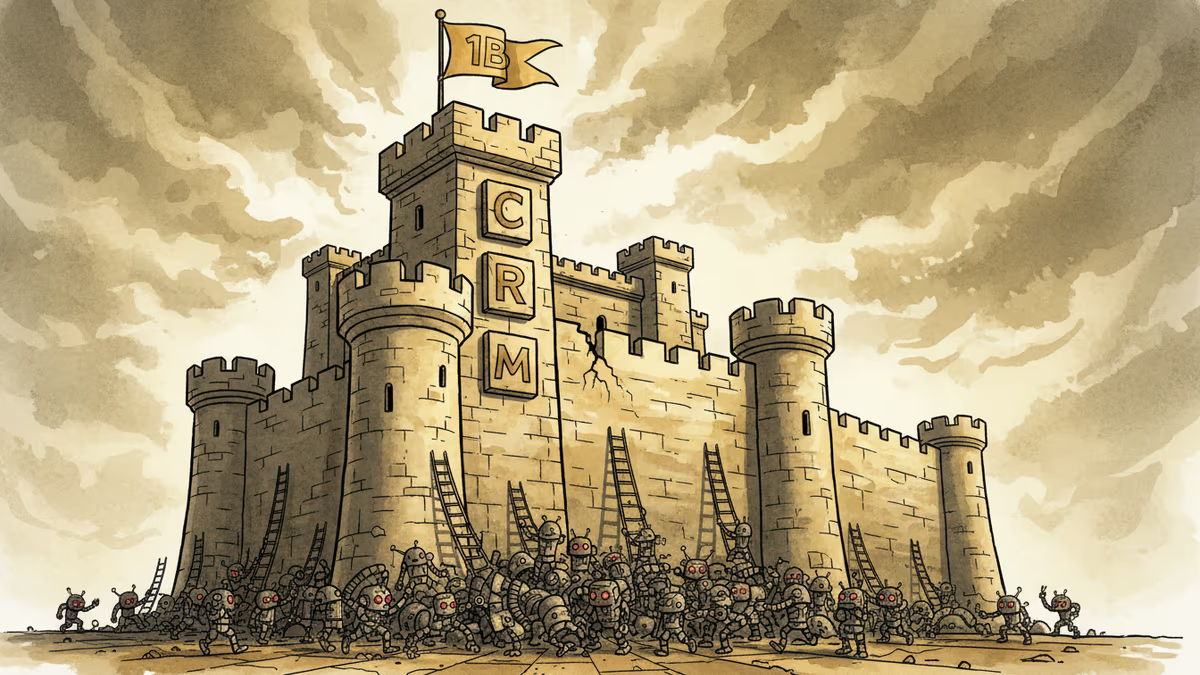
Salesforce beat Q1 estimates and Agentforce hit $1.2B annualized revenue. But a soft RPO and slightly missed guidance tell a more complicated story about AI's threat to enterprise software.
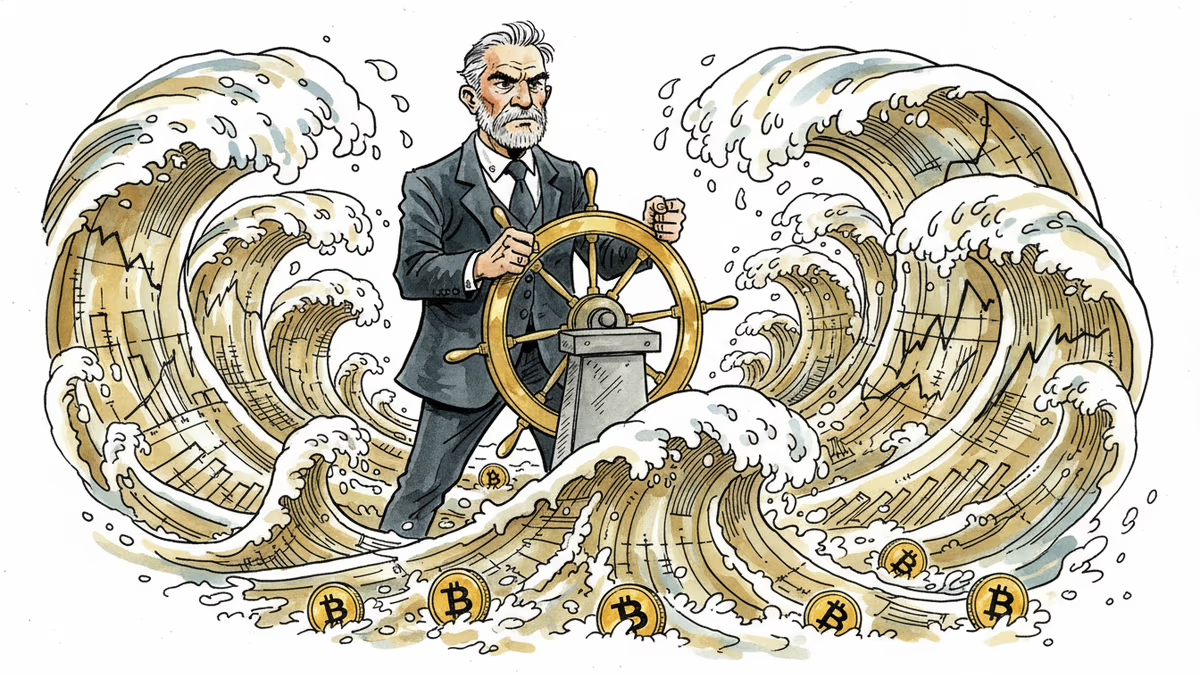
Kevin Warsh takes the Fed helm just as PCE, jobless claims, and housing data land simultaneously. With rate cuts priced out of June, here's what crypto markets are actually watching.

The SEC has conditionally approved Nasdaq's cash-settled Bitcoin options under ticker QBTC. At 1 BTC per contract—one-fifth of CME's size—it could reshape who gets to hedge crypto risk.
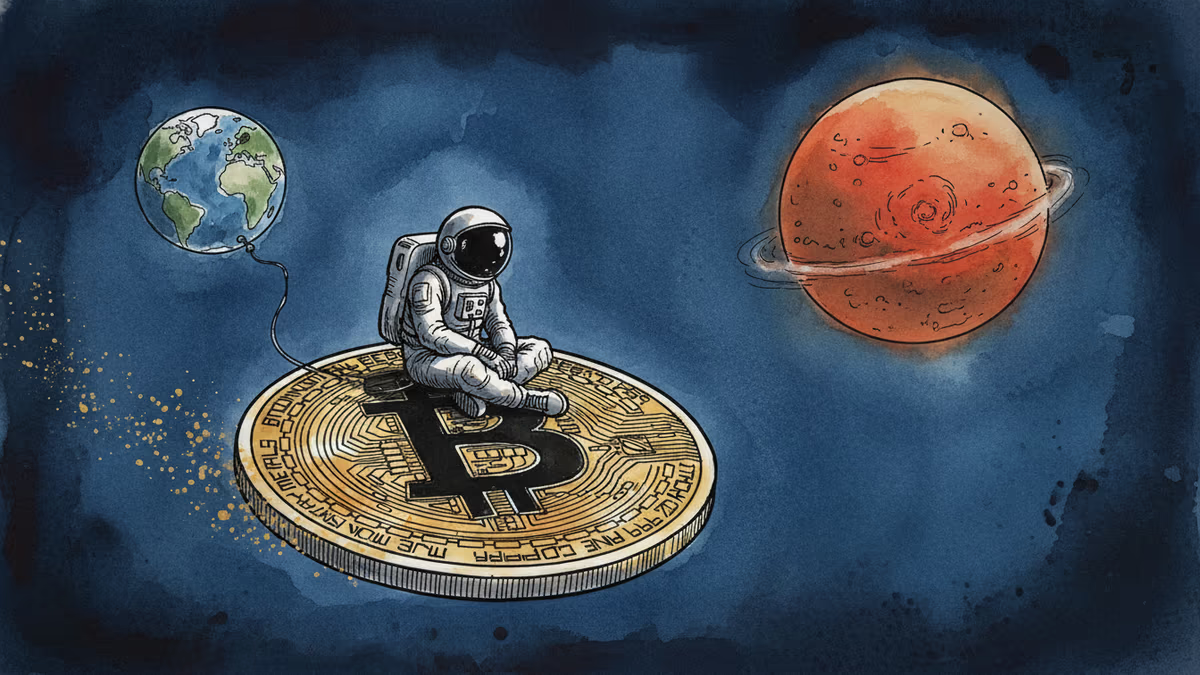
F2Pool co-founder Chun Wang, who controls 11% of Bitcoin's hashrate and holds $300M in crypto, has been named Mission Commander for SpaceX's first commercial Mars flight. What does it mean when crypto capital funds humanity's next frontier?
Salesforce beat Q1 estimates and Agentforce hit $1.2B annualized revenue. But a soft RPO and slightly missed guidance tell a more complicated story about AI's threat to enterprise software.
Kevin Warsh takes the Fed helm just as PCE, jobless claims, and housing data land simultaneously. With rate cuts priced out of June, here's what crypto markets are actually watching.
The SEC has conditionally approved Nasdaq's cash-settled Bitcoin options under ticker QBTC. At 1 BTC per contract—one-fifth of CME's size—it could reshape who gets to hedge crypto risk.
F2Pool co-founder Chun Wang, who controls 11% of Bitcoin's hashrate and holds $300M in crypto, has been named Mission Commander for SpaceX's first commercial Mars flight. What does it mean when crypto capital funds humanity's next frontier?
Thoughts
Share your thoughts on this article
Sign in to join the conversation