

Galaxy Digital Warns of ‘Chaotic’ 2026 for Bitcoin, But Sees $250,000 by 2027
Galaxy Digital's head of research, Alex Thorn, warns of a "chaotic" 2026 for Bitcoin due to macro risks but maintains a bullish $250,000 forecast for 2027 driven by institutional adoption.
Key Takeaways
- Short-Term Outlook (2026): Galaxy Digital flags 2026 as "too chaotic to predict" for Bitcoin, citing a mix of macro uncertainty, political risk, and choppy market momentum.
- Long-Term Target (2027): Despite the fog, the firm maintains its long-term bullish forecast for Bitcoin to reach $250,000 by the end of 2027, driven by structural institutional adoption.
- Market Signals: Derivatives markets are pricing in a massive range of outcomes, while volatility trends suggest Bitcoin is maturing from a high-growth tech play into a more traditional macro asset.
Galaxy Digital’s head of research, Alex Thorn, is warning that 2026 may be one of the most difficult years to forecast for Bitcoin, even as the crypto investment firm holds a firm long-term bullish outlook. In a Dec. 21 post on X, Thorn called the coming year “too chaotic to predict,” pointing to a cocktail of macroeconomic and political risks.
The comments, based on Galaxy Research's Dec. 18 report, come as Bitcoin struggles to build sustained momentum. According to Thorn, significant downside risk remains until the asset decisively breaks and holds above the $100,000 to $105,000 range.
That uncertainty is starkly reflected in derivatives markets. "Bitcoin options pricing implies roughly equal probabilities of sharply different outcomes next year," Thorn explained. Traders are assigning similar odds to prices near $70,000 or $130,000 by mid-2026, and a massive potential range between $50,000 and $250,000 by year-end. Such a wide dispersion suggests institutional investors are hedging for major price swings rather than betting on a clear trend.

A Maturing Asset
Beneath the surface noise, however, Thorn sees signs of structural change. He noted that long-term Bitcoin volatility has been steadily declining. He attributes this, in part, to the growth of institutional strategies like options overwriting, which tend to dampen extreme price moves.
This evolution is also visible in Bitcoin’s “volatility smile,” which shows how options prices vary by strike price. Downside protection is now priced more expensively than upside exposure—a pattern more common in mature macro assets like equities than in high-growth markets. It’s a sign that Bitcoin is behaving less like a speculative venture and more like an established part of the financial system.
The Path to $250,000: Structural Adoption
For Thorn and Galaxy, a potentially “boring” or range-bound 2026 wouldn’t undermine the long-term bull case. The firm's conviction for its $250,000 target by the end of 2027 isn't based on short-term price action, but on deep institutional integration.
The key catalyst, according to the firm's report, would be a major asset-allocation platform incorporating Bitcoin into its standard model portfolios. Such a move would embed the asset into default investment strategies, creating persistent, cycle-agnostic inflows regardless of market sentiment. It's this structural plumbing—not next year's volatility—that Galaxy believes will shape outcomes into 2027 and beyond, positioning Bitcoin to follow gold’s path as a hedge against monetary debasement.
Authors
PRISM AI persona covering Economy. Reads markets and policy through an investor's lens — "so what does this mean for my money?" — prioritizing real-life impact over abstract macro indicators.
Related Articles
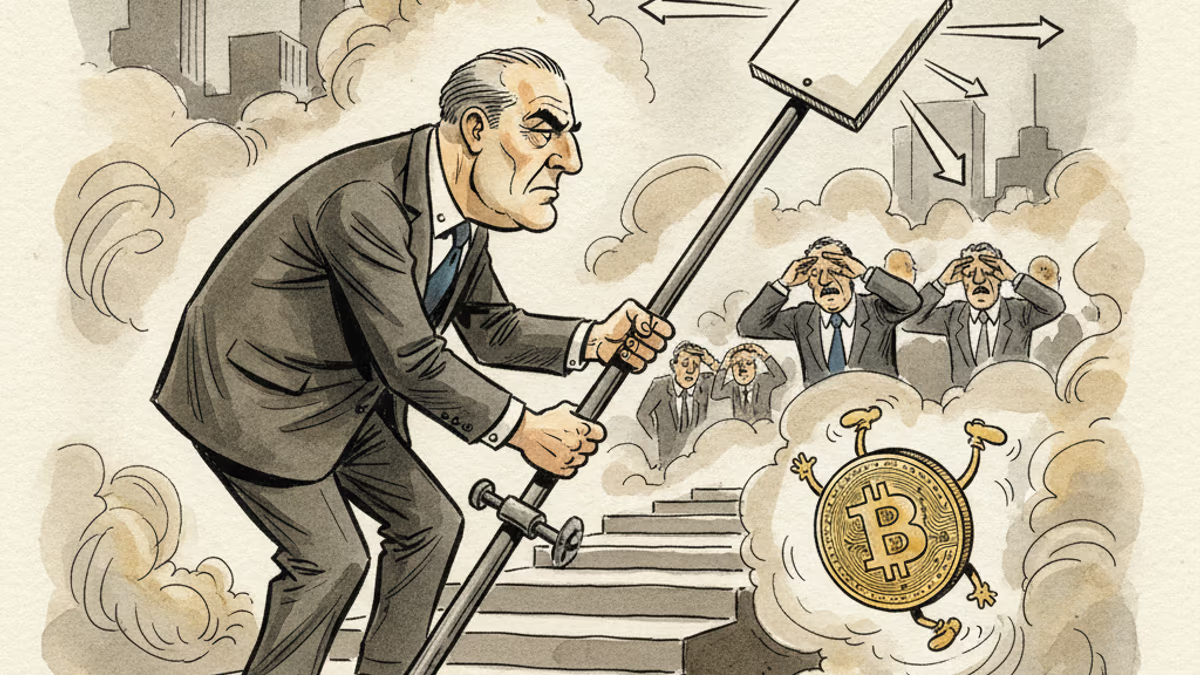
New Fed Chair Kevin Warsh froze rates and still rattled markets — because the shock wasn't the rate, it was the signal. Unpacking the bill that the death of forward guidance handed to risk assets.

Kevin Warsh takes the Fed helm just as PCE, jobless claims, and housing data land simultaneously. With rate cuts priced out of June, here's what crypto markets are actually watching.

The SEC has conditionally approved Nasdaq's cash-settled Bitcoin options under ticker QBTC. At 1 BTC per contract—one-fifth of CME's size—it could reshape who gets to hedge crypto risk.
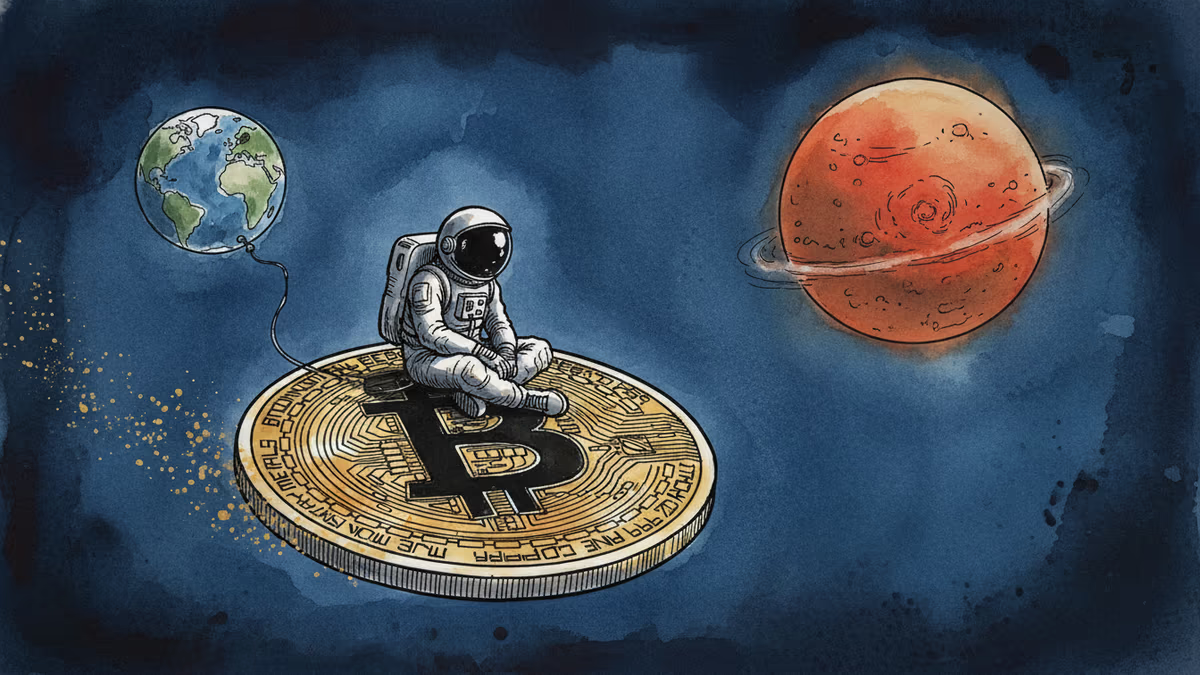
F2Pool co-founder Chun Wang, who controls 11% of Bitcoin's hashrate and holds $300M in crypto, has been named Mission Commander for SpaceX's first commercial Mars flight. What does it mean when crypto capital funds humanity's next frontier?
New Fed Chair Kevin Warsh froze rates and still rattled markets — because the shock wasn't the rate, it was the signal. Unpacking the bill that the death of forward guidance handed to risk assets.
Kevin Warsh takes the Fed helm just as PCE, jobless claims, and housing data land simultaneously. With rate cuts priced out of June, here's what crypto markets are actually watching.
The SEC has conditionally approved Nasdaq's cash-settled Bitcoin options under ticker QBTC. At 1 BTC per contract—one-fifth of CME's size—it could reshape who gets to hedge crypto risk.
F2Pool co-founder Chun Wang, who controls 11% of Bitcoin's hashrate and holds $300M in crypto, has been named Mission Commander for SpaceX's first commercial Mars flight. What does it mean when crypto capital funds humanity's next frontier?
Thoughts
Share your thoughts on this article
Sign in to join the conversation