
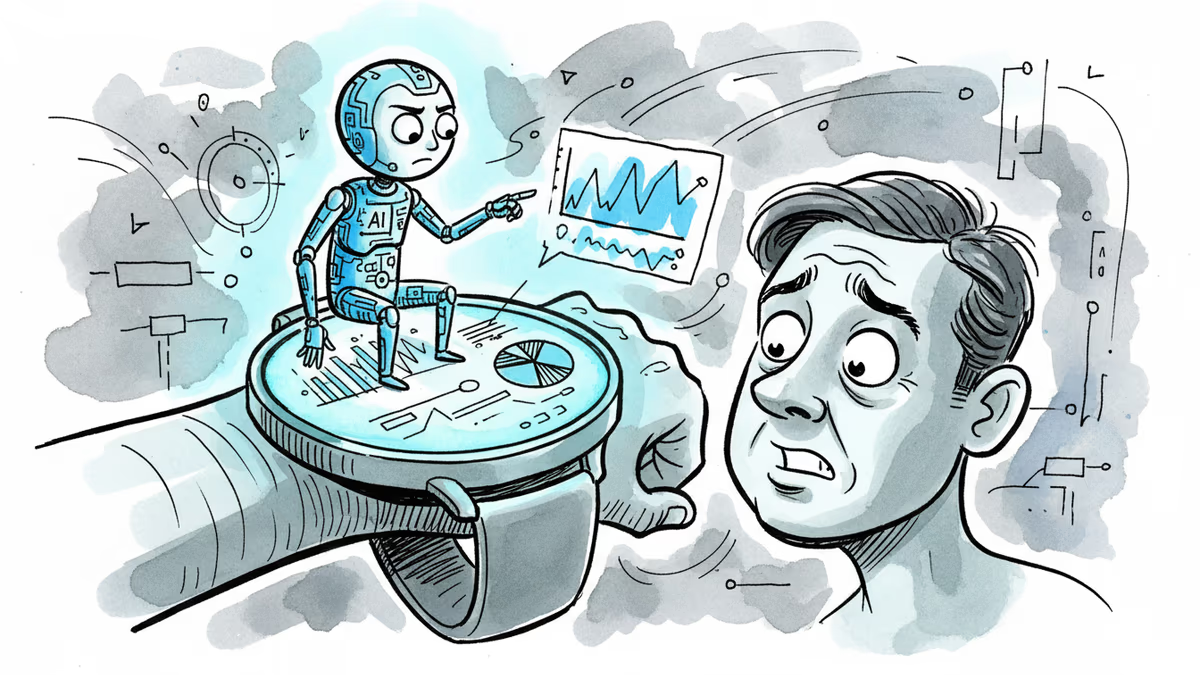
Google's AI Health Coach Goes Global: Your Wrist Just Got Smarter
Google expands Fitbit's AI personal health coach to 6 countries beyond the US. As personalized health coaching becomes mainstream, how will this reshape our relationship with wellness?
200 millionFitbit users worldwide can now carry a personal trainer on their wrist. Google's Tuesday announcement expanding its AI personal health coach beyond U.S. borders isn't just a feature rollout—it's the mainstreaming of algorithmic wellness advice.
The service, previously limited to Android users in America since October, now reaches iOS users stateside plus both platforms across the UK, Canada, Australia, New Zealand, and Singapore. All you need is a Fitbit Premium subscription and one of 14 supported devices.
From Niche to Necessity
The AI coach analyzes your sleep patterns, activity levels, and heart rate data to deliver personalized recommendations. "Consider going to bed 30 minutes earlier tonight" or "Your stress levels seem elevated—try a 5-minute breathing exercise." It's like having a wellness expert who never sleeps, never judges, and costs a fraction of human coaching.
But here's where it gets interesting: the global expansion reveals Google's bet that health anxiety is universal. Whether you're in Manhattan or Melbourne, the promise remains the same—better health through better data.
The Subscription Health Economy
At $9.99 monthly, Fitbit Premium positions itself as affordable wellness. That's roughly one-tenth the cost of a personal trainer session. Yet when you factor in device costs—Pixel Watch starts at $349—the entry barrier isn't trivial.

This shift toward subscription-based health reflects a broader trend: wellness as a service, not a one-time purchase. Your health data becomes the product you're constantly refining, guided by algorithmic insights.
Healthcare Professionals: Cautious Optimism
Doctors are watching closely. While they appreciate data-driven health insights, many emphasize these tools complement, not replace, professional medical advice. "It's useful for tracking trends, but concerning if people start self-diagnosing based on AI suggestions," notes Dr. Sarah Chen, a digital health researcher at Stanford.
The regulatory landscape remains murky. Unlike medical devices, these AI coaches operate in a gray zone—offering health advice without medical oversight.
The Privacy Paradox
Here's the uncomfortable truth: the more accurate your AI health coach becomes, the more intimate data you surrender. Sleep quality, stress levels, exercise intensity—Google now has unprecedented insight into millions of users' daily rhythms.
Apple and Samsung are undoubtedly taking notes. The race isn't just for better sensors or longer battery life—it's for the most trusted health AI. The winner could reshape how we think about preventive care.
What happens when your AI coach's advice conflicts with how you actually feel?
Authors
Related Articles
In a post-Google I/O interview, Sundar Pichai acknowledged flawed search results, real AI anxiety, and an AGI timeline that makes the label irrelevant. Here's what he said — and what it means.

Xreal's Project Aura debuted at Google I/O with OLED displays, hand tracking, and an IPO on the horizon. The industry has burned billions for a decade. So why does it feel like something has actually shifted?
Google is building AI agents that search the web proactively, without user prompting. That's not just a product update — it's a fundamental shift in who controls the information you receive.
Google unveiled the 'Googlebook' platform to replace Chromebook and ChromeOS—but revealed zero hardware specs. What's the strategy, and what does it mean for users, manufacturers, and the education market?
In a post-Google I/O interview, Sundar Pichai acknowledged flawed search results, real AI anxiety, and an AGI timeline that makes the label irrelevant. Here's what he said — and what it means.
Xreal's Project Aura debuted at Google I/O with OLED displays, hand tracking, and an IPO on the horizon. The industry has burned billions for a decade. So why does it feel like something has actually shifted?
Google is building AI agents that search the web proactively, without user prompting. That's not just a product update — it's a fundamental shift in who controls the information you receive.
Google unveiled the 'Googlebook' platform to replace Chromebook and ChromeOS—but revealed zero hardware specs. What's the strategy, and what does it mean for users, manufacturers, and the education market?
Thoughts
Share your thoughts on this article
Sign in to join the conversation