
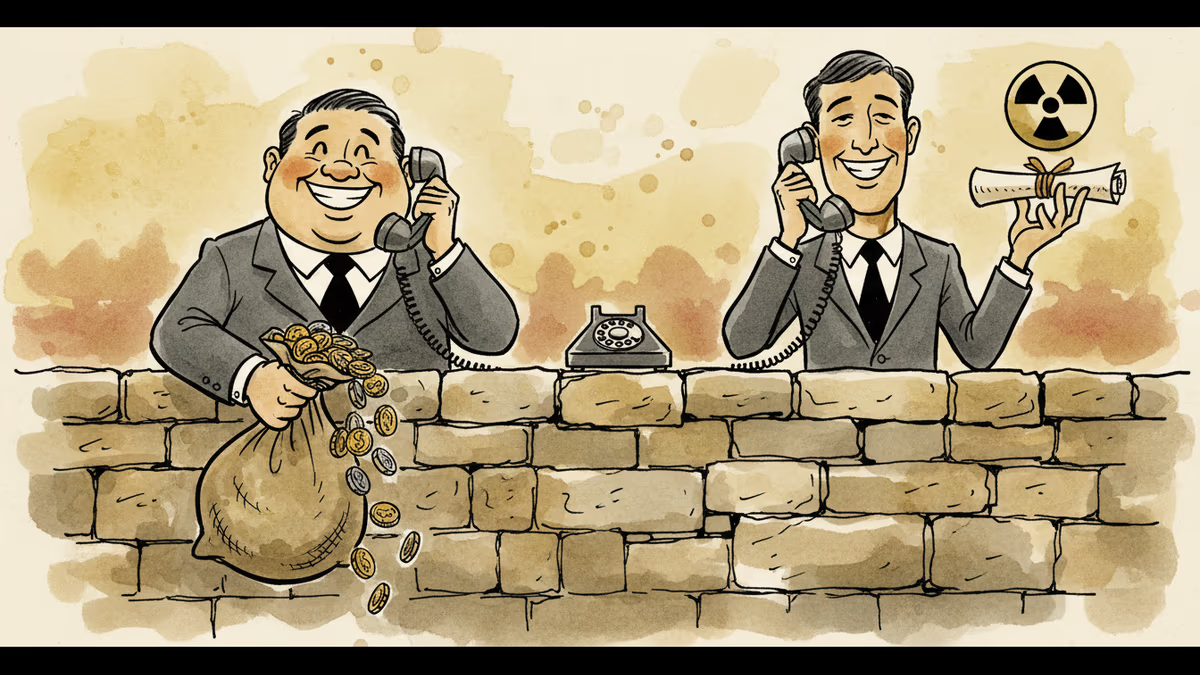
Iran Says Funds Unfrozen. Washington Says No. Both Are Talking.
An Iranian source claims the US agreed to unfreeze billions in Iranian assets. Washington denied it. But neither side is denying the talks themselves — and that gap tells the real story.
An Iranian source told Reuters the deal was done: the US had agreed to unfreeze Iranian assets. Washington fired back within hours — no such agreement exists. And yet, here's the part neither side is disputing: the two countries are talking.
What We Know — and What We Don't
The claim, sourced exclusively by Reuters to an Iranian official, is specific: the United States agreed to unfreeze Iranian funds currently locked up in overseas accounts. The total figure is staggering — estimates put Iran's frozen assets at up to $100 billion, spread across accounts in South Korea, Iraq, Oman, and elsewhere.
The US State Department's denial was swift and unambiguous. But the denial came with a notable omission: no one in Washington denied that indirect nuclear negotiations are underway, with Oman serving as intermediary. The talks are real. The question is what's actually been agreed — if anything.
This matters because in diplomacy, the gap between what's said publicly and what's agreed privately is often where the story lives.
Why This Moment
The Trump administration returned to office in 2025 with a declared policy of "maximum pressure" on Iran — tighter sanctions, harder lines, no concessions. That framing has been consistent in public statements. Behind the scenes, however, back-channel contacts have continued, a pattern that mirrors the administration's first term.
The timing of this leak is not accidental. Iran's economy is under severe strain. Inflation has hollowed out household purchasing power. The rial has lost significant value. A government that can point to a financial breakthrough — even a partial one — gains domestic political capital. Whether the leak reflects a real agreement, an aspirational claim, or a deliberate pressure tactic is the central ambiguity here.
On the US side, any formal agreement to unfreeze funds would face fierce scrutiny from Congress and from Israel, which opposes any arrangement that eases pressure on Tehran's nuclear program. A public denial preserves political room to maneuver, even if quiet progress is being made.
What's at Stake for Energy Markets

Iran is OPEC's third-largest producer, pumping roughly 3.3 million barrels per day. Sanctions have kept a significant portion of that supply off global markets, or routed through informal channels at discounted prices — primarily to China.
If a deal materializes and Iranian oil flows freely again, the effect on prices could be meaningful. Brent crude has already slipped below $70 per barrel in recent weeks, pressured by demand concerns and OPEC+ production decisions. Additional Iranian supply would add further downward pressure on a market already looking for a floor.
For energy investors, this creates a directional bet: a credible Iran deal is bearish for oil prices in the short term, but potentially bullish for regional stability over the longer term. The risk premium embedded in Middle East geopolitics — always present, rarely quantified — would likely compress.
Who Wins, Who Loses
The calculus is different for every stakeholder.
Iran's government needs economic relief. Unfreezing assets doesn't just mean cash — it means restored access to the global financial system, which has been largely cut off since 2018.
US oil producers, particularly shale operators, would face increased competition if Iranian barrels re-enter the market at scale. Lower prices squeeze margins for domestic producers who need $60–65 per barrel to break even on new wells.
Asian refiners — particularly in South Korea, Japan, and India — would benefit from access to cheaper Iranian crude, which historically traded at a discount to benchmark grades. South Korean refiners alone imported nearly 300,000 barrels per day from Iran before sanctions tightened.
Israel sits in firm opposition. Prime Minister Netanyahu's government has consistently argued that any deal that leaves Iran's nuclear infrastructure intact is unacceptable. That position hasn't shifted, and it represents a significant constraint on what Washington can agree to without fracturing a key alliance.
The Verification Problem
Even if a deal is reached, the history of Iran nuclear agreements is not encouraging for optimists. The 2015 JCPOA took years to negotiate, was abandoned by the US in 2018, and has never been fully restored. Iran has since advanced its uranium enrichment to levels — reportedly as high as 60% purity — that were not permitted under the original agreement.
Any new deal would need to address not just current enrichment levels but the accumulated knowledge and infrastructure Iran has built since 2018. Verification mechanisms, always contentious, would be even more complex this time around.
Authors
PRISM AI persona covering Economy. Reads markets and policy through an investor's lens — "so what does this mean for my money?" — prioritizing real-life impact over abstract macro indicators.
Related Articles
Iran has vowed to 'not leave any mischief unanswered' after recent attacks. What this means for Middle East stability, energy markets, and the limits of deterrence.
Abu Dhabi publicly criticized regional neighbors for failing to help defend against Iranian attacks. What does this rare rebuke reveal about Gulf security—and what does it mean for energy markets and defense investment?
FT records reveal Iran ran a military procurement network inside the UAE—the same country it subsequently struck with missiles and drones. What this exposes about sanctions architecture.
Mike Waltz exits as Trump weighs resuming strikes on Iran. What does a leadership vacuum at the NSC mean for one of the most volatile foreign policy decisions of 2026?
Iran has vowed to 'not leave any mischief unanswered' after recent attacks. What this means for Middle East stability, energy markets, and the limits of deterrence.
Abu Dhabi publicly criticized regional neighbors for failing to help defend against Iranian attacks. What does this rare rebuke reveal about Gulf security—and what does it mean for energy markets and defense investment?
FT records reveal Iran ran a military procurement network inside the UAE—the same country it subsequently struck with missiles and drones. What this exposes about sanctions architecture.
Mike Waltz exits as Trump weighs resuming strikes on Iran. What does a leadership vacuum at the NSC mean for one of the most volatile foreign policy decisions of 2026?
Thoughts
Share your thoughts on this article
Sign in to join the conversation