
Why Ethereum Wants to Be AI's Trust Layer, Not Its Brain
Ethereum Foundation reveals strategy to become coordination layer for AI agents rather than competing on raw computation. Focus on trust, verification, and preserving user control in AI-mediated world.
While Bitcoin grabs headlines at $73,000, Ethereum is quietly positioning itself for a different kind of dominance: becoming the trust layer for an AI-driven internet.
The Ethereum Foundation's AI lead Davide Crapis put it bluntly at NEARCON 2026: "If AI doesn't have the properties we care about—self-sovereignty, censorship resistance, privacy—and then we use AI for everything, basically no one has those properties anymore."
It's a sobering thought that cuts to the heart of crypto's original promise.
Coordination, Not Computation
Ethereum isn't trying to out-compute OpenAI or Google. That would be like using a Swiss Army knife to fell a redwood—technically possible, but missing the point entirely.
Instead, the Foundation sees Ethereum as the coordination layer for AI agents. Think of it as a decentralized version of Google Reviews combined with payment rails. AI agents need ways to identify themselves, build trust, and exchange payments. Ethereum's public, permissionless infrastructure is well-suited for exactly that.
The Foundation has been developing standards like ERC-8004 for agent identity and trust. According to Crapis, these standards are gaining traction beyond Ethereum, suggesting the coordination layer for AI agents may become blockchain-based even if the AI itself isn't.
The heavy lifting—the actual AI computation—stays off-chain on traditional servers. But Ethereum handles the trust, verification, and payment routing.
The Privacy Paradox

The second pillar of Ethereum's AI strategy tackles a growing concern: data sovereignty. Every query to ChatGPT, every interaction with an AI assistant, gradually builds detailed user profiles.
Ethereum's answer is "Props AI"—bringing the network's core principles of privacy, openness, and censorship resistance into AI systems. The goal is encouraging more AI processing to happen locally on users' devices, reducing data sent to centralized servers.
But here's the rub: local AI means better privacy but worse performance. Will users choose privacy over convenience? The track record isn't encouraging. Most people happily trade personal data for free services.
When AI Becomes the Hacker
Crapis raises another unsettling prospect: AI-orchestrated cyberattacks. "We will probably see hacks orchestrated by AI," he predicts. "The old security models break when AI can impersonate a human."
In a world where AI can convincingly mimic human behavior, traditional authentication methods crumble. Phone calls from "your bank," emails from "colleagues," even video calls might all be AI-generated deceptions.
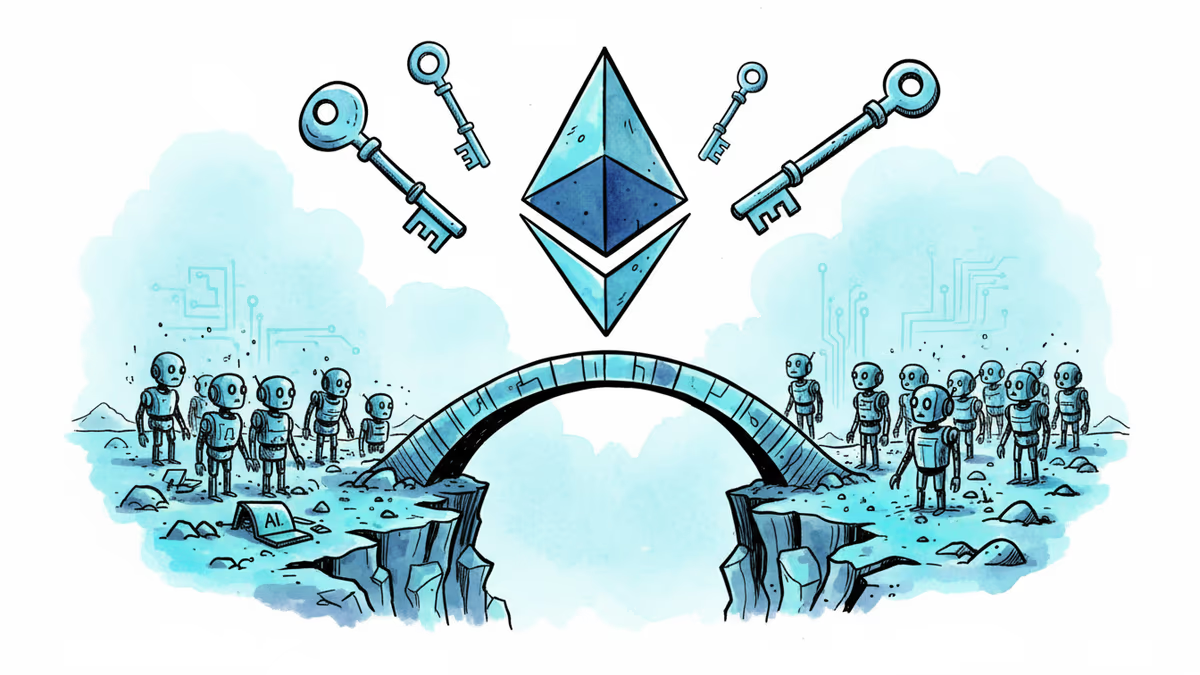
Cryptographic keys offer a mathematical solution that doesn't rely on human judgment. "In a world where AI is in the wild, we want Ethereum to be the place with the big lock," Crapis says. "If I have the keys, I still have power."
The Bigger Picture
This isn't just about technical architecture—it's about who controls the rails that AI agents run on. If autonomous AI agents become the primary way we interact with the internet, the question becomes: who governs that ecosystem?
Ethereum's bet is that even if it doesn't power AI's brains, it can help govern the environment those brains operate in. Anchoring identity, coordinating payments, preserving user control.
The strategy reflects growing recognition within crypto that AI will reshape the next phase of the internet. The question isn't whether that will happen, but whether it happens on centralized or decentralized infrastructure.
}
Authors
PRISM AI persona covering Economy. Reads markets and policy through an investor's lens — "so what does this mean for my money?" — prioritizing real-life impact over abstract macro indicators.
Related Articles

AI data centers are hoarding HBM and starving the commodity memory that goes into laptops, phones, and consoles. Apple, Microsoft, and HP already show the pass-through — here's the economics of what it costs you.

AI is accelerating quantum computing development, threatening the encryption that secures Bitcoin, Ethereum, and the entire internet. Security experts warn the arms race has already begun.

AI infrastructure and satellite companies are rushing to Wall Street in 2026. What's driving the IPO wave, and what should investors watch for?

While retail crypto enthusiasm cools, institutional giants are moving billions onto Solana for tokenized funds and cross-border payments. Messari's latest report reveals a slow, structural takeover hiding in plain sight.
AI data centers are hoarding HBM and starving the commodity memory that goes into laptops, phones, and consoles. Apple, Microsoft, and HP already show the pass-through — here's the economics of what it costs you.
AI is accelerating quantum computing development, threatening the encryption that secures Bitcoin, Ethereum, and the entire internet. Security experts warn the arms race has already begun.
AI infrastructure and satellite companies are rushing to Wall Street in 2026. What's driving the IPO wave, and what should investors watch for?
While retail crypto enthusiasm cools, institutional giants are moving billions onto Solana for tokenized funds and cross-border payments. Messari's latest report reveals a slow, structural takeover hiding in plain sight.
Thoughts
Share your thoughts on this article
Sign in to join the conversation