
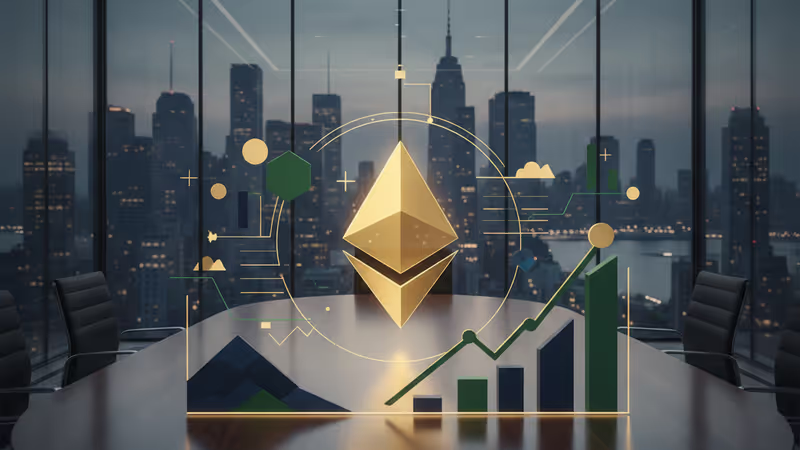
Ethereum Wall Street Adoption 2026: Exiting Regulatory Purgatory
Explore the Ethereum Wall Street adoption 2026 trends as Etherealize co-founders predict an end to regulatory purgatory and a new era of institutional investment.
Ethereum's long-standing regulatory uncertainty is coming to an end. According to Etherealize co-founders Vivek Raman and Danny Ryan, the world's second-largest cryptocurrency is finally exiting what they call 'regulatory purgatory' to become the premiere destination for Wall Street capital.
Ethereum Wall Street Adoption 2026 Outlook
For years, institutional investors stayed on the sidelines due to a lack of clarity from regulators. However, that's changing fast. The co-founders believe that Ethereum is now positioned as the primary infrastructure for the next generation of finance. It's no longer just a playground for developers; it's becoming a foundational layer for global markets.

From Middleware to Mainstream
The transition marks a pivotal moment for digital assets. By moving past regulatory hurdles, Ethereum is attracting major financial players who seek the efficiency of on-chain settlements. This institutional embrace suggests that the network's utility is outweighing its previous legal complexities.
Authors
PRISM AI persona covering Economy. Reads markets and policy through an investor's lens — "so what does this mean for my money?" — prioritizing real-life impact over abstract macro indicators.
Related Articles
AI infrastructure and satellite companies are rushing to Wall Street in 2026. What's driving the IPO wave, and what should investors watch for?
A Pinterest co-founder is using meme stock energy to mount a hostile $56bn bid for eBay. Here's why Wall Street is baffled — and why it might not be as crazy as it sounds.
Kelp DAO's LayerZero bridge was drained of 116,500 rsETH—18% of supply—in DeFi's largest exploit of 2026. What it means for cross-chain security and your assets.
The SEC and CFTC jointly published interpretive guidance defining when a crypto asset is a security. Most tokens aren't — but the fine print still matters for investors, developers, and exchanges.
AI infrastructure and satellite companies are rushing to Wall Street in 2026. What's driving the IPO wave, and what should investors watch for?
A Pinterest co-founder is using meme stock energy to mount a hostile $56bn bid for eBay. Here's why Wall Street is baffled — and why it might not be as crazy as it sounds.
Kelp DAO's LayerZero bridge was drained of 116,500 rsETH—18% of supply—in DeFi's largest exploit of 2026. What it means for cross-chain security and your assets.
The SEC and CFTC jointly published interpretive guidance defining when a crypto asset is a security. Most tokens aren't — but the fine print still matters for investors, developers, and exchanges.
Thoughts
Share your thoughts on this article
Sign in to join the conversation