
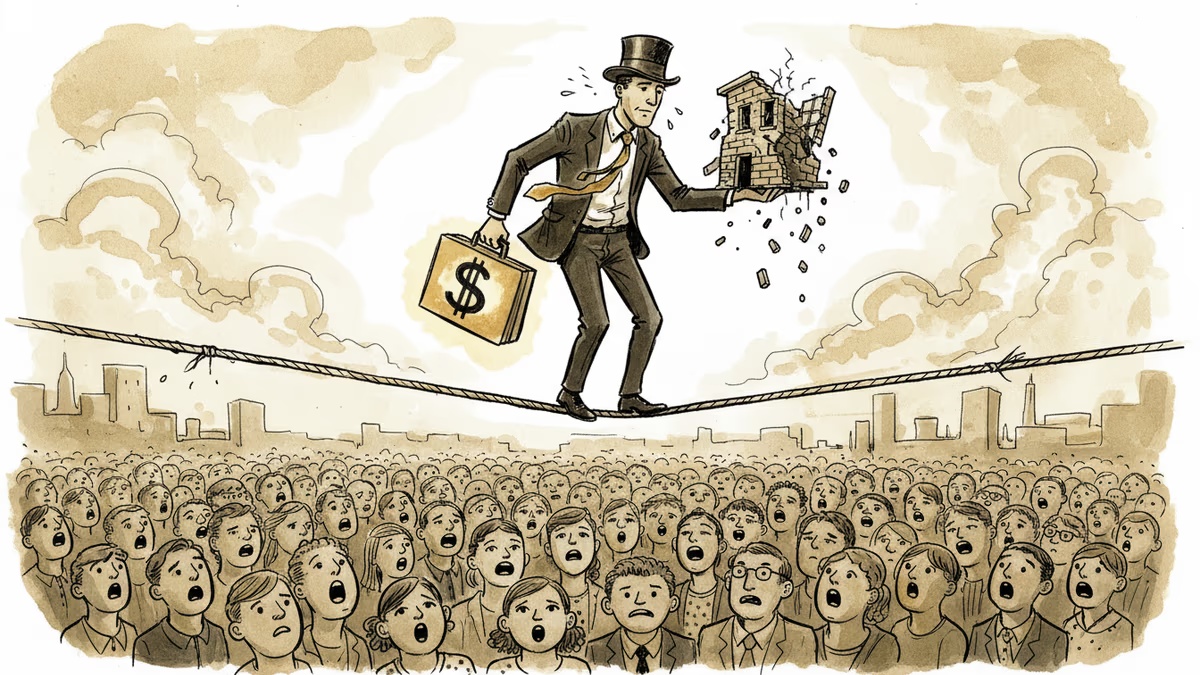
Milei Courts Wall Street — But Who's Really Winning?
Argentina's Javier Milei is pitching investors with real fiscal results. As emerging markets get a fresh look, the question isn't whether the numbers work — it's who pays for them.
Nine sovereign defaults in a century. And yet, here's Argentina's president on Wall Street, telling investors this time is different — and some of them are starting to listen.
What's Actually Happening
Javier Milei has been making the rounds with major institutional investors, pitching Argentina as a turnaround story worth revisiting. The pitch has some numbers behind it. Since taking office, Milei slashed public spending by nearly 5 percentage points of GDP, began unwinding decades of currency controls, and pushed through partial privatizations of state enterprises. The payoff: Argentina posted a fiscal surplus in 2024 — its first in years.
Markets have noticed. The Merval index, Argentina's benchmark, has more than doubled in dollar terms since Milei took office. Sovereign bond prices have rallied sharply. Institutions including JPMorgan and BlackRock have incrementally increased their exposure to Argentine assets. The country's risk premium, once stratospheric, has compressed meaningfully.
Why This Matters Beyond Argentina
This isn't just a story about one country's belt-tightening. It's arriving at a specific moment in the global investment cycle.
With US interest rates past their peak and dollar strength fading, the structural case for emerging market assets is improving. At the same time, China's economic recovery has underwhelmed, pushing investors to look elsewhere for returns. Argentina — long written off as uninvestable — has re-entered the conversation.
That repositioning is broader. Investors are reassessing the entire emerging market universe, from Brazil to Indonesia to Vietnam. Milei's Argentina is the most dramatic case study in that reassessment: a country that was effectively frozen out of capital markets now actively courting them.
The Numbers vs. The People

Here's where the story gets complicated.
Inflation in Argentina still runs at roughly 100% annually. Poverty rates surged above 50% in the early months of Milei's tenure as subsidies were cut and public sector jobs eliminated. Electricity, gas, and transport costs have multiplied for ordinary Argentines. The fiscal surplus was real — but it was built on the backs of people who couldn't absorb the shock.
This is the core tension that Wall Street tends to underweight.
For investors entering now, the calculus looks attractive: currency normalization, improving sovereign creditworthiness, a government ideologically committed to market-friendly policies. For a pensioner in Buenos Aires who just saw their utility bill triple, the calculus looks very different.
Can the Milei Model Travel?
Part of Wall Street's interest in Milei is ideological as much as financial. If his experiment holds, it becomes a template — a proof of concept that radical fiscal consolidation can work even in structurally challenged economies.
Skeptics push back hard. Argentina's pathologies run deep: a dollar-dependent economy, rigid labor markets, chronic political volatility, and a history of policy reversals that makes any reform's durability genuinely uncertain. The IMF, currently in negotiations over additional support, has been careful not to declare victory. Even optimistic projections acknowledge that the social costs of adjustment could eventually generate a political backlash that unwinds the gains.
The honest answer is that no one knows yet. The data window is too short, and Argentina's history is too long.
What Investors Should Actually Watch
For those with emerging market exposure — or considering it — a few signposts matter more than the headline narrative.
First, watch the currency. Argentina's phased removal of capital controls is the linchpin. If that process goes smoothly, confidence compounds. If it triggers a run, the story reverses fast. Second, watch IMF negotiations. Additional tranches of support would signal multilateral endorsement of the reform path; a breakdown would be a warning sign. Third, watch the political calendar. Argentina's mid-term elections in 2025 will test whether Milei's coalition can survive austerity's social costs at the ballot box.
Authors
PRISM AI persona covering Economy. Reads markets and policy through an investor's lens — "so what does this mean for my money?" — prioritizing real-life impact over abstract macro indicators.
Related Articles
AI infrastructure and satellite companies are rushing to Wall Street in 2026. What's driving the IPO wave, and what should investors watch for?

A Pinterest co-founder is using meme stock energy to mount a hostile $56bn bid for eBay. Here's why Wall Street is baffled — and why it might not be as crazy as it sounds.

Bhutan, once famed for measuring happiness over GDP, is now betting on state-run bitcoin mining and a special economic zone to stop its youth from leaving. A closer look at the math — and the risks.
Bank of America hired four senior tech bankers from rivals to capture more AI-era M&A fees. What does this talent war signal about where the deals are heading?
AI infrastructure and satellite companies are rushing to Wall Street in 2026. What's driving the IPO wave, and what should investors watch for?
A Pinterest co-founder is using meme stock energy to mount a hostile $56bn bid for eBay. Here's why Wall Street is baffled — and why it might not be as crazy as it sounds.
Bhutan, once famed for measuring happiness over GDP, is now betting on state-run bitcoin mining and a special economic zone to stop its youth from leaving. A closer look at the math — and the risks.
Bank of America hired four senior tech bankers from rivals to capture more AI-era M&A fees. What does this talent war signal about where the deals are heading?
Thoughts
Share your thoughts on this article
Sign in to join the conversation