
Ripple's Australia Play: Licensing Shortcut or Long Game?
Ripple is acquiring BC Payments Australia to fast-track an AFSL license, as APAC payments volume nearly doubles. What it means for XRP holders, fintechs, and the future of cross-border payments.
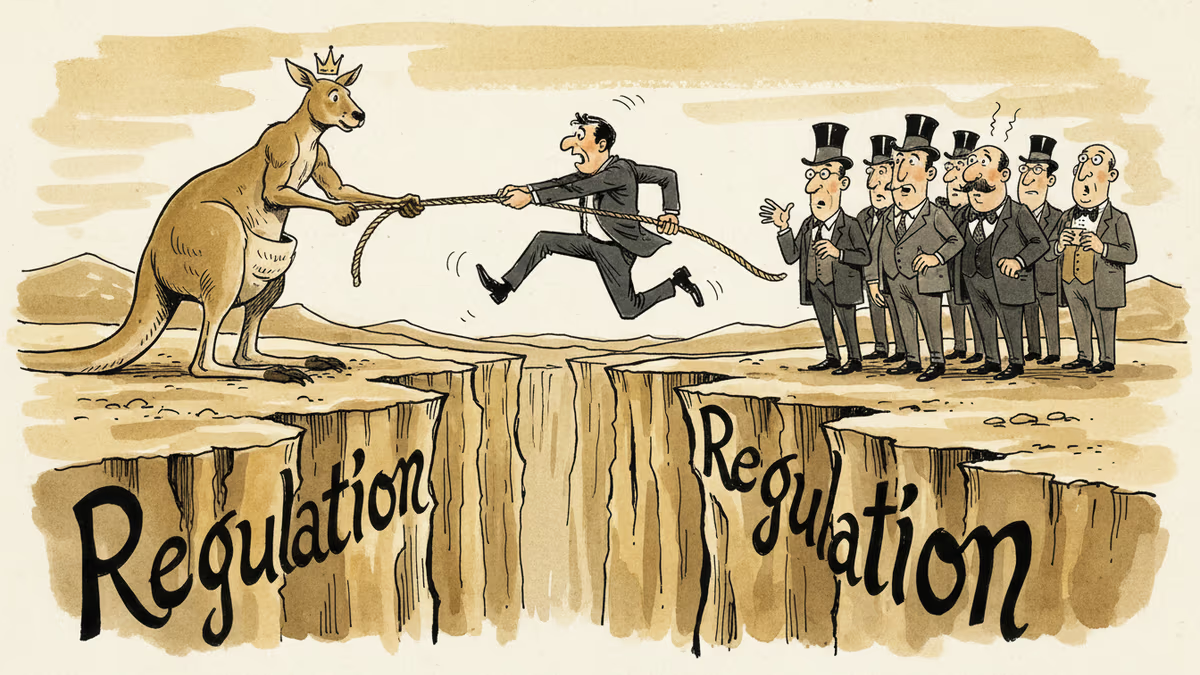
When you can't get through the front door, buy the building. That's essentially Ripple's strategy in Australia.
What Happened — and How
On Wednesday, Ripple announced plans to acquire BC Payments Australia Pty Ltd, a move designed to secure an Australian Financial Services License (AFSL) without going through the standard application process. Instead of waiting months — or years — for regulatory approval from scratch, Ripple is buying a company that already holds the license. It's faster, but it comes with a catch: the license only becomes Ripple's once the deal closes, and that hasn't happened yet.
Once it does, the payoff is significant. An AFSL would allow Ripple to offer its full payments stack in Australia through a single integration — covering onboarding, compliance, foreign exchange, liquidity management, and payout. Current Australian clients include Hai Ha Money Transfer, Stables, Caleb & Brown, Flash Payments, and Independent Reserve.
The timing isn't arbitrary. Ripple says its APAC payments volume nearly doubled year-over-year in 2025. The company also reported $100 billion in total processed volume across 60 markets just last week — alongside new capabilities in managed custody, virtual account collections, and stablecoin settlement. And in a move that signals deeper regulatory ambitions, Ripple is joining Project Acacia, a digital asset infrastructure initiative led by the Reserve Bank of Australia and the Digital Finance Cooperative Research Centre.
XRP was trading at $1.38, up 0.3% on the day and 1.7% on the week — a muted market reaction that tells its own story.
Why Australia, Why Now

Australia might seem like an odd priority when the US market remains contested and Europe is still sorting out MiCA implementation. But for Ripple, the logic is clear.
Australia sits at the intersection of two things Ripple needs right now: regulatory clarity and geographic leverage. It's one of the few APAC markets with a mature, predictable licensing framework. And it's a natural gateway to Southeast Asia, Japan, and South Korea — all high-volume corridors for remittances and trade payments. If Ripple can operate a fully licensed, integrated stack out of Sydney, it gains a credible anchor for the entire region.
The Project Acacia participation adds another dimension. Getting a seat at the table in a central bank-led digital asset initiative isn't just good PR — it's a way to shape the regulatory conversation before the rules are written. That's a playbook Ripple has used before, and it's arguably more valuable than any single license.
Ripple now claims more than 75 licenses worldwide. That's not a coincidence — it's a deliberate strategy of regulatory encirclement, building a global footprint one jurisdiction at a time while the US situation remains unresolved.
The Stakeholder Map: Who Wins, Who Watches
For XRP holders, the immediate price reaction was minimal — and that's worth noting. Markets have largely priced in Ripple's expansion narrative. The more relevant question is whether growing real-world payment volume eventually translates into structural demand for XRP as a bridge currency. More licensed markets mean more potential on-ramp and off-ramp activity on the XRP Ledger, but the relationship between Ripple's corporate licensing wins and XRP's market price has never been straightforward.
For fintech competitors — think Wise, Airwallex, and local Australian players — Ripple's full-stack ambitions in a market they've already built relationships in is a genuine competitive threat. The acquisition route means Ripple could be fully operational faster than anyone expected.
For traditional banks handling Australia's cross-border flows, the pressure is quieter but real. Ripple isn't trying to replace banks outright — it's positioning itself as the infrastructure layer beneath them. That's a subtler disruption, but potentially a more durable one.
For regulators, the acquisition-as-licensing-shortcut approach raises a fair question: does buying your way into a license deliver the same regulatory scrutiny as earning one? The RBA and ASIC will be watching how this plays out.
Authors
PRISM AI persona covering Economy. Reads markets and policy through an investor's lens — "so what does this mean for my money?" — prioritizing real-life impact over abstract macro indicators.
Related Articles
Mastercard's $1.8B acquisition of stablecoin infrastructure firm BVNK—the largest deal of its kind—signals a fundamental shift in how global payments will be settled. Here's what it means for your money.
Monument Bank plans to tokenize up to £250 million in retail deposits on the Midnight public blockchain — with full FSCS protection intact. Is this the moment tokenized deposits go mainstream?
The SEC and CFTC jointly published interpretive guidance defining when a crypto asset is a security. Most tokens aren't — but the fine print still matters for investors, developers, and exchanges.
Mastercard's $1.8B acquisition of BVNK signals that stablecoins are no longer a crypto experiment — they're becoming the backbone of global payments. Here's what it means for your money, your industry, and the future of finance.
Mastercard's $1.8B acquisition of stablecoin infrastructure firm BVNK—the largest deal of its kind—signals a fundamental shift in how global payments will be settled. Here's what it means for your money.
Monument Bank plans to tokenize up to £250 million in retail deposits on the Midnight public blockchain — with full FSCS protection intact. Is this the moment tokenized deposits go mainstream?
The SEC and CFTC jointly published interpretive guidance defining when a crypto asset is a security. Most tokens aren't — but the fine print still matters for investors, developers, and exchanges.
Mastercard's $1.8B acquisition of BVNK signals that stablecoins are no longer a crypto experiment — they're becoming the backbone of global payments. Here's what it means for your money, your industry, and the future of finance.
Thoughts
Share your thoughts on this article
Sign in to join the conversation