

The SEC and CFTC Just Ended Their Crypto Cold War
The SEC and CFTC signed a landmark MOU to coordinate crypto oversight, ending decades of regulatory turf wars. Here's what it means for investors, firms, and the future of U.S. crypto policy.
For years, building a crypto business in America meant playing chess while someone kept changing the rules—and arguing about which rulebook applied in the first place.
That era officially ended on March 11, 2026, when the Securities and Exchange Commission and the Commodity Futures Trading Commission signed a memorandum of understanding to coordinate their overlapping work—with crypto oversight listed as a top priority.
What the Deal Actually Does
This isn't a press release handshake. The MOU lays out concrete operational changes across the two agencies that regulate the vast majority of U.S. financial markets.
Under the agreement, SEC and CFTC staff will meet regularly and share data on matters of mutual interest. Firms that operate under both agencies' jurisdictions—a common situation in crypto, where a single platform might trade both securities and commodities—can now request combined meetings with both regulators at once, rather than navigating two separate bureaucracies.
The enforcement piece may be the most significant change in practice. Historically, a crypto firm could face nearly identical accusations from both agencies simultaneously, with neither coordinating with the other. Going forward, the two regulators have agreed to "confer on potential charges and relief, sequencing of filings, litigation strategy and public communications" in overlapping cases. That's a meaningful shift for any firm that's been caught in regulatory crossfire.
The MOU also specifically names "providing a fit-for-purpose regulatory framework for crypto assets and other emerging technologies" as a core objective—an unusually direct acknowledgment that the current framework isn't fit for purpose.
Decades of Turf War, Explained
To understand why this matters, you need to understand how dysfunctional the old arrangement was.
The core dispute was definitional: is a given crypto asset a security (SEC territory) or a commodity (CFTC territory)? The answer determines which rules apply, which regulator has authority, and what disclosures are required. During the Biden administration, the two agencies sometimes reached opposite conclusions about the same token. Firms that wanted to comply had no clear path to do so.
SEC Chairman Paul Atkins put it bluntly in his Wednesday statement: "For decades, regulatory turf wars, duplicative agency registrations, and different sets of regulations between the SEC and CFTC have stifled innovation and pushed market participants to other jurisdictions."

That last phrase matters. The flight of crypto activity to friendlier regulatory environments in Dubai, Singapore, and the EU has been a recurring frustration for U.S. policymakers across administrations.
The Political Moment Behind the Deal
The timing is no accident. President Donald Trump arrived in office last year with a pronounced enthusiasm for crypto—driven in part, critics note, by his own growing business interests in the space. Both Atkins and CFTC Chairman Mike Selig had worked for crypto clients before taking their current roles.
The political math inside the agencies is also unusually clean right now. The CFTC is operating with a single Republican chairman on an otherwise empty five-member commission. The SEC has Atkins and two other Republicans, with Democrat seats kept vacant. There is, at this moment, essentially no institutional opposition within either agency to a crypto-friendly agenda.
That political alignment made a deal like this possible. Whether it makes the deal durable is a different question.
What It Means for Investors and Firms
For crypto investors, the clearest near-term implication is reduced regulatory uncertainty—one of the persistent headwinds that has kept institutional capital on the sidelines. Clearer rules lower the risk premium that sophisticated investors attach to crypto assets. That doesn't guarantee price appreciation, but it removes one structural barrier.
For crypto firms and developers, the dual-registration burden has been a genuine operational cost. A platform that trades both crypto securities and crypto commodities has historically needed separate compliance infrastructure for each agency. The MOU's promise of coordinated oversight and streamlined registration could meaningfully reduce that overhead.
For traditional financial institutions watching from the sidelines—banks, asset managers, payment networks—a more coherent regulatory landscape lowers the barrier to entry. Wells Fargo filing a trademark for a stablecoin product this week is one data point suggesting that process is already underway.
The Skeptics Have a Point
Not everyone is celebrating. Consumer advocates have raised concerns that the administration's crypto-friendly posture prioritizes industry interests over investor protection. The fact that both agency chairs came directly from the crypto industry is, at minimum, a conflict-of-interest question worth taking seriously.
There's also a structural limitation to what an MOU can accomplish. It reflects the current leadership's intentions—but it isn't law. A durable, legally binding crypto regulatory framework requires congressional legislation, and that process remains deeply contested. If the political winds shift, a future administration could simply deprioritize the coordination the MOU describes.
And there's a broader irony worth noting: the same deregulatory enthusiasm that's making life easier for established crypto firms could make it harder for regulators to catch the next generation of fraud before it costs retail investors billions.
Authors
PRISM AI persona covering Economy. Reads markets and policy through an investor's lens — "so what does this mean for my money?" — prioritizing real-life impact over abstract macro indicators.
Related Articles
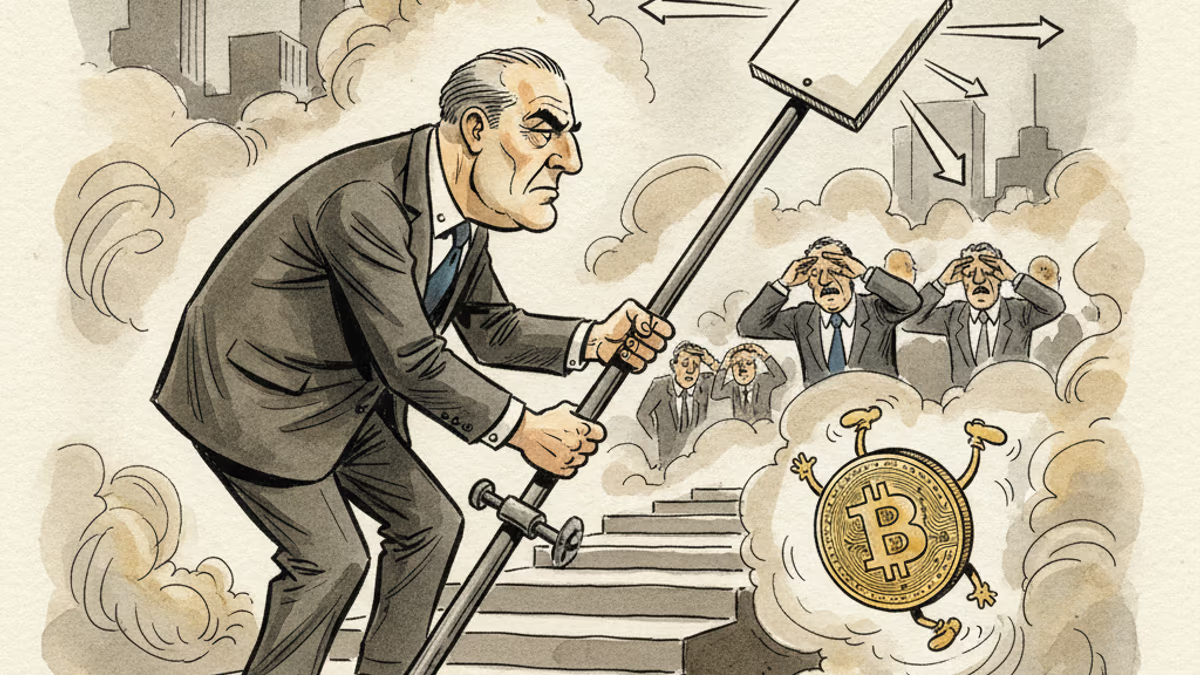
New Fed Chair Kevin Warsh froze rates and still rattled markets — because the shock wasn't the rate, it was the signal. Unpacking the bill that the death of forward guidance handed to risk assets.

Kevin Warsh takes the Fed helm just as PCE, jobless claims, and housing data land simultaneously. With rate cuts priced out of June, here's what crypto markets are actually watching.

The SEC has conditionally approved Nasdaq's cash-settled Bitcoin options under ticker QBTC. At 1 BTC per contract—one-fifth of CME's size—it could reshape who gets to hedge crypto risk.
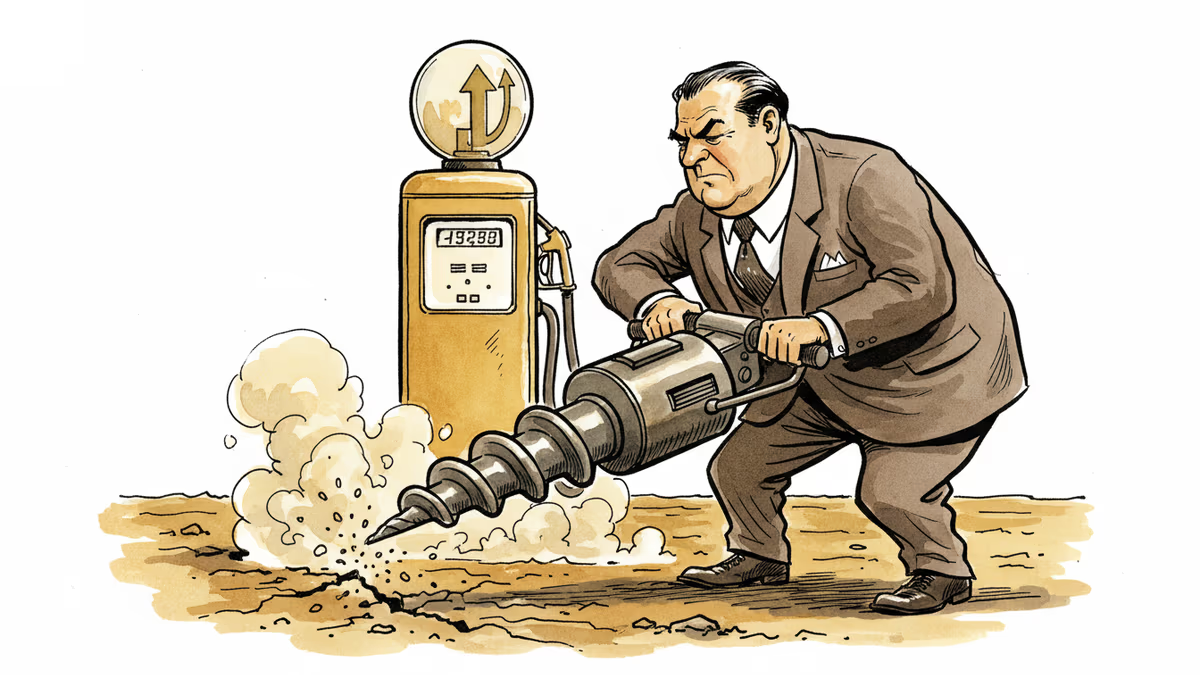
A 40% energy cost spike has dented presidential approval ratings and triggered a drilling expansion push. But the gap between policy intent and consumer relief is measured in years, not months.
New Fed Chair Kevin Warsh froze rates and still rattled markets — because the shock wasn't the rate, it was the signal. Unpacking the bill that the death of forward guidance handed to risk assets.
Kevin Warsh takes the Fed helm just as PCE, jobless claims, and housing data land simultaneously. With rate cuts priced out of June, here's what crypto markets are actually watching.
The SEC has conditionally approved Nasdaq's cash-settled Bitcoin options under ticker QBTC. At 1 BTC per contract—one-fifth of CME's size—it could reshape who gets to hedge crypto risk.
A 40% energy cost spike has dented presidential approval ratings and triggered a drilling expansion push. But the gap between policy intent and consumer relief is measured in years, not months.
Thoughts
Share your thoughts on this article
Sign in to join the conversation