

Epic and Google Just Redefined What an App Can Be
Epic Games and Google agree on 'metaverse browsers' as new app category. This quiet deal could reshape platform competition and app store economics.
After four years of courtroom battles, Epic Games and Google have called a truce. But buried in their settlement documents is something potentially more significant: an agreement to create a new category of apps called "metaverse browsers."
This isn't just corporate jargon. It's the first time major platform holders have formally recognized that the future of apps might not look like apps at all.
The App That Contains Apps
Tim Sweeney, Epic's CEO, has spent years evangelizing his vision of the metaverse—a persistent digital world where users can seamlessly move between experiences. His company's Fortnite already operates as a proto-metaverse, hosting concerts, movie screenings, and brand activations alongside its core battle royale gameplay.
But traditional app store policies weren't designed for this reality. When Apple kicked Fortnite off the App Store in 2020, it wasn't just about payment processing—it was about control over what constitutes an "app" in the first place.
Metaverse browsers represent something fundamentally different: applications that can host other applications, creating nested digital experiences that blur the lines between platforms, stores, and content.
Platform Wars Enter a New Phase
Google's willingness to formalize "metaverse browsers" as a distinct category signals a strategic shift. While Apple maintains tight control over its walled garden, Google is betting on a more open approach to next-generation platforms.

This matters because whoever sets the rules for metaverse browsers could control the next evolution of digital commerce. Think of it as the difference between owning a mall versus owning the zoning laws that determine how all malls operate.
For developers, this creates both opportunity and uncertainty. Building for metaverse browsers means potentially reaching users across multiple traditional app boundaries—but it also means navigating an entirely new set of platform policies that don't yet exist.
The Regulatory Wild Card
The timing isn't coincidental. As regulators in the EU, US, and elsewhere scrutinize app store monopolies, defining new categories of applications becomes a defensive strategy. By proactively creating frameworks for metaverse browsers, Google and Epic are positioning themselves as innovation leaders rather than gatekeepers.
But regulators might not see it that way. The Digital Markets Act in Europe and similar legislation elsewhere could treat metaverse browsers as just another form of platform control—especially if they become dominated by a few major players.
Microsoft, notably absent from this particular agreement, has been building its own vision of cross-platform experiences through Xbox Game Pass and cloud gaming. The company's approach suggests there are multiple paths toward platform-agnostic digital experiences.
Beyond the Metaverse Hype
While the term "metaverse" has fallen out of fashion—even Mark Zuckerberg talks more about AI these days—the underlying concept remains compelling. Users want seamless experiences that transcend individual apps and platforms.
The real question isn't whether metaverse browsers will succeed, but whether they'll represent genuine user empowerment or just a new form of platform lock-in with better marketing.
Authors
Related Articles

In a post-Google I/O interview, Sundar Pichai acknowledged flawed search results, real AI anxiety, and an AGI timeline that makes the label irrelevant. Here's what he said — and what it means.
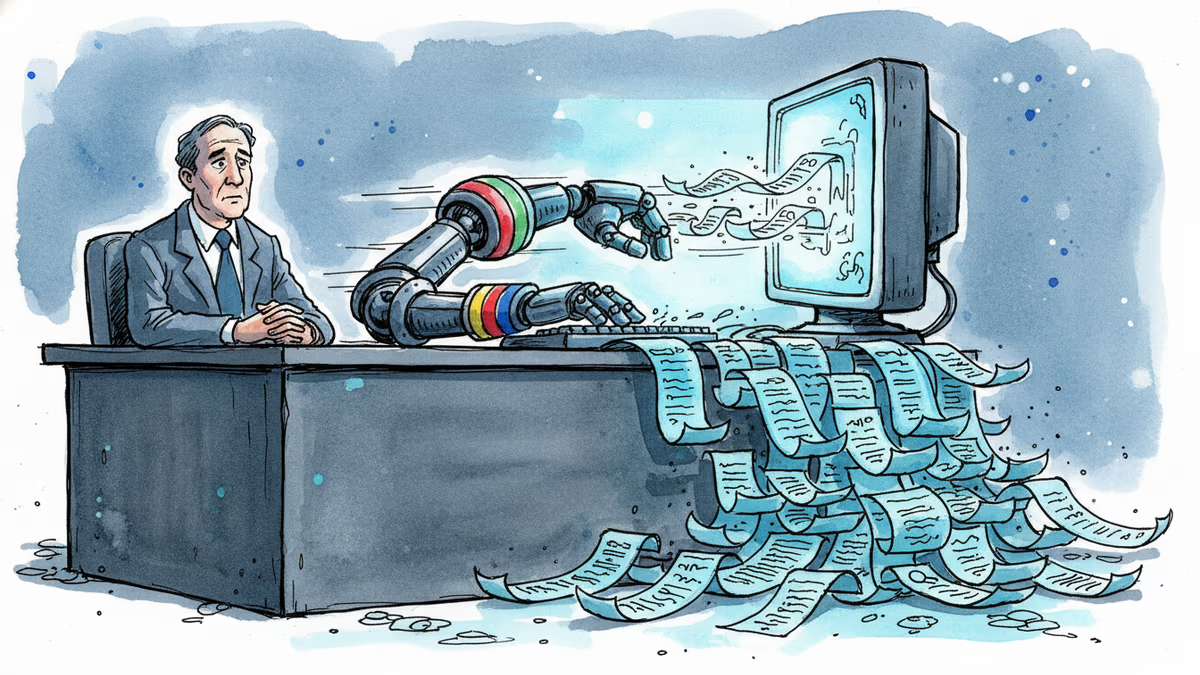
Google is building AI agents that search the web proactively, without user prompting. That's not just a product update — it's a fundamental shift in who controls the information you receive.

Google unveiled the 'Googlebook' platform to replace Chromebook and ChromeOS—but revealed zero hardware specs. What's the strategy, and what does it mean for users, manufacturers, and the education market?

After 15 years of fragmented mobile messaging, Apple and Google are rolling out end-to-end encrypted RCS messaging between iPhones and Android devices. Here's what changed, why it took so long, and what it means for your privacy.
In a post-Google I/O interview, Sundar Pichai acknowledged flawed search results, real AI anxiety, and an AGI timeline that makes the label irrelevant. Here's what he said — and what it means.
Google is building AI agents that search the web proactively, without user prompting. That's not just a product update — it's a fundamental shift in who controls the information you receive.
Google unveiled the 'Googlebook' platform to replace Chromebook and ChromeOS—but revealed zero hardware specs. What's the strategy, and what does it mean for users, manufacturers, and the education market?
After 15 years of fragmented mobile messaging, Apple and Google are rolling out end-to-end encrypted RCS messaging between iPhones and Android devices. Here's what changed, why it took so long, and what it means for your privacy.
Thoughts
Share your thoughts on this article
Sign in to join the conversation