
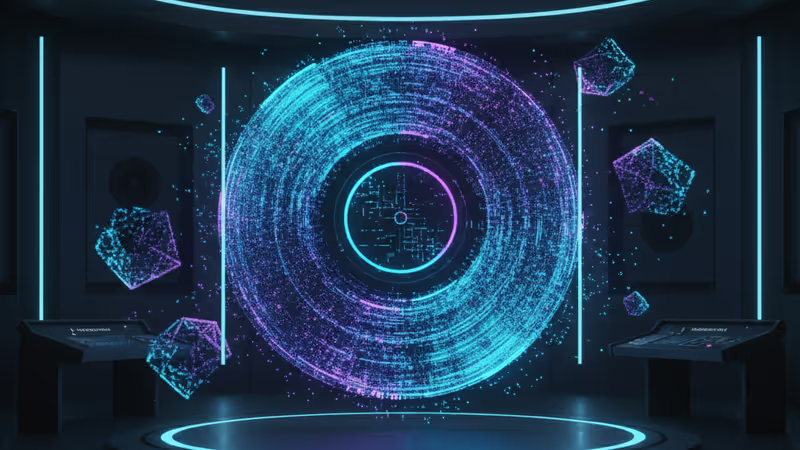
ElevenLabs AI Music Album Debuts: 'The Eleven Album' Redefines Digital Authorship
ElevenLabs launches 'The Eleven Album' to demonstrate how its AI music generator protects artist authorship and commercial rights. Explore the future of ethical AI music.
Can AI truly coexist with human creativity without stealing the spotlight? ElevenLabs just answered that with the release of The Eleven Album, a collection of songs generated entirely through its AI tools. According to reports from The Verge, the project aims to prove that artists can wield AI as a creative tool while retaining full commercial rights and authorship.
ElevenLabs AI Music Album Showcases Ethical AI Innovation
The album serves as a high-profile showcase for the Eleven Music generator and the Iconic Voices Marketplace, both of which were rolled out in 2025. These platforms allow musicians to blend their signature styles with AI-driven capabilities, ensuring that the resulting tracks aren't just robotic mimics but original artistic expressions.

ElevenLabs emphasized that every artist involved produced a "fully original track." This approach tackles the industry's biggest fear: the loss of intellectual property. By clearing these tools for commercial use, the company is positioning itself as the 'pro-artist' alternative in a sea of controversial AI music startups.
Technical Specifications & Commercial Rights
| Feature | Detail |
|---|---|
| Platform | Eleven Music Generator |
| Rights | 100% Artist Ownership |
| Licensing | Cleared for Commercial Use |
| Marketplace | Iconic Voices Rev-Share Model |
Authors
Related Articles
From a niche experiment in 2018 to a mainstream disruption in 2026, AI-generated music is forcing the industry to rethink creativity, copyright, and compensation.
Samsung Electronics' union branch revealed that 84% of survey respondents oppose the government's roughly $290 billion (₩400 trillion) semiconductor megaproject in Gwangju. Government, management, the union and shareholders are all reading the same national project in sharply different ways.
Nvidia shipped roughly a billion RISC-V cores in 2024, then announced it would run CUDA on the open standard. We break down how royalty-free instruction sets and open software stacks are trying to route around CUDA's lock-in. Part 2 of the Semiconductor Sovereignty series.
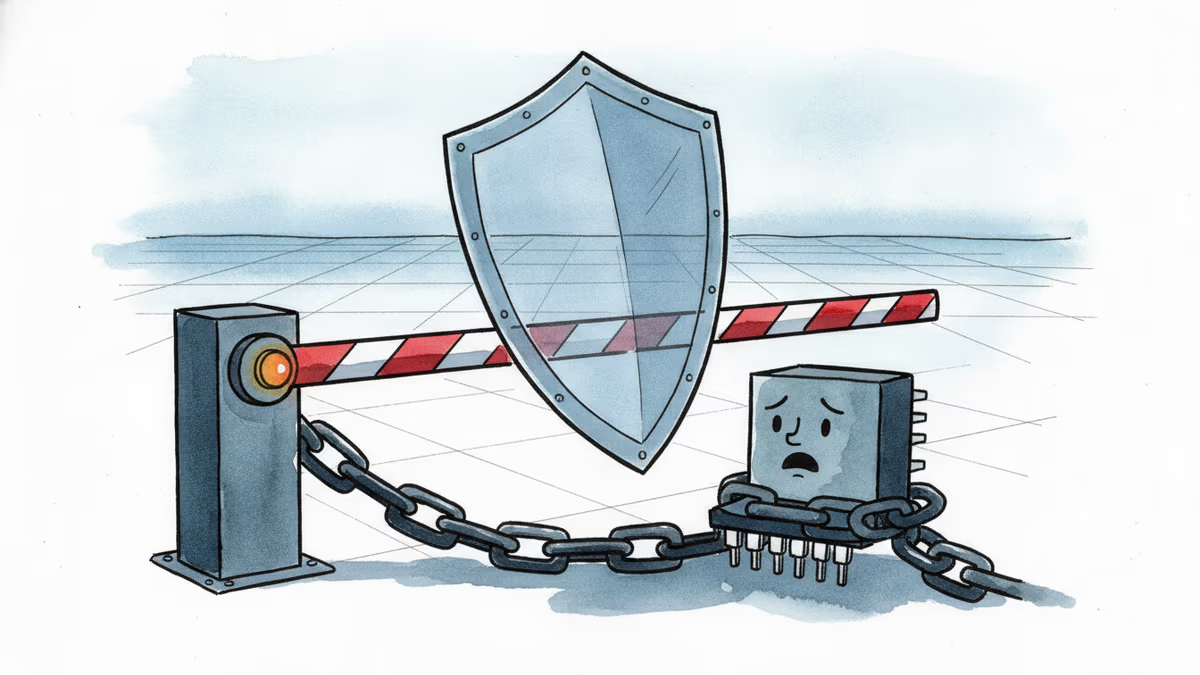
US AI-chip export controls split into three layers in the first half of 2026 — January easing, a May crackdown on circumvention, and a pending bill. Nvidia erased China from its guidance and still posted a record $81.6 billion quarter. A look at the export policy that both shields and cages it.
From a niche experiment in 2018 to a mainstream disruption in 2026, AI-generated music is forcing the industry to rethink creativity, copyright, and compensation.
Samsung Electronics' union branch revealed that 84% of survey respondents oppose the government's roughly $290 billion (₩400 trillion) semiconductor megaproject in Gwangju. Government, management, the union and shareholders are all reading the same national project in sharply different ways.
Nvidia shipped roughly a billion RISC-V cores in 2024, then announced it would run CUDA on the open standard. We break down how royalty-free instruction sets and open software stacks are trying to route around CUDA's lock-in. Part 2 of the Semiconductor Sovereignty series.
US AI-chip export controls split into three layers in the first half of 2026 — January easing, a May crackdown on circumvention, and a pending bill. Nvidia erased China from its guidance and still posted a record $81.6 billion quarter. A look at the export policy that both shields and cages it.
Thoughts
Share your thoughts on this article
Sign in to join the conversation