

When Presidential Pressure Meets State Justice: The Tina Peters Test Case
Trump's escalating pressure campaign against Colorado over imprisoned election clerk Tina Peters reveals new dimensions of federal-state power dynamics and raises questions about judicial independence.
For 14 months, Tina Peters has been serving a nine-year sentence in a Colorado women's prison. The former Mesa County election clerk's case might have remained a footnote in election denial history, but it's now become the center of an unprecedented federal pressure campaign that's testing the boundaries between presidential power and state justice.
Donald Trump can't legally pardon Peters—she was convicted on state, not federal charges. But that hasn't stopped him from launching what Colorado officials describe as systematic retaliation against the entire state to secure her release.
From Obscure Case to Presidential Obsession
Peters first gained notoriety in May 2021 when she allowed Conan Hayes, an associate of pillow salesman turned election denier Mike Lindell, unauthorized access to Mesa County's election equipment. Their goal: prove the 2020 presidential election was stolen. Instead, Peters was convicted on seven of ten charges, including four felonies, in August 2024.
Initially, Trump showed little interest in Peters' case. The shift began this year. In March, the Department of Justice announced it was reviewing her conviction. By May, Trump was posting on Truth Social, calling Peters "an innocent Political Prisoner" suffering "Cruel and Unusual Punishment."
The escalation has been methodical. Trump has posted about Peters eight times over the past nine months, increasingly targeting Colorado Governor Jared Polis, whom he's called a "sleazebag" and "scumbag."
The Pressure Campaign Intensifies
What makes this case extraordinary isn't just Trump's rhetoric—it's the concrete actions that appear designed to punish Colorado. In September, Trump announced the relocation of Space Command from Peterson Space Force Base in Colorado to Alabama. In December, he vetoed the Arkansas Valley Conduit project, which would have brought clean drinking water to 50,000 people in southeastern Colorado.
The administration has also threatened to remove Colorado's control over its wolf reintroduction program and announced plans to dismantle the National Center for Atmospheric Research in Boulder. Federal grants to low-income families in Colorado are reportedly being clawed back.

"I do not believe that giving in to a vengeful president makes the retribution stop," Jena Griswold, Colorado's Secretary of State, tells WIRED. "Trump is a lawless president. He disregards the law, he disregards the Constitution, and when people do not cave, he then starts retribution."
A Governor's Dilemma
The pressure appears to be working. Governor Polis, who initially seemed unlikely to consider clemency, has recently hinted he might commute Peters' sentence, calling it "harsh." He's cited her status as "nonviolent, a first-time offender, elderly" as potential mitigating factors.
This shift has baffled and alarmed Colorado officials across party lines. Griswold, along with a county clerk and the director of the state's clerks association, sent Polis a letter urging him not to commute Peters' sentence. All but one member of the Colorado County Clerks Association agreed to oppose any clemency.
"I have major concerns that [commuting Peters' sentence] emboldens the far right that has been attacking our elections and election officials," Griswold says. The worry isn't just symbolic—election workers fear for their safety ahead of November's midterms.
Testing Constitutional Boundaries
Trump's approach reveals sophisticated understanding of pressure points. While he can't directly pardon Peters, he's found ways to make her case Colorado's problem. In November, the Federal Bureau of Prisons sent a letter requesting Peters' transfer to federal custody—a move that requires state initiation but sends a clear message about federal interest.
Trump even issued a symbolic "pardon" on Truth Social in December, despite having no legal authority over state convictions. Peters' attorney Peter Ticktin, who attended military academy with Trump, claims this applies to his client—a legally meaningless but politically powerful gesture.
The Broader Stakes
What's happening in Colorado extends beyond one case. It's a test of whether systematic federal pressure can override state judicial decisions. The administration's multi-pronged approach—threatening funding, relocating facilities, targeting infrastructure projects—creates a template for future federal-state conflicts.
Election officials nationwide are watching. If Colorado yields to pressure in Peters' case, it could signal that state-level election prosecutions are vulnerable to federal political interference. The implications for 2026 and 2028 elections are significant.
Matt Crane, executive director of the Colorado County Clerks Association, warns that reducing Peters' sentence "would endanger the lives of election workers" and undermine efforts to maintain election integrity.
Authors
Related Articles

Josh D'Amaro took over Disney with a bold Disney Plus vision. Days later, he's in a First Amendment fight with the Trump administration over The View. What does this mean for media freedom?
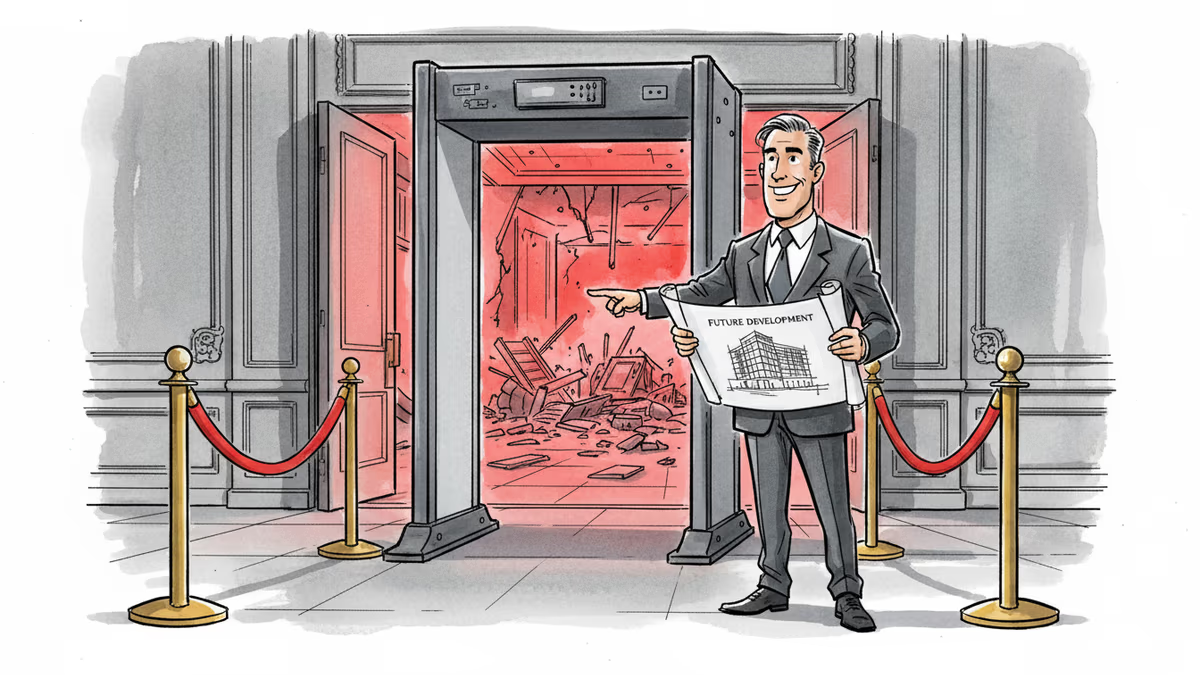
A gunman attacked a Secret Service checkpoint at the White House Correspondents' Dinner. Trump's first public reaction wasn't about security. It was about his $400M ballroom project.

Hours after an armed suspect attempted to breach the White House Correspondents Dinner, Trump used the security scare to publicly defend his White House ballroom project. What does that tell us?

As Washington D.C. enters another political spring, the battle over Big Tech regulation is heating up — and the stakes extend far beyond Silicon Valley.
Josh D'Amaro took over Disney with a bold Disney Plus vision. Days later, he's in a First Amendment fight with the Trump administration over The View. What does this mean for media freedom?
A gunman attacked a Secret Service checkpoint at the White House Correspondents' Dinner. Trump's first public reaction wasn't about security. It was about his $400M ballroom project.
Hours after an armed suspect attempted to breach the White House Correspondents Dinner, Trump used the security scare to publicly defend his White House ballroom project. What does that tell us?
As Washington D.C. enters another political spring, the battle over Big Tech regulation is heating up — and the stakes extend far beyond Silicon Valley.
Thoughts
Share your thoughts on this article
Sign in to join the conversation