
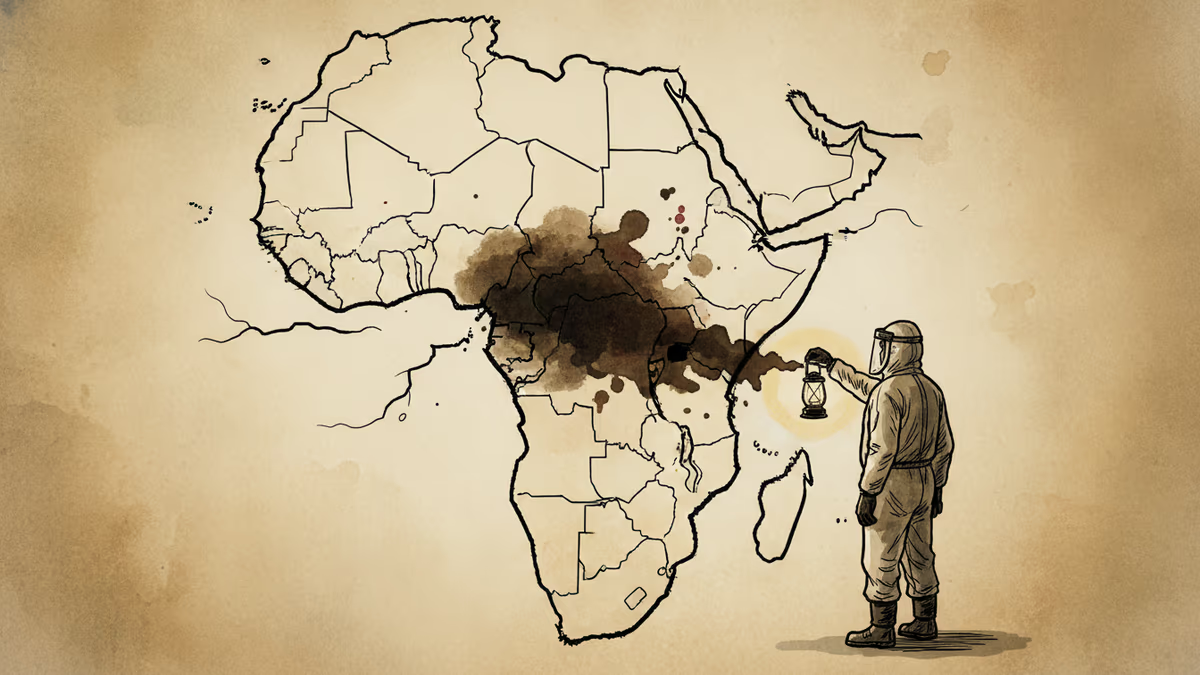
Ebola Is Crossing Borders Again. Here's Why This Outbreak Feels Different.
The DRC Ebola outbreak has already crossed into Uganda and earned a WHO emergency declaration. The case count isn't the alarming part—the gaps in detection are.
The confirmed case count is 10. The suspected case count is 336. That gap is the story.
What We Know So Far
On Friday, May 16, the Democratic Republic of the Congo officially reported a new Ebola outbreak. Within 72 hours, the situation had already crossed an international border. As of May 17, Uganda had confirmed 2 cases and 1 death. Back in the DRC: 10 confirmed, 336 suspected, 88 dead—including 4 healthcare workers.
For context, those numbers already place this outbreak among the top 10 largest Ebola outbreaks ever recorded. The worst on record—the 2014–2016 West African epidemic—killed over 11,000 people from more than 28,000 cases. This isn't that. Not yet. But the trajectory in the first week is being watched closely.
On Sunday, WHO Director-General Tedros Adhanom Ghebreyesus declared the outbreak a Public Health Emergency of International Concern (PHEIC)—the organization's highest alert level short of a pandemic emergency. The declaration wasn't just about the numbers. It was about what the numbers can't explain.
The Part That's Actually Alarming
Ebola's spread is typically traceable. The virus transmits through direct contact with bodily fluids, which means contact tracing—identifying and isolating everyone an infected person touched—is the primary containment tool. It's slow, labor-intensive work, but it works. When it works.

The problem WHO flagged is that geographically distant cases and clusters in the DRC show no apparent epidemiological links. Cases are appearing in multiple health zones simultaneously, with no clear chain connecting them. That points to one of two things: undetected transmission has been spreading for longer than the official timeline suggests, or the surveillance infrastructure simply isn't catching what's already out there.
WHO's own language leans toward the latter: the outbreak is "larger than what is currently being detected." When you have 336 suspected cases but only 10 confirmed, that's not just a testing backlog—it's a visibility problem. And in outbreak response, what you can't see is what kills you.
The healthcare worker deaths compound this. Frontline responders are the immune system of any outbreak response. When they fall, the entire detection and containment apparatus weakens. It happened in 2014. The parallel isn't lost on anyone watching.
Who's Responding—And What They're Working Against
The PHEIC declaration is a formal call to action: it unlocks international coordination mechanisms, pressures governments to share resources, and signals to donors that funding is needed now. Merck's rVSV-ZEBOV (Ervebo) vaccine, FDA-approved in 2019 and proven effective in previous DRC outbreaks, is expected to be deployed. But proven efficacy in a clinical setting doesn't automatically translate to rapid distribution in a region where cold-chain logistics are fragile and road infrastructure is limited.
Then there's the trust problem. The DRC has experienced more Ebola outbreaks than any other country. Repeated crises, combined with a history of armed conflict and community distrust of outside medical teams, have made containment harder than the biology alone would suggest. Patients avoiding isolation, communities resisting contact tracing—these aren't irrational responses in contexts where institutions have repeatedly failed people. They are, however, epidemiologically catastrophic.
For the global health policy community, this outbreak also arrives at an uncomfortable moment. WHO is navigating significant funding pressures following US withdrawal of contributions earlier in 2025, and the broader international health financing architecture is under strain. A PHEIC declaration means little if the pledges that follow it are slow or insufficient.
This content is AI-generated based on source articles. While we strive for accuracy, errors may occur. We recommend verifying with the original source.
Related Articles
WHO's 2026 global health statistics report shows HIV, tuberculosis, and malaria targets are badly off track. What went wrong—and what does it mean for 2030?
Dr. Erica Schwartz, a pro-vaccine physician with an unimpeachable public health résumé, is Trump's third CDC director nominee—a quiet but pointed rebuke of RFK Jr.'s agenda.

Illinois health officials deployed an AI chatbot to investigate a salmonella outbreak linked to a county fair. But questions remain about whether artificial intelligence can truly revolutionize epidemic tracking.
Jay Bhattacharya now leads both NIH and CDC simultaneously, marking unprecedented consolidation of US health authority. With vaccine skeptics gaining influence, scientific independence faces its biggest test in decades.
WHO's 2026 global health statistics report shows HIV, tuberculosis, and malaria targets are badly off track. What went wrong—and what does it mean for 2030?
Dr. Erica Schwartz, a pro-vaccine physician with an unimpeachable public health résumé, is Trump's third CDC director nominee—a quiet but pointed rebuke of RFK Jr.'s agenda.
Illinois health officials deployed an AI chatbot to investigate a salmonella outbreak linked to a county fair. But questions remain about whether artificial intelligence can truly revolutionize epidemic tracking.
Jay Bhattacharya now leads both NIH and CDC simultaneously, marking unprecedented consolidation of US health authority. With vaccine skeptics gaining influence, scientific independence faces its biggest test in decades.
Thoughts
Share your thoughts on this article
Sign in to join the conversation