
The Mystery of Space's 'Little Red Dots' Finally Solved
Scientists have solved the puzzle of mysterious 'Little Red Dots' spotted by the James Webb Space Telescope, revealing a crucial phase in supermassive black hole evolution.
When the James Webb Space Telescope beamed back its first high-definition infrared images, astronomers spotted something peculiar: tiny, glowing, crimson stains scattered across the cosmic canvas. These objects were too bright to be normal galaxies and too red to be simple star clusters. They seemed to harbor supermassive black holes that defied everything scientists thought they knew about cosmic evolution.
The mystery deepened when researchers calculated the mass of these black holes. They were far too massive for their age—like finding a 300-pound toddler. In the 13.8-billion-year history of the universe, there simply hadn't been enough time for black holes to grow this large through conventional feeding.
The Overmassive Black Hole Problem
Initially, scientists theorized these "Little Red Dots" were ultra-compact, distant galaxies. But the math didn't add up. "They were too massive," explains Vadim Rusakov, an astronomer at the University of Manchester and lead author of the new study. "They'd have to be completely filled with stars, producing them at 100 percent efficiency. That's not what we see in nature."
Real galaxies max out at about 20 percent star formation efficiency. For these objects to exist as pure galaxies, they'd need to break fundamental laws of physics. Something else had to be going on.

The Cocoon Solution
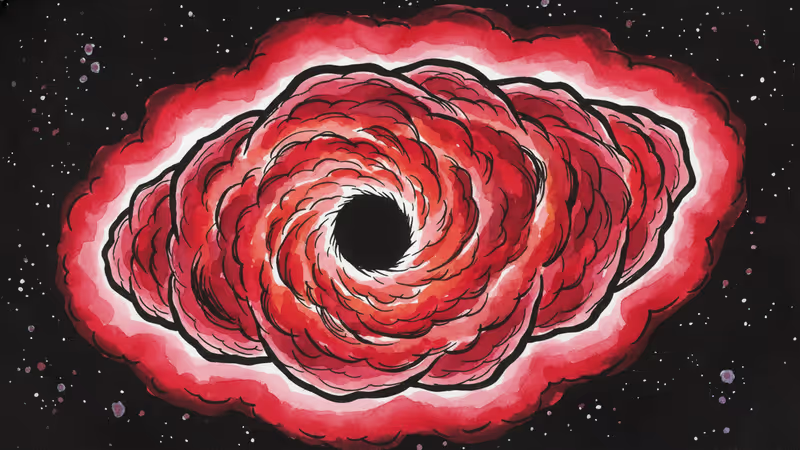
A new study published in Nature offers an elegant explanation: young supermassive black holes may go through a "cocoon phase." During this period, they grow while surrounded by dense, hot gas clouds that they actively feed on. These gaseous cocoons are likely what JWST captured as the Little Red Dots.
Think of it as cosmic adolescence. Just as teenagers go through awkward growth spurts, young black holes may experience rapid expansion phases where they're temporarily shrouded in the very material that fuels their growth. The superheated gas glows bright red in infrared light, creating the distinctive signature that puzzled astronomers.
Rewriting Cosmic Evolution
This discovery doesn't just solve a puzzle—it reveals a previously unknown chapter in cosmic history. The cocoon phase suggests that supermassive black holes can grow much faster than previously thought, potentially explaining how they reached enormous sizes so early in the universe's timeline.
The implications extend beyond pure science. Understanding rapid black hole growth could inform everything from galaxy formation models to the search for life-supporting environments. If black holes can grow this quickly, it changes our calculations about when and where stable planetary systems might have emerged.
Authors
Related Articles

Five stories from late September, traced to where the paper trail stops: Korea's export record, Nvidia's Hugging Face 8-K, a US-China AI channel, the UN on AI, and rising births.

Huawei's CANN is open source under a license barring software for non-Ascend chips. Inside China's second CUDA, and the two links still outside it: pre-training compute and 5nm capacity.

Samsung Electronics' union branch revealed that 84% of survey respondents oppose the government's roughly $290 billion (₩400 trillion) semiconductor megaproject in Gwangju. Government, management, the union and shareholders are all reading the same national project in sharply different ways.

Nvidia shipped roughly a billion RISC-V cores in 2024, then announced it would run CUDA on the open standard. We break down how royalty-free instruction sets and open software stacks are trying to route around CUDA's lock-in. Part 2 of the Semiconductor Sovereignty series.
Five stories from late September, traced to where the paper trail stops: Korea's export record, Nvidia's Hugging Face 8-K, a US-China AI channel, the UN on AI, and rising births.
Huawei's CANN is open source under a license barring software for non-Ascend chips. Inside China's second CUDA, and the two links still outside it: pre-training compute and 5nm capacity.
Samsung Electronics' union branch revealed that 84% of survey respondents oppose the government's roughly $290 billion (₩400 trillion) semiconductor megaproject in Gwangju. Government, management, the union and shareholders are all reading the same national project in sharply different ways.
Nvidia shipped roughly a billion RISC-V cores in 2024, then announced it would run CUDA on the open standard. We break down how royalty-free instruction sets and open software stacks are trying to route around CUDA's lock-in. Part 2 of the Semiconductor Sovereignty series.
Thoughts
Share your thoughts on this article
Sign in to join the conversation