
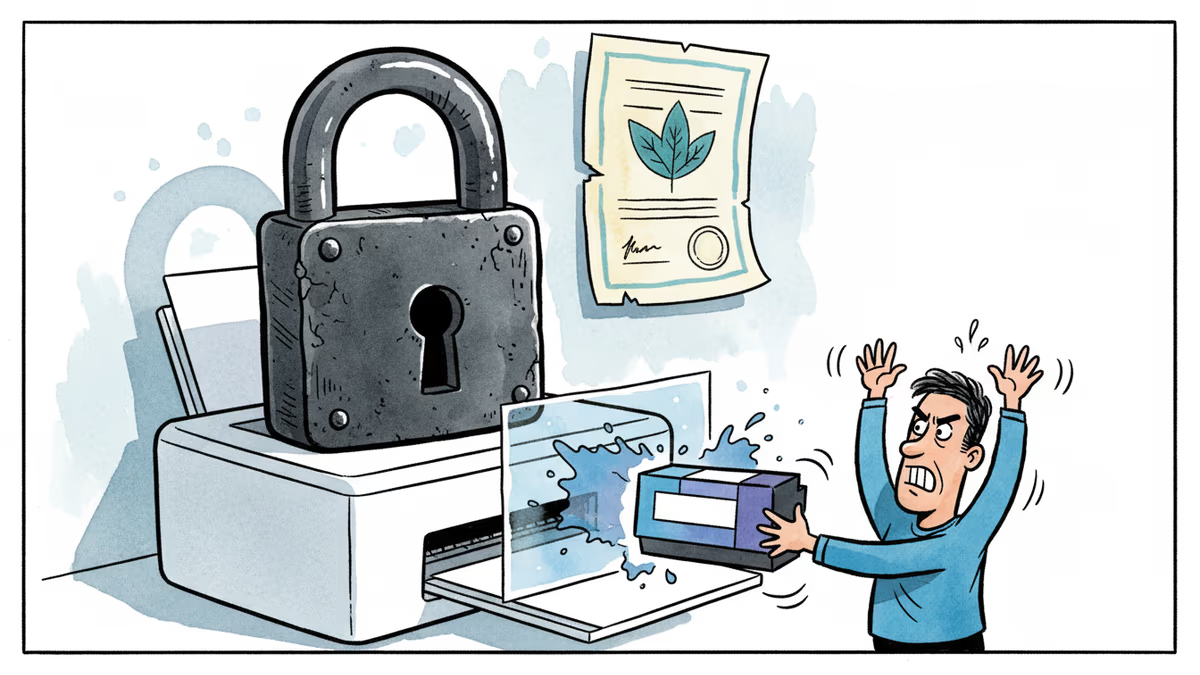
Your HP Printer Just Rejected Your Ink
HP's Dynamic Security firmware updates block third-party ink cartridges—and now that practice may violate the EPEAT 2.0 environmental certification HP itself applied for.
You bought the printer. You own it. But a quiet firmware update arrived overnight, and now it refuses to recognize the ink you've been using for months. HP calls this Dynamic Security. Critics call it something else entirely.
What Actually Happened
The International Imaging Technology Council (Int'l ITC)—a nonprofit representing North American cartridge remanufacturers, component suppliers, and cartridge collectors—has gone public with a pointed accusation: HP's firmware updates, which disable third-party ink and toner cartridges, directly violate the terms of the General Electronics Council'sEPEAT 2.0 registry.
EPEAT (Electronic Product Environmental Assessment Tool) is an internationally recognized certification system for evaluating the environmental impact of electronics. Its 2.0 iteration includes explicit provisions requiring that certified devices support third-party consumables—a nod to repairability and waste reduction. If HP's printers are registered under EPEAT 2.0 while simultaneously running firmware that locks out aftermarket cartridges, the Int'l ITC argues HP is in direct breach of the certification it sought.
HP's Dynamic Security is not new. The company has deployed it for years, framing it publicly as a consumer protection measure—guarding against print quality degradation and security vulnerabilities allegedly posed by non-genuine cartridges.
Why This Fight Is Different Now
Previous battles over Dynamic Security played out mostly in courtrooms and complaint forums. The FTC opened inquiries. Class-action suits were filed. Consumers grumbled. But HP largely held its ground.

EPEAT 2.0 changes the terrain. The certification isn't just a green badge for marketing brochures. US federal agencies and many institutional buyers require EPEAT-certified products in procurement decisions. Losing—or being formally challenged on—that certification carries real commercial consequences. The Int'l ITC isn't just making a moral argument; it's pointing at a mechanism with teeth.
This matters for the $80 billion+ global printer market, where the hardware-cheap, consumables-expensive model has been the dominant playbook for decades. HP's printing division leans heavily on ink and toner revenue. Third-party cartridges, which can cost 50–80% less than OEM equivalents, directly erode that margin.
Three Ways to Read This Story
The consumer view is the most straightforward: if you paid for a device, you should decide what goes in it. The firmware-as-lockout approach feels less like a security feature and more like a subscription you never agreed to. For small businesses, schools, and clinics running high print volumes, the cost difference between OEM and third-party cartridges is not trivial.
The environmental view cuts against HP's own EPEAT positioning. Remanufactured cartridges—the core product of Int'l ITC members—extend the life of existing plastic and components. Blocking them pushes more cartridges into landfills. That's a difficult posture to reconcile with an eco-certification.
The industry view requires some honesty about who's talking. The Int'l ITC represents businesses that profit directly when OEM lockouts fail. Their members have a financial stake in this fight. That doesn't make their EPEAT argument wrong—it's grounded in documented certification criteria—but it does mean the advocacy isn't purely altruistic. Readers should weigh the argument on its merits, not just its framing.
HP, for its part, has not yet publicly responded to the Int'l ITC's specific EPEAT challenge as of this writing.
Authors
Related Articles
Elon Musk confirmed on Tesla's Q1 2026 earnings call that Hardware 3 vehicles will never receive unsupervised Full Self-Driving — locking out millions who paid for the feature.

Sony's PlayStation Store has been quietly A/B testing personalized game prices across 150+ titles in 68 regions. Is dynamic pricing coming to gaming — and what does that mean for players?
Rising electricity rates across America are sparking unprecedented protests as frustrated consumers demand answers from obscure regulatory agencies. What this grassroots movement reveals about energy policy.
Amazon settles billion-dollar class action over refund failures. As consumers receive compensation, questions emerge about Big Tech accountability and the true cost of broken promises.
Elon Musk confirmed on Tesla's Q1 2026 earnings call that Hardware 3 vehicles will never receive unsupervised Full Self-Driving — locking out millions who paid for the feature.
Sony's PlayStation Store has been quietly A/B testing personalized game prices across 150+ titles in 68 regions. Is dynamic pricing coming to gaming — and what does that mean for players?
Rising electricity rates across America are sparking unprecedented protests as frustrated consumers demand answers from obscure regulatory agencies. What this grassroots movement reveals about energy policy.
Amazon settles billion-dollar class action over refund failures. As consumers receive compensation, questions emerge about Big Tech accountability and the true cost of broken promises.
Thoughts
Share your thoughts on this article
Sign in to join the conversation