

Everyone Recommended It. You Still Haven't Read It.
Dungeon Crawler Carl went viral without a bestseller list or bookstore shelf. The Verge's Installer newsletter shows how recommendation loops now shape what we read, watch, and buy — and who's really curating your taste.
He ignored the first recommendation. And the second. By the time enough readers had said it enough times, he finally opened the book.
That's how David Pierce, editor of The Verge's weekly newsletter Installer, describes finally starting Dungeon Crawler Carl in Issue #119 — not because an algorithm surfaced it, not because it topped a bestseller list, but because real people kept telling him to. "After you recommended it so many times," he writes.
It's a small moment in a casual newsletter. But it points to something worth sitting with.
What Is Dungeon Crawler Carl, and Why Does It Keep Coming Up?
Dungeon Crawler Carl is a LitRPG novel by Matt Dobinskiy — a genre where game mechanics (levels, stats, loot drops) are baked directly into the narrative. The premise: Earth gets demolished by aliens and converted into a massive dungeon. A regular guy and his cat have to fight their way through it, leveling up as they go.
The genre itself originated largely in Russia and Eastern Europe, then crossed into English-language publishing through Amazon Kindle Unlimited, where page-reads translate directly into author royalties. No gatekeeping editor. No bookstore buyer. Just readers, and what they clicked next.
From there, it spread through Reddit communities like r/Fantasy and r/litrpg, YouTube "best fantasy" listicles, and podcast recommendations. It now appears on nearly every "what should I read next" thread in gaming and fantasy spaces. And yet it has never appeared on a New York Times bestseller list. It didn't need to.
The YouTube Face Connection
In the same newsletter, Pierce also mentions YouTube Face — that specific wide-eyed, open-mouthed expression YouTubers pull in thumbnails to maximize click-through rates. It looks ridiculous. It works anyway. The algorithm rewards it, so creators do it.

Dungeon Crawler Carl's viral path and YouTube Face come from the same underlying logic: platforms shape the content they distribute. Kindle Unlimited's payment model rewards long, fast-paced, bingeable series. Reddit's upvote culture rewards enthusiastic consensus. The result is a specific kind of book — propulsive, game-adjacent, deeply satisfying in a mechanical way — that thrives in those environments.
This isn't a criticism. It's an observation. The same dynamic produced Spotify-optimized pop songs with no intros, TikTok-optimized videos that hook in 3 seconds, and Instagram-optimized photography that pops at thumbnail size. Distribution infrastructure doesn't just carry culture — it quietly authors it.
Curation as Trust, Not Algorithm
What makes Installer interesting as a case study is that it operates differently. 119 editions in, it's a newsletter built on one editor's genuine taste: testing Fairbuds XL headphones, rebuilding an Obsidian note-taking setup, buying a MacBook Neo he admits he didn't need. Readers follow it because they trust the human behind it, not because an AI decided they would.
That trust is increasingly rare — and increasingly valuable. A 2024 Edelman Trust Barometer found that peer recommendations remain the most trusted form of product discovery, outranking both advertising and algorithmic suggestions. The irony is that "peer recommendations" at scale now travel through the same algorithmic pipes as everything else. When thousands of people simultaneously "discover" the same book on Reddit, is that organic word-of-mouth or platform-amplified consensus?
The line is genuinely blurry.
What Casual Readers and Gamers Should Notice
For anyone who plays games or reads in genre fiction spaces, this matters practically. The LitRPG and progression fantasy genres — Dungeon Crawler Carl, He Who Fights With Monsters, The Wandering Inn — have built enormous audiences almost entirely outside traditional publishing infrastructure. No literary agents. No advance reviews in Publishers Weekly. Just platform mechanics and reader enthusiasm compounding over time.
This is the same dynamic that built Roblox, Minecraft, and Among Us into cultural phenomena before mainstream media noticed them. The discovery loop runs: niche community → enthusiast content creators → algorithmic amplification → mainstream arrival. By the time a newsletter editor writes about finally reading something "after so many recommendations," the community that loved it first has already moved on to the next thing.
For game designers and indie creators, there's a practical takeaway: the platforms you publish on don't just distribute your work. They determine what kind of work succeeds. Building for Kindle Unlimited produces different books than building for traditional publishing. Building for Steam produces different games than building for Nintendo eShop.
Authors
Related Articles

Mathematician Anton Bernshteyn has linked descriptive set theory and computer science. His 2023 research reveals how infinite sets can be solved using algorithms.
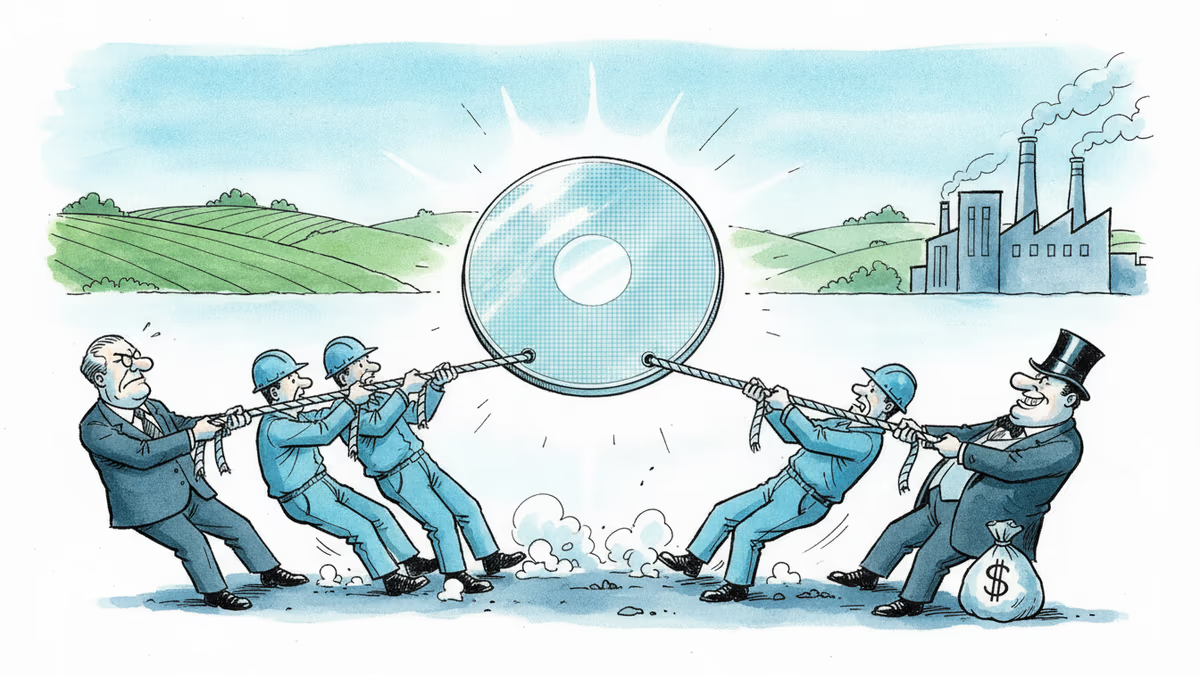
Samsung Electronics' union branch revealed that 84% of survey respondents oppose the government's roughly $290 billion (₩400 trillion) semiconductor megaproject in Gwangju. Government, management, the union and shareholders are all reading the same national project in sharply different ways.
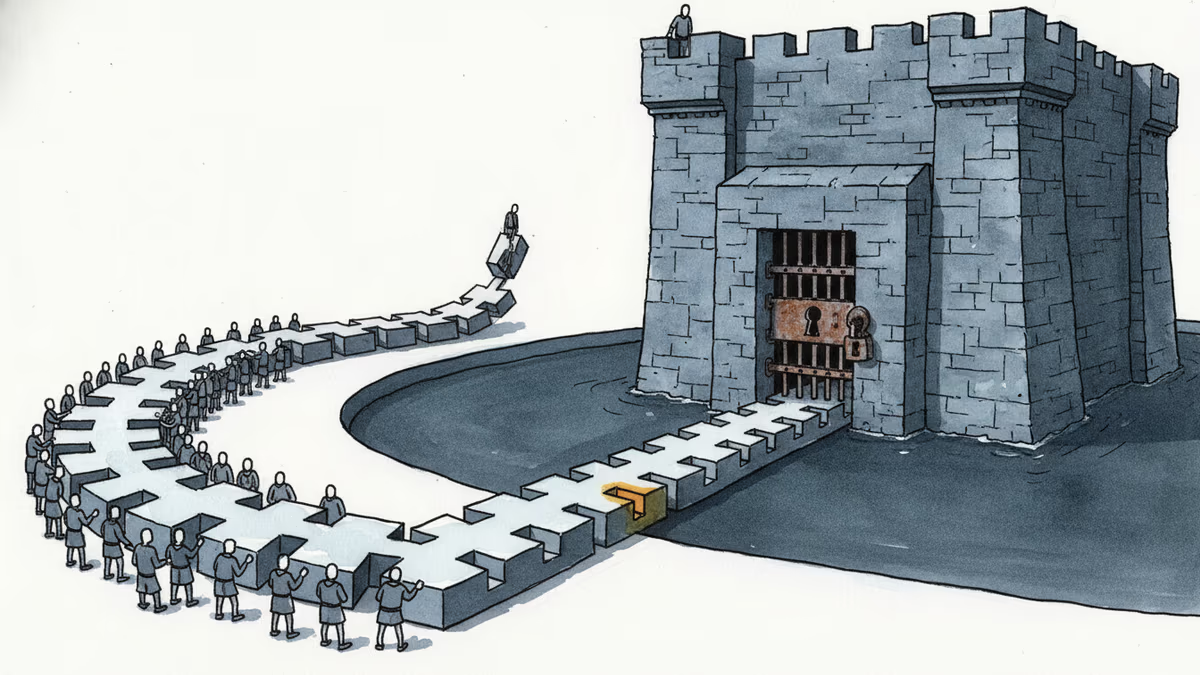
Nvidia shipped roughly a billion RISC-V cores in 2024, then announced it would run CUDA on the open standard. We break down how royalty-free instruction sets and open software stacks are trying to route around CUDA's lock-in. Part 2 of the Semiconductor Sovereignty series.

US AI-chip export controls split into three layers in the first half of 2026 — January easing, a May crackdown on circumvention, and a pending bill. Nvidia erased China from its guidance and still posted a record $81.6 billion quarter. A look at the export policy that both shields and cages it.
Mathematician Anton Bernshteyn has linked descriptive set theory and computer science. His 2023 research reveals how infinite sets can be solved using algorithms.
Samsung Electronics' union branch revealed that 84% of survey respondents oppose the government's roughly $290 billion (₩400 trillion) semiconductor megaproject in Gwangju. Government, management, the union and shareholders are all reading the same national project in sharply different ways.
Nvidia shipped roughly a billion RISC-V cores in 2024, then announced it would run CUDA on the open standard. We break down how royalty-free instruction sets and open software stacks are trying to route around CUDA's lock-in. Part 2 of the Semiconductor Sovereignty series.
US AI-chip export controls split into three layers in the first half of 2026 — January easing, a May crackdown on circumvention, and a pending bill. Nvidia erased China from its guidance and still posted a record $81.6 billion quarter. A look at the export policy that both shields and cages it.
Thoughts
Share your thoughts on this article
Sign in to join the conversation