

Anton Bernshteyn Bridges Descriptive Set Theory and Computer Science
Mathematician Anton Bernshteyn has linked descriptive set theory and computer science. His 2023 research reveals how infinite sets can be solved using algorithms.
One mathematician just bridged the gap between the infinite and the finite. In a move that's reshaped the foundation of modern logic, a deep connection has been found between the most abstract branches of mathematics and the algorithms that power our digital world.
Anton Bernshteyn and the Infinite Network Connection
In 2023, mathematician Anton Bernshteyn published a groundbreaking result that links descriptive set theory directly to computer science. He demonstrated that complex problems regarding infinite sets can be translated into the language of how computer networks communicate. The revelation has stunned researchers who previously thought these fields were worlds apart.
While set theory typically deals with the vastness of the infinite, computer science is rooted in the finite world of algorithms. Bernshteyn's work shows that these two domains aren't just related—they're often equivalent. Václav Rozhoň, a computer scientist at Charles University, noted that this kind of synergy isn't supposed to exist, yet it's opening doors to unprecedented collaborations across the mathematical landscape.

Infinite Graphs and the Problem of Choice
The core of the discovery lies in how we color nodes in an infinite graph. For decades, mathematicians relied on the axiom of choice—one of the nine fundamental blocks of math—to solve these problems. However, this often led to 'non-measurable' sets that behave in counterintuitive ways. Anton Bernshteyn utilized distributed computing principles to find solutions that don't depend on such problematic assumptions.
By treating infinite mathematical objects as if they were massive computer networks, Bernshteyn has provided a new toolkit for descriptive set theorists. This allows them to apply finite algorithmic insights to rethink the nature of infinity itself. The bridge is already being used to prove new theorems on both sides of the discipline, signaling a new era of unified logic.
Authors
Related Articles
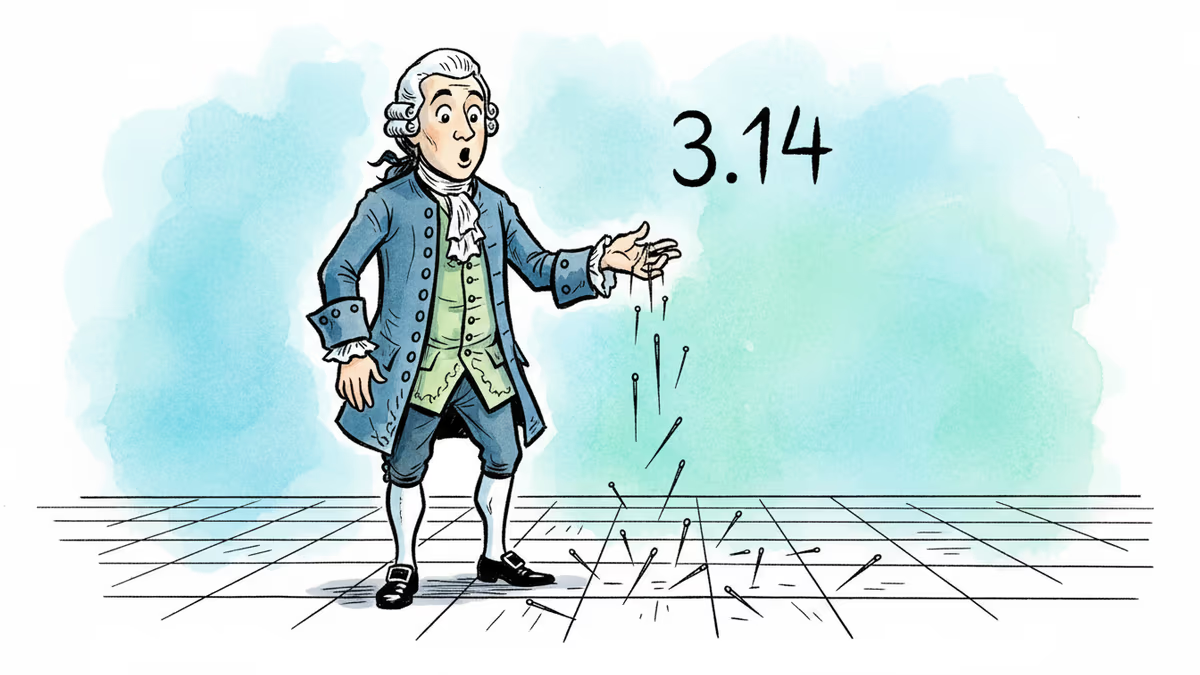
Buffon's Needle, a 1777 probability puzzle, can approximate pi using random chance alone. On Pi Day, we trace how this parlor trick became the Monte Carlo method powering modern science.

Dungeon Crawler Carl went viral without a bestseller list or bookstore shelf. The Verge's Installer newsletter shows how recommendation loops now shape what we read, watch, and buy — and who's really curating your taste.

When an OpenAI researcher claimed GPT-5 solved 10 unsolved math problems, Google DeepMind's CEO called it 'embarrassing.' Here's the real story behind the AI hype and what it means for actual progress.

For nearly 80 years, the simplex method algorithm had a theoretical flaw suggesting it could be exponentially slow. Two researchers have now proven why it's always fast in practice.
Buffon's Needle, a 1777 probability puzzle, can approximate pi using random chance alone. On Pi Day, we trace how this parlor trick became the Monte Carlo method powering modern science.
Dungeon Crawler Carl went viral without a bestseller list or bookstore shelf. The Verge's Installer newsletter shows how recommendation loops now shape what we read, watch, and buy — and who's really curating your taste.
When an OpenAI researcher claimed GPT-5 solved 10 unsolved math problems, Google DeepMind's CEO called it 'embarrassing.' Here's the real story behind the AI hype and what it means for actual progress.
For nearly 80 years, the simplex method algorithm had a theoretical flaw suggesting it could be exponentially slow. Two researchers have now proven why it's always fast in practice.
Thoughts
Share your thoughts on this article
Sign in to join the conversation