
Toss a Needle, Find Pi—Seriously
Buffon's Needle, a 1777 probability puzzle, can approximate pi using random chance alone. On Pi Day, we trace how this parlor trick became the Monte Carlo method powering modern science.
A French count threw needles on his floor in 1777 and accidentally discovered a way to calculate pi. The method still runs inside your weather app.
Every March 14, the world marks Pi Day—because 3/14 matches the first three digits of π. It's a gentle, nerdy holiday. But buried inside the celebration is one of the strangest ideas in the history of mathematics: that you can extract a fundamental constant of the universe from pure randomness, no geometry required. Just a handful of toothpicks and a lined floor.
What Pi Actually Is (and Why It Won't Sit Still)
π is the ratio of a circle's circumference to its diameter. Simple enough. What's less simple is that it's irrational—its decimal expansion never ends, never repeats. Humanity has now calculated it to 314 trillion decimal places and still hasn't found a pattern. For practical purposes, this is overkill: NASA navigates interplanetary spacecraft using just 15 decimal places of π. Everything else is mathematical curiosity.
But that curiosity has produced something remarkable: dozens of completely unrelated methods for approximating π. You can get there through infinite series, through oscillating springs, through the prime numbers. And then there's the method that looks, on the surface, like a party trick.
The Needle Problem: Probability Meets the Circle
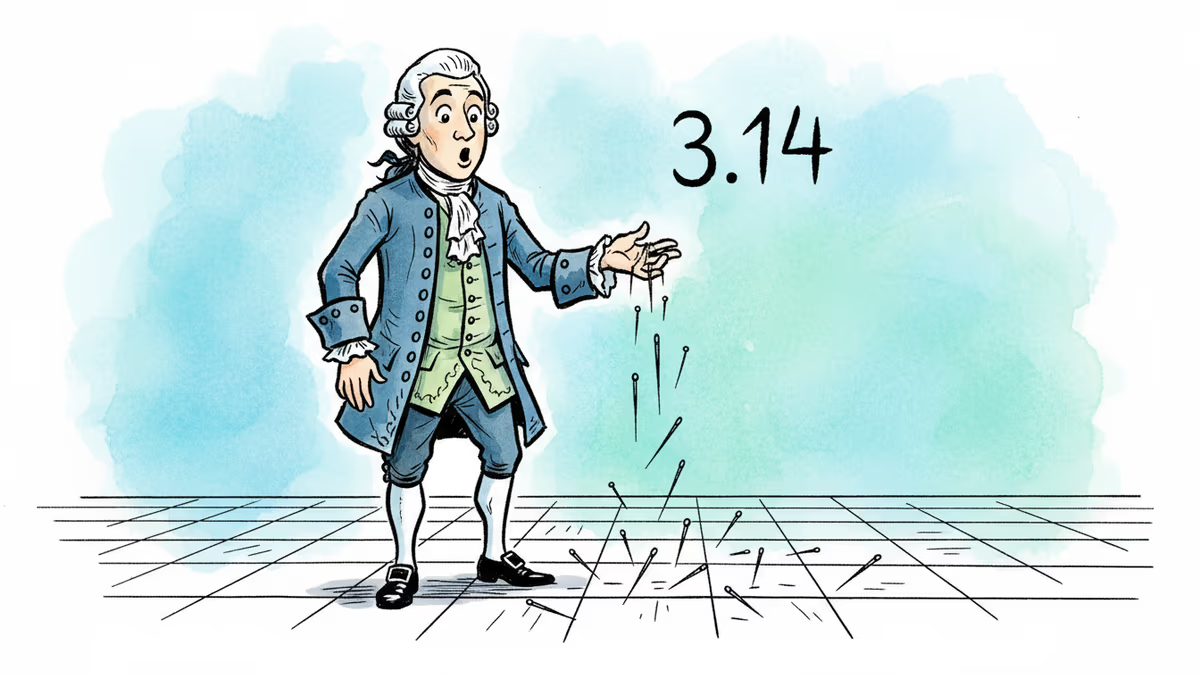
In the decades before his proof, Georges-Louis Leclerc, Comte de Buffon posed a deceptively simple geometry puzzle: take a floor with parallel lines spaced a distance d apart. Drop a needle of length L onto it. What's the probability the needle crosses a line?
To solve it, you only need to track two things about each dropped needle: the distance from its far end to the nearest line, and the angle it makes with the perpendicular. A needle crosses a line when that distance is small enough relative to the angle. Work through the geometry, set up the integral—and out falls 2/π.
That's where the circle sneaks in. The needle's angle ranges from −π/2 to +π/2, sweeping two quarter-circles. The moment a cosine function enters the calculation, π is inevitable. The floor knows nothing about circles, but the mathematics does.

The punchline: run this in reverse. Drop a large number of needles, count the crossings, divide by total throws. That ratio approximates 2/π, so you can solve for π directly. In a Python simulation of 100 needles, 66 crossed a line—yielding π ≈ 3.0303. Not precise, but not bad. Scale up to 30,000 needles and you can hit six decimal places.
From an 18th-Century Parlor to the Manhattan Project
Here's where the story accelerates.
The idea of using large numbers of random trials to approximate a hard-to-calculate value didn't get a name or a formal framework until 1946, when physicists working on the Manhattan Project needed to model the behavior of neutrons in nuclear reactions—a problem too complex for closed-form mathematics. They called the technique the Monte Carlo method, after the Monaco casino, because the whole thing runs on chance.
Today, Monte Carlo simulations are everywhere. Climate scientists use them to model atmospheric uncertainty. Pharmaceutical companies run them to predict drug interactions. Quantitative analysts use them to stress-test financial portfolios against thousands of simulated market scenarios. The AI models being trained right now rely on stochastic sampling methods that trace a direct intellectual lineage back to this approach.
Buffon's needles, then, were an 18th-century analog random-number generator—a physical Monte Carlo machine built from wood and linen, a century before anyone had a word for it.
Why This Matters Beyond the Math
There's a deeper point here that tends to get lost in Pi Day celebrations.
π keeps appearing in places that have nothing obvious to do with circles—probability distributions, quantum wave functions, the distribution of prime numbers. Each surprise appearance raises the same question: is this a coincidence of notation, or does it reveal something structural about how the universe is organized? Mathematicians have debated this for centuries without settling it.
The Monte Carlo angle matters practically, too. As computation has become cheap and abundant, the method has expanded from physics into biology, economics, and machine learning. The ability to approximate the intractable through randomness is one of the most powerful tools in modern science—and it was prefigured by a man tossing needles on his study floor while trying to answer a geometry question.
For educators, there's an argument here that rarely gets made explicitly: the most durable mathematical insights aren't the ones that solve a specific problem, but the ones that reveal an unexpected connection. Buffon wasn't trying to calculate π. He was asking about probability. The circle showed up uninvited.
Authors
Related Articles

Mathematician Anton Bernshteyn has linked descriptive set theory and computer science. His 2023 research reveals how infinite sets can be solved using algorithms.

When an OpenAI researcher claimed GPT-5 solved 10 unsolved math problems, Google DeepMind's CEO called it 'embarrassing.' Here's the real story behind the AI hype and what it means for actual progress.

Samsung Electronics' union branch revealed that 84% of survey respondents oppose the government's roughly $290 billion (₩400 trillion) semiconductor megaproject in Gwangju. Government, management, the union and shareholders are all reading the same national project in sharply different ways.

Nvidia shipped roughly a billion RISC-V cores in 2024, then announced it would run CUDA on the open standard. We break down how royalty-free instruction sets and open software stacks are trying to route around CUDA's lock-in. Part 2 of the Semiconductor Sovereignty series.
Mathematician Anton Bernshteyn has linked descriptive set theory and computer science. His 2023 research reveals how infinite sets can be solved using algorithms.
When an OpenAI researcher claimed GPT-5 solved 10 unsolved math problems, Google DeepMind's CEO called it 'embarrassing.' Here's the real story behind the AI hype and what it means for actual progress.
Samsung Electronics' union branch revealed that 84% of survey respondents oppose the government's roughly $290 billion (₩400 trillion) semiconductor megaproject in Gwangju. Government, management, the union and shareholders are all reading the same national project in sharply different ways.
Nvidia shipped roughly a billion RISC-V cores in 2024, then announced it would run CUDA on the open standard. We break down how royalty-free instruction sets and open software stacks are trying to route around CUDA's lock-in. Part 2 of the Semiconductor Sovereignty series.
Thoughts
Share your thoughts on this article
Sign in to join the conversation