
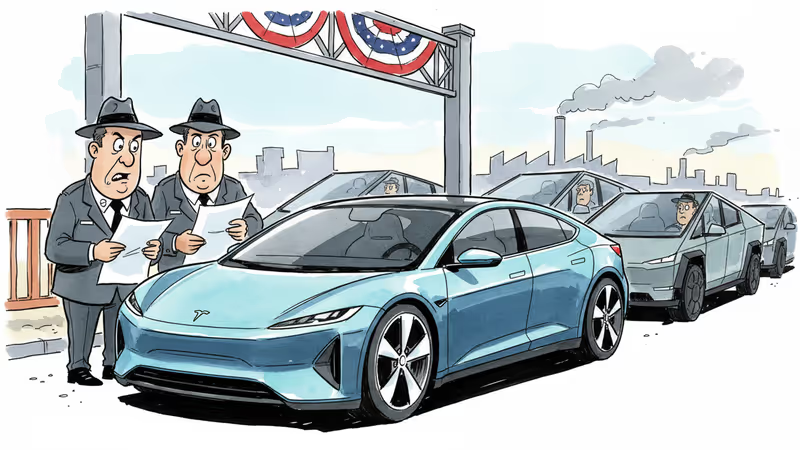
Chinese EVs Could Hit US Roads Tomorrow - But Will They?
A test drive of the Zeekr 7X reveals Chinese EVs are competitive with Tesla, priced $7,000 cheaper. What's stopping them from entering the US market?
A $32,000 electric crossover that rivals the Tesla Model Y in performance, comfort, and features. That's what Chinese automaker Zeekr is selling in Europe right now - for $7,000 less than Musk's bestseller.
The Zeekr 7X isn't just competitive; it's a wake-up call. After a brief test drive, automotive journalists are reaching the same conclusion: Chinese EVs have arrived at a level where they could be sold in America tomorrow. The compact battery-electric crossover delivers everything US consumers expect - five seats, impressive road grip, energetic performance, and a smooth ride that matches or exceeds established players.
The Readiness Gap
Zeekr, owned by Chinese automotive giant Geely, represents the new wave of Chinese EV manufacturers who've moved beyond copying Western designs to creating genuinely competitive products. The 7X is already a bestseller in Europe, proving that Western consumers will embrace Chinese automotive technology when given the choice.
But here's the puzzle: if Chinese EVs are technically ready for the US market, why aren't they here? The answer lies not in engineering capabilities but in a complex web of trade policies, political tensions, and market access barriers that have little to do with product quality.

Geely appears best positioned among Chinese automakers to potentially break through first, given its existing global presence through brands like Volvo and Polestar. The company has demonstrated it can navigate Western regulatory requirements and consumer preferences - skills that pure-play Chinese brands are still developing.
The $7,000 Question
The price differential reveals the real disruption potential. At $32,000, the Zeekr 7X undercuts the Model Y significantly while offering comparable features. This isn't about cutting corners - it's about manufacturing scale, supply chain integration, and government support that Chinese automakers enjoy.
For American consumers, this represents a missed opportunity. Lower prices could accelerate EV adoption, helping the US meet climate goals faster. For American automakers, it represents an existential challenge they're currently shielded from by trade barriers rather than competitive advantages.
The European market serves as a preview of what could happen in the US. Chinese EV brands are gaining market share not through aggressive dumping but by offering genuine value propositions that resonate with consumers prioritizing features, quality, and price over brand heritage.
Authors
Related Articles
Waymo's new Ojai robotaxi isn't just a vehicle upgrade. It's the company's most serious attempt yet at cracking the cost problem that has kept autonomous vehicles from scaling. Here's what's really at stake.
Mercedes-AMG's new GT 4-door coupe packs three YASA axial flux motors producing 1,153 hp and 1,475 lb-ft of torque. Here's what it means for the EV performance race—and who actually wins.
Auto China 2026 set records with 1,451 vehicles and 181 world premieres. But the real story isn't the size—it's how Chinese automakers stopped competing on price and started competing on brains.

Expiring leases will flood the US used car market with over a million electric vehicles by 2028. Could this do what subsidies couldn't — make EVs genuinely affordable?
Waymo's new Ojai robotaxi isn't just a vehicle upgrade. It's the company's most serious attempt yet at cracking the cost problem that has kept autonomous vehicles from scaling. Here's what's really at stake.
Mercedes-AMG's new GT 4-door coupe packs three YASA axial flux motors producing 1,153 hp and 1,475 lb-ft of torque. Here's what it means for the EV performance race—and who actually wins.
Auto China 2026 set records with 1,451 vehicles and 181 world premieres. But the real story isn't the size—it's how Chinese automakers stopped competing on price and started competing on brains.
Expiring leases will flood the US used car market with over a million electric vehicles by 2028. Could this do what subsidies couldn't — make EVs genuinely affordable?
Thoughts
Share your thoughts on this article
Sign in to join the conversation