
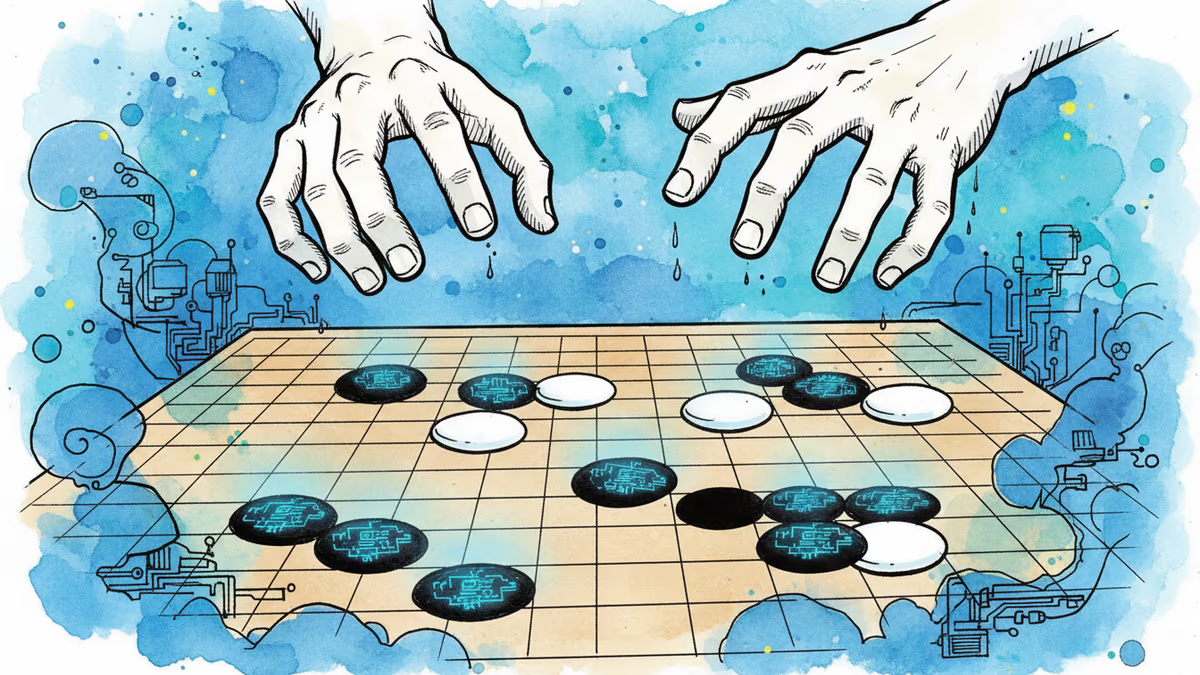
AI Rewired the Ancient Game of Go—And Human Creativity
Ten years after AlphaGo's victory, AI has fundamentally transformed how the world's best Go players think, train, and compete. But has it killed creativity or unlocked new forms of human potential?
4,364 years. That's how long humans had been perfecting the game of Go before AlphaGo shattered everything they thought they knew. Ten years after Google DeepMind's AI defeated Lee Sedol, the reverberations are still reshaping how the world's best players think.
When Ancient Wisdom Became Obsolete
The transformation wasn't gradual—it was seismic. Overnight, centuries-old principles about optimal moves were overturned. Players who had spent decades mastering traditional patterns suddenly found themselves studying an alien intelligence that played moves no human would ever consider.
Lee Sedol, the legendary Korean player who faced AlphaGo in that historic 2016 match, recently reflected on the shift: "We thought we understood Go. We were wrong." The AI didn't just win 4-1—it introduced entirely new concepts that human players are still trying to decode.
Today, it's essentially impossible to compete professionally without AI assistance. The top players spend hours analyzing AI-generated moves, even when the machine's reasoning remains mysterious to them.
The Democratization of Excellence
One unexpected beneficiary of the AI revolution? Female players. Traditionally, Go was dominated by male professionals who had access to exclusive training environments and mentorship networks. AI changed that equation.
According to the Korean Baduk Association, female professional players' win rates have improved by 12% over the past five years, compared to just 3% for their male counterparts. The reason is clear: AI doesn't discriminate. It provides world-class training to anyone with a computer.
Choi Jung, a 9-dan professional, explains: "AI democratized access to top-level training. You no longer need to be in the right place with the right connections. The best teacher in the world is available 24/7."
The Creativity Debate

But not everyone celebrates this transformation. Critics argue that AI has homogenized the game, draining it of the individual creativity that once defined great players.
Ichiriki Ryo from the Japan Go Association voices a common concern: "When everyone studies the same AI moves, everyone starts playing similarly. We're losing the unique styles that made players like Takemiya or Kobayashi legendary."
The numbers support this worry. Analysis shows that 70% of opening moves in recent professional games match AI-preferred sequences—a stark contrast to the diverse approaches of pre-AI era.
The Human Element Persists
Yet younger players push back against the creativity-is-dead narrative. Shin Jinseo, currently ranked world number one, argues that AI has actually expanded creative possibilities: "AI showed us the game is deeper than we imagined. Within that expanded space, human creativity still matters enormously."
The viewing public seems to agree. Paradoxically, Go viewership has surged since AI's dominance became clear. In China, Go broadcast ratings have increased 40% over the past three years. AI commentary helps casual viewers understand the sophisticated battles unfolding on the board.
The Broader Implications
Go's transformation offers a preview of what happens when AI surpasses human capability in complex cognitive tasks. Unlike chess, where AI superiority led to declining interest in human competition, Go has maintained its appeal by reframing what matters.
The question isn't whether humans can beat machines—they can't. Instead, it's about what makes human competition compelling in an age of artificial superintelligence.
Demis Hassabis, co-founder of DeepMind, observes: "AlphaGo didn't diminish human players—it revealed new dimensions of the game that humans are now exploring. That's the pattern we hope to see across other domains."
Training the Next Generation
Today's young Go prodigies grow up in a world where AI partnership is assumed. They don't see it as cheating or as a crutch—it's simply part of the game's evolution.
Kevin Ren, a 15-year-old American prodigy, represents this new generation: "I can't imagine learning Go without AI. It's like asking a musician to ignore recorded music or a painter to ignore photography. The tool changes, but the art remains."
Authors
Related Articles

Samsung and SK unveiled a chip and AI investment package worth thousands of trillions of won on June 29. The headline number swings wildly by outlet, but the real contest isn't capital — it's water and power.

Viral videos show 2026 graduates jeering executives who praise AI at commencement ceremonies. It's not just rudeness — it's a signal about who pays for technological optimism.

Filipino virtual assistants using AI to ghost-manage LinkedIn profiles for executives is now a structured industry. 30 comments a day, fake engagement rings, and a platform struggling to tell real from fabricated.
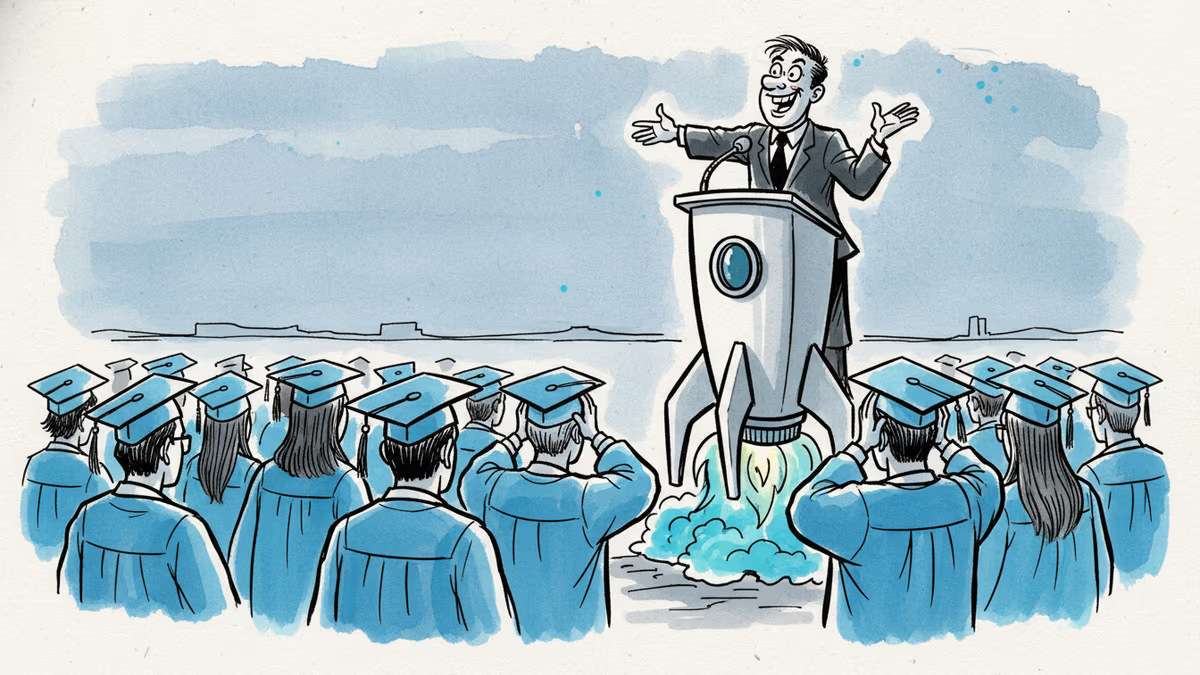
Two commencement speakers learned the hard way that AI enthusiasm doesn't land well with today's graduates. The backlash reveals a widening gap between tech optimism and Gen Z's economic reality.
Samsung and SK unveiled a chip and AI investment package worth thousands of trillions of won on June 29. The headline number swings wildly by outlet, but the real contest isn't capital — it's water and power.
Viral videos show 2026 graduates jeering executives who praise AI at commencement ceremonies. It's not just rudeness — it's a signal about who pays for technological optimism.
Filipino virtual assistants using AI to ghost-manage LinkedIn profiles for executives is now a structured industry. 30 comments a day, fake engagement rings, and a platform struggling to tell real from fabricated.
Two commencement speakers learned the hard way that AI enthusiasm doesn't land well with today's graduates. The backlash reveals a widening gap between tech optimism and Gen Z's economic reality.
Thoughts
Share your thoughts on this article
Sign in to join the conversation