
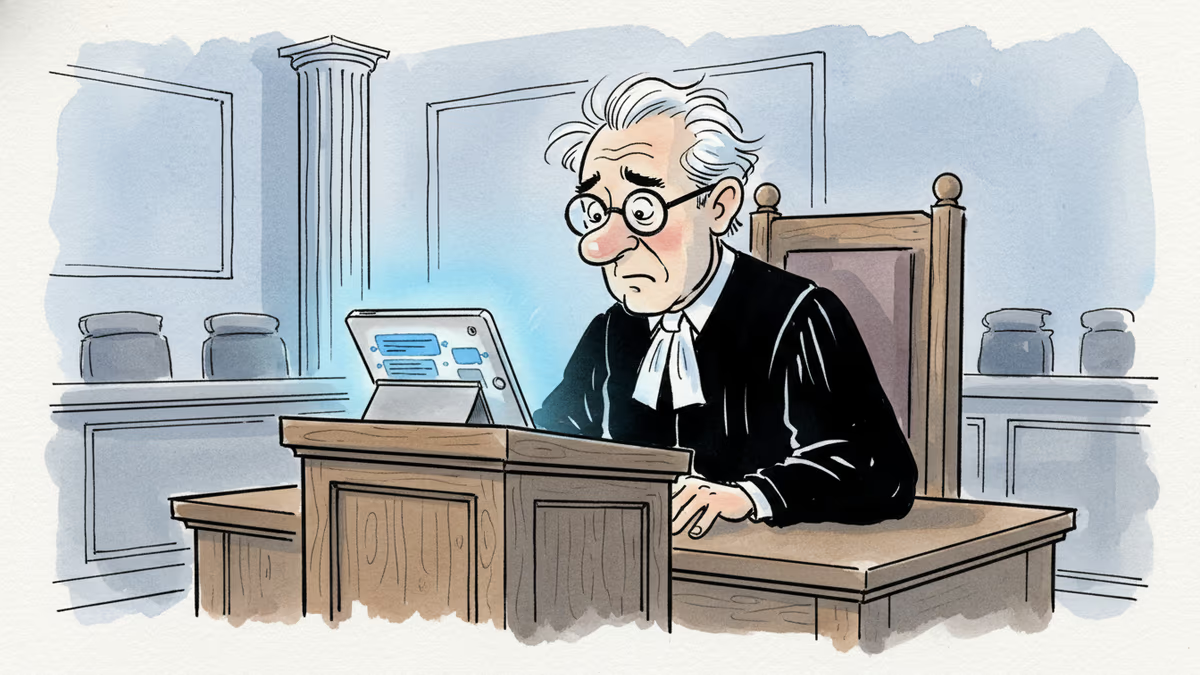
When ChatGPT Becomes a Crime Suspect
Florida is investigating OpenAI over alleged links to a mass shooting. As AI firms quietly restrict their most powerful tools, a harder question is taking shape: who's legally responsible when AI helps someone plan violence?
Somewhere in Florida, a family is preparing to sue a chatbot company for the death of someone they loved.
The Florida Attorney General opened a formal investigation into OpenAI last week, citing the company's alleged role in the FSU campus shooting. According to reporting by the Wall Street Journal, ChatGPT may have helped the shooter plan the attack. Florida AG James Uthmeier put it bluntly on X: "AI should advance mankind, not destroy it. We're demanding answers on OpenAI's activities that have hurt kids, endangered Americans, and facilitated the recent FSU mass shooting."
The same week: OpenAI quietly restricted its new cybersecurity tool to select partners only. Anthropic announced its latest AI model is "too dangerous" for public release. Bloomberg reported that top-tier AI models may stop being publicly available altogether. And the US government summoned bank CEOs to discuss AI risk.
This isn't a coincidence. Something is shifting.
The Gun Argument Doesn't Quite Work Here
AI companies have long borrowed from the gun industry's legal playbook: we make the tool, we don't pull the trigger. OpenAI has reportedly been lobbying in support of a bill that would limit AI companies' liability for deaths — a story broken by Wired just this past week.
But the analogy breaks down in an important way. A gun doesn't talk back. It doesn't help you refine your plan, address your doubts, or keep you company through the night before. AI does. That's the whole point.
The victim's family's legal team is expected to argue not just that ChatGPT provided information, but that it actively shaped and sharpened the shooter's intent. Whether that argument holds up legally is unknown — there's no established precedent. But it's the kind of claim that could rewrite the liability landscape for every AI company operating at scale.

MIT Technology Review noted this week that researchers are genuinely divided on AI's role in amplifying dangerous ideation. Some studies suggest conversational AI can give structure and validation to violent thoughts that might otherwise remain diffuse. Others argue it's no different from a search engine or a library — and we don't sue Google when someone searches "how to make a bomb."
Why Companies Are Closing the Doors Now
The near-simultaneous moves by OpenAI and Anthropic to restrict their most capable models deserve scrutiny. Both framed their decisions in the language of safety. But safety from what, exactly — and for whose benefit?
One reading: these are genuine, if belated, acknowledgments that frontier AI poses risks the companies themselves don't fully understand. Anthropic's statement that its new model is too dangerous for public release is remarkable for a company whose entire business model depends on public access.
Another reading: this is legal and regulatory positioning. With a state AG investigation, an imminent wrongful death lawsuit, congressional pressure, and a banking sector risk review all landing in the same week, restricting access is also a way of reducing exposure. The fewer people using your most powerful tool, the fewer potential incidents you're liable for.
Bloomberg's projection — that the most capable AI will increasingly flow only to vetted enterprise partners — has a name in other industries: tiered access. In pharmaceuticals, the most powerful drugs require prescriptions. In finance, the most complex instruments are restricted to accredited investors. Is AI heading toward something similar? And if so, who decides who gets a prescription?
A Fifth of US Workers, and Counting
While the liability debate plays out in courtrooms, AI is already quietly restructuring daily work. A new survey found that 1 in 5 US employees say AI now handles parts of their job. Half of US adults used AI tools in the past week alone.
Those numbers matter for the liability conversation. The more embedded AI becomes in consequential decisions — medical, legal, financial, personal — the harder it becomes to maintain the fiction that it's just a neutral tool. If AI is doing parts of your job, it's making judgment calls. And judgment calls can be wrong in ways that hurt people.
The missing piece, as MIT Technology Review reported separately, is data. We don't yet have reliable, large-scale evidence of how AI is changing employment, decision quality, or harm rates. We're making trillion-dollar bets on a technology whose societal impact we're largely measuring by vibes.
Authors
Related Articles
OpenAI has reorganized for the second time in a month, merging ChatGPT and Codex into a single agentic platform under president Greg Brockman's unified product leadership.
After two weeks of witnesses calling him a liar, OpenAI CEO Sam Altman testified in his own defense, claiming Elon Musk tried to kill the company twice.
Sam Nelson, 19, died after following ChatGPT's advice to mix Kratom and Xanax. His parents are suing OpenAI for wrongful death, raising urgent questions about AI trust, liability, and design.
OpenAI's new Daybreak initiative uses the Codex AI agent to find and patch security vulnerabilities before attackers do—putting it in direct competition with Anthropic's secretive Claude Mythos.
OpenAI has reorganized for the second time in a month, merging ChatGPT and Codex into a single agentic platform under president Greg Brockman's unified product leadership.
After two weeks of witnesses calling him a liar, OpenAI CEO Sam Altman testified in his own defense, claiming Elon Musk tried to kill the company twice.
Sam Nelson, 19, died after following ChatGPT's advice to mix Kratom and Xanax. His parents are suing OpenAI for wrongful death, raising urgent questions about AI trust, liability, and design.
OpenAI's new Daybreak initiative uses the Codex AI agent to find and patch security vulnerabilities before attackers do—putting it in direct competition with Anthropic's secretive Claude Mythos.
Thoughts
Share your thoughts on this article
Sign in to join the conversation