
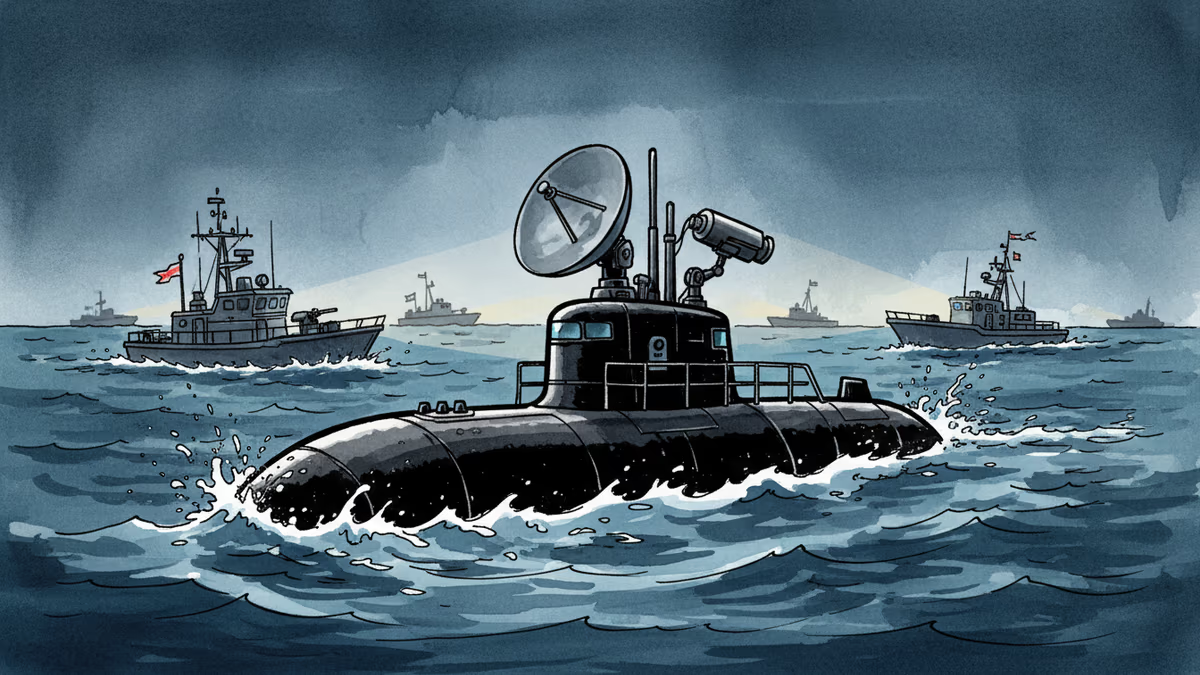
How Uncrewed Narco Subs Could Rewrite the Rules of Drug Trafficking
Colombian cartels are weaponizing Starlink and autopilot tech to create uncrewed drug submarines. Law enforcement faces an unprecedented challenge as the cat-and-mouse game enters a new phase.
3 Tons of Cocaine, Zero Human Risk
A handmade submarine slips beneath the surface off Colombia's Pacific coast, carrying $100 million worth of cocaine toward North American shores. But this isn't your typical narco sub operation. The cramped pilot compartment sits empty. Instead, a Starlink terminal, plug-and-play autopilot, and high-resolution cameras guide the vessel through 2,000 miles of open ocean.
For decades, these "narco subs" have been the workhorses of the cocaine trade—crude but effective vessels that ferry multi-ton loads while staying just below the radar. Now, off-the-shelf technology is pushing this cat-and-mouse game into uncharted territory. Uncrewed subs promise to move more drugs over longer distances without putting human smugglers at risk of capture.
Law enforcement agencies worldwide are scrambling to understand what this technological leap means for the future of drug interdiction.
The Democratization of Crime Tech
The technology powering these ghost ships isn't exotic. Maritime autopilot systems cost less than $100,000. Starlink terminals provide global internet coverage for $100 per month. High-resolution cameras and GPS systems are standard equipment on fishing vessels.
"What we're seeing is the democratization of technology that was once only available to governments and large corporations," says Mike Vigil, former DEA agent and author of Deal. "Criminal organizations are early adopters—they have to be to survive."
The implications extend far beyond drug trafficking. These same technologies could revolutionize human smuggling, arms trafficking, and even terrorism. A vessel that can cross international waters without human intervention fundamentally changes the risk-reward calculation for transnational crime.
Law Enforcement's New Headache

Traditional drug interdiction relies heavily on human intelligence. Agents track smugglers' behavior patterns, intercept communications, and flip cooperators. But uncrewed subs eliminate the human element that makes detection possible.
"When you intercept a traditional narco sub, you've got pilots who can be interrogated, communications equipment that can be analyzed, and a clear chain of evidence," explains a U.S. Coast Guard official who requested anonymity. "With an uncrewed vessel, you've got a robot filled with drugs and no clear way to trace it back to its operators."
The legal challenges are equally complex. How do you prosecute someone for operating an uncrewed vessel in international waters? What evidence standards apply when there's no human operator to arrest? These questions are forcing courts to grapple with crimes that didn't exist a decade ago.
The AI Arms Race at Sea
But law enforcement isn't standing still. Agencies are deploying their own technological countermeasures: AI-powered maritime surveillance systems, satellite data analysis, and underwater drones for tracking suspicious vessels.
Companies like Palantir are working with government agencies to develop systems that analyze maritime traffic patterns and flag anomalous behavior. By combining satellite imagery, radar data, and shipping manifests, these systems can identify "dark vessels" that don't match normal commercial traffic.
The challenge is scale. The ocean is vast, and these submarines are small. More importantly, it's an asymmetric battle. While law enforcement agencies must navigate bureaucracy, budgets, and international law, criminal organizations can pivot quickly to new technologies and tactics.
Beyond the Cartels
The implications reach far beyond Colombian drug traffickers. State actors are watching closely. Iran has already demonstrated sophisticated underwater drone capabilities. North Korea has a history of submarine-based smuggling operations. The technology that enables uncrewed narco subs could easily be adapted for espionage, sanctions evasion, or worse.
"We're not just talking about drug interdiction anymore," warns Sarah Thompson, a maritime security expert at the Center for Strategic and International Studies. "This is about the fundamental challenge of policing ungoverned spaces in an age of autonomous systems."
Authors
Related Articles
South Korean police accidentally revealed recovery phrases in a press release photo, leading to the theft of seized cryptocurrency assets worth $5.6 million. A costly lesson in digital evidence handling.
International law enforcement dismantled Lumma Stealer in May, but it's back at scale, infecting 395,000 Windows PCs. Why are cybercrime takedowns so temporary?

California restricts federal law enforcement from wearing masks during operations, sparking a nationwide debate over accountability versus security. Will other states follow?

Five stories from late September, traced to where the paper trail stops: Korea's export record, Nvidia's Hugging Face 8-K, a US-China AI channel, the UN on AI, and rising births.
South Korean police accidentally revealed recovery phrases in a press release photo, leading to the theft of seized cryptocurrency assets worth $5.6 million. A costly lesson in digital evidence handling.
International law enforcement dismantled Lumma Stealer in May, but it's back at scale, infecting 395,000 Windows PCs. Why are cybercrime takedowns so temporary?
California restricts federal law enforcement from wearing masks during operations, sparking a nationwide debate over accountability versus security. Will other states follow?
Five stories from late September, traced to where the paper trail stops: Korea's export record, Nvidia's Hugging Face 8-K, a US-China AI channel, the UN on AI, and rising births.
Thoughts
Share your thoughts on this article
Sign in to join the conversation