
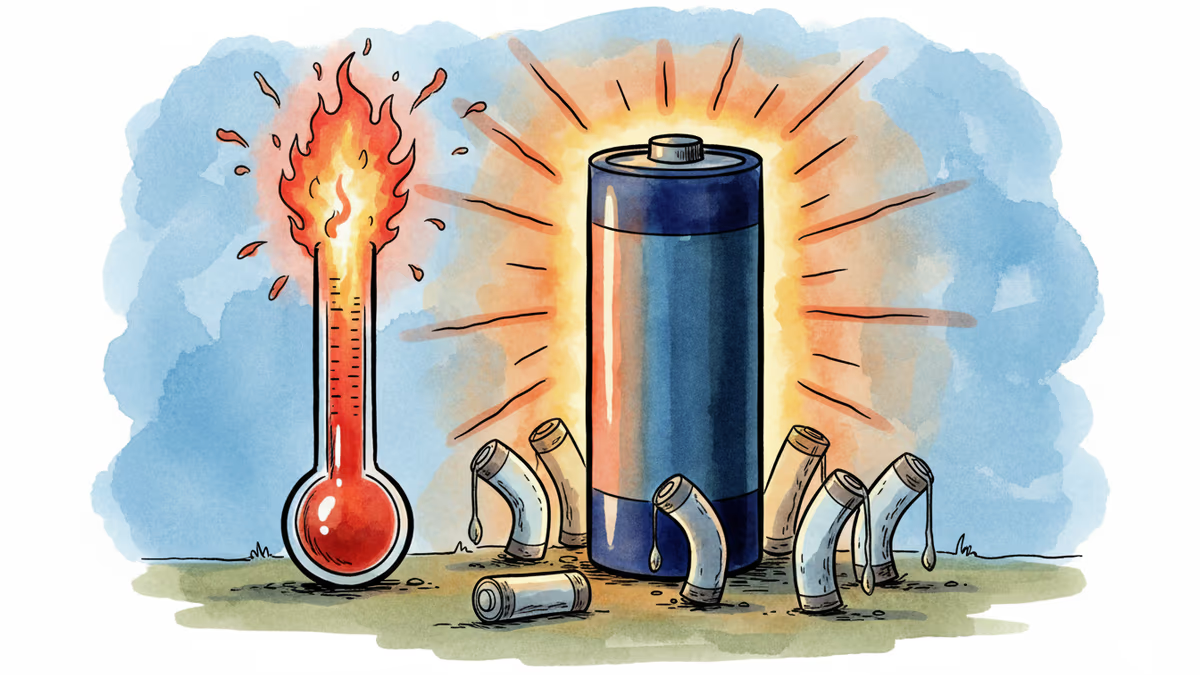
This Battery Gets Stronger at 212°F—Here's Why That Matters
Finnish startup Donut Lab's solid-state battery actually gains capacity at extreme heat, challenging everything we know about EV battery performance in hot climates.
When 212°F Makes Batteries Stronger
Everything you know about battery performance just got flipped upside down. While conventional lithium-ion batteries start degrading around 95°F, Finnish startup Donut Lab just proved their solid-state battery doesn't just survive at 212°F—it actually gets better.
The test, conducted by Finland's state-owned VTT Technical Research Centre, showed Donut Lab's cells not only discharged energy normally at boiling point temperatures but actually gained capacity. This follows last week's fast-charging validation, building a compelling case for a technology that could reshape how we think about EV thermal management.
The $50 Billion Cooling Problem
This isn't just a lab curiosity—it strikes at the heart of a massive industry challenge. Automakers spend billions on battery cooling systems because heat is lithium-ion's kryptonite. Tesla uses a complex liquid cooling loop. Ford employs phase-change materials. GM has invested heavily in thermal management software.
All because traditional EV batteries start losing performance above 95°F and can become dangerous above 140°F. In Phoenix summers or Middle Eastern heat, EVs often can't deliver their promised range.
Donut Lab's breakthrough could eliminate this entire problem. No more complex cooling systems. No more range anxiety in hot climates. No more limiting EV adoption in tropical markets.
Industry Giants vs. Garage Innovators
The timing creates an interesting dynamic. While Toyota, Samsung, and QuantumScape have poured billions into solid-state development, a relatively unknown Finnish startup might be leapfrogging them all.

QuantumScape, once valued at $50 billion, has struggled with manufacturing challenges. Toyota keeps pushing back its solid-state timeline. Meanwhile, Donut Lab is quietly racking up impressive test results with what appears to be a fundamentally different approach.
This reflects a broader shift in battery innovation. The next breakthrough might not come from the usual suspects but from startups willing to challenge fundamental assumptions about how batteries should work.
The Skeptic's View
Of course, lab results and real-world performance are different beasts. Critics point out several unknowns:
- Cycle life: How many charge-discharge cycles can these cells handle?
- Manufacturing scale: Can this technology move beyond small lab samples?
- Cost structure: Solid-state batteries typically cost 3-5x more than lithium-ion
- Cold weather performance: 212°F is impressive, but what about -4°F?
Battery veteran Venkat Viswanathan from Carnegie Mellon notes: "We've seen many promising lab results that couldn't scale. The real test is consistent performance across thousands of cycles and temperature ranges."
What This Means for Consumers
If Donut Lab can solve the manufacturing puzzle, the implications are significant:
For EV buyers: Cars that perform consistently from Alaska to Arizona, with simpler, potentially cheaper thermal systems.
For automakers: Redesigned battery packs, reduced cooling costs, and access to previously challenging markets.
For investors: A potential reshuffling of the battery supply chain, with new winners and losers emerging.
Authors
Related Articles

Finnish startup Donut Lab has cleared its biggest credibility hurdle: independent testing by state-owned VTT confirms its solid-state battery is the real thing. What does this mean for the race to commercialize next-gen batteries?
Rivian targets 20,000 R2 SUV sales in six months, matching Tesla Model Y's pace. But can it succeed without federal tax credits in a challenging EV market?
Donut Lab claims breakthrough solid-state battery tech with 5-minute charging and 400Wh/kg density. Experts are skeptical. Could this unknown startup really leapfrog industry giants?
Sodium-ion batteries emerge as cheaper, safer alternatives to lithium, entering EVs and grid storage. MIT Technology Review names it a 2026 breakthrough technology.
Finnish startup Donut Lab has cleared its biggest credibility hurdle: independent testing by state-owned VTT confirms its solid-state battery is the real thing. What does this mean for the race to commercialize next-gen batteries?
Rivian targets 20,000 R2 SUV sales in six months, matching Tesla Model Y's pace. But can it succeed without federal tax credits in a challenging EV market?
Donut Lab claims breakthrough solid-state battery tech with 5-minute charging and 400Wh/kg density. Experts are skeptical. Could this unknown startup really leapfrog industry giants?
Sodium-ion batteries emerge as cheaper, safer alternatives to lithium, entering EVs and grid storage. MIT Technology Review names it a 2026 breakthrough technology.
Thoughts
Share your thoughts on this article
Sign in to join the conversation