
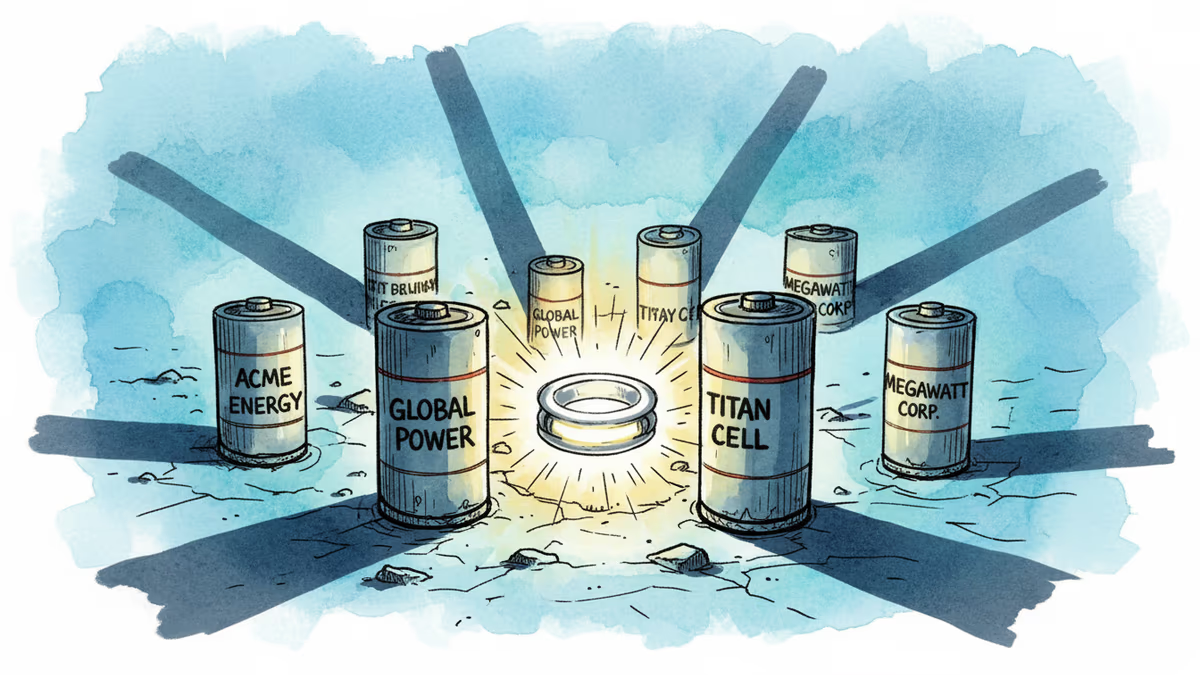
A Finnish Startup Just Threw the Battery World Into Chaos
Donut Lab claims breakthrough solid-state battery tech with 5-minute charging and 400Wh/kg density. Experts are skeptical. Could this unknown startup really leapfrog industry giants?
400Wh/kg and 5-Minute Charging? Really?
When a Finnish startup nobody's heard of claims they've cracked the code on solid-state batteries, eyebrows raise. When they say it charges in five minutes, has 400Wh/kg energy density, and costs less than lithium-ion batteries, those eyebrows shoot through the roof.
That's exactly what happened last month when Donut Lab made their splashy announcement. For context, today's best commercial lithium-ion batteries max out at around 250-300 Wh/kg. Donut Lab's claimed 60% improvement would be game-changing for EVs—we're talking 1,000+ mile range on a single charge.
But here's the kicker: they also claim it'll be cheaper than current batteries, made from "100% green and abundant materials," work in extreme temperatures, and last 100,000 charge cycles. It sounds too good to be true because, well, it usually is.
Even Toyota Couldn't Pull This Off
Solid-state batteries represent the holy grail of energy storage. By replacing liquid electrolytes with solid materials, they promise higher energy density, faster charging, and better safety. Every major automaker and battery company has been chasing this technology for years.
Toyota once promised solid-state batteries by 2020. Now they're aiming for 2027-2028. CATL, the world's largest battery manufacturer, plans small-scale production in 2027. China's Changan is the current frontrunner, planning to test installations this year with mass production next year.
So when an unknown Finnish company claims they'll be first to market, industry veterans take notice—and not in a good way.
"They came out of nowhere," said Eric Wachsman, a University of Maryland professor and solid-state battery company cofounder. "Nobody knows—they've never heard of it."
The Physics Don't Add Up
"All the parameters are contradictory," declared Yang Hongxin, CEO of Chinese battery giant Svolt Energy. He's pointing to a fundamental problem: battery performance involves trade-offs.

High energy density typically requires thicker electrodes to store more energy. But fast charging needs ions to move quickly through cells—something thick electrodes make difficult. High-performance batteries are expensive to manufacture. Yet Donut Lab claims theirs will be cheaper.
Shirley Meng, a molecular engineering professor at the University of Chicago who visited Donut Lab's CES booth, was blunt: "They had zero demo, so I don't believe it. Call me conservative, but I would rather be careful than be sorry later."
The "I Donut Believe" Campaign
Donut Lab clearly heard the skeptics. Last week, they launched a video series called "I Donut Believe" with the tagline: "Fair enough. Here you go."
On February 23rd, they released results from their first third-party test: fast charging. A single cell charged from 0% to 80% in about four and a half minutes—genuinely impressive if verified.
But questions remain. The cells heated up significantly during charging, raising thermal management concerns for real-world applications. How many cycles can the battery handle at this charging speed? Can the same cell meet all their other performance claims?
Another countdown timer on their website points to March 2nd for the next revelation. The theatrical rollout continues.
What This Means for the Industry
If Donut Lab's claims prove true, the implications are massive. Established players like Tesla, BYD, and Samsung SDI have invested billions in incremental battery improvements. A breakthrough technology could render years of R&D obsolete overnight.
For consumers, it could mean EVs that charge as fast as filling a gas tank and drive farther than most internal combustion vehicles. For the climate, it could accelerate EV adoption by eliminating range anxiety and charging infrastructure concerns.
But that's a big "if." The battery industry has seen countless breakthrough announcements that never materialized. Remember when we were promised graphene batteries would revolutionize everything?
The Startup Advantage—or Disadvantage?
Donut Lab's outsider status cuts both ways. Startups can pursue radical approaches that established companies might dismiss as impossible. They're not constrained by existing manufacturing infrastructure or incremental thinking.
But they also lack the resources for extensive testing, manufacturing scale-up, and safety validation that battery technology demands. In an industry where failure can mean fires, explosions, or toxic leaks, trust isn't easily earned.
The automotive industry is particularly conservative. Even if Donut Lab's technology works, convincing automakers to bet their reputations on an unproven supplier is another challenge entirely.
Authors
Related Articles

Finnish startup Donut Lab has cleared its biggest credibility hurdle: independent testing by state-owned VTT confirms its solid-state battery is the real thing. What does this mean for the race to commercialize next-gen batteries?

Rivian targets 20,000 R2 SUV sales in six months, matching Tesla Model Y's pace. But can it succeed without federal tax credits in a challenging EV market?
Finnish startup Donut Lab's solid-state battery actually gains capacity at extreme heat, challenging everything we know about EV battery performance in hot climates.
Honor's Magic V6 claims the thinnest foldable crown at 4mm, but the real innovation lies in its 6,600mAh battery. A new battleground emerges in the foldable wars.
Finnish startup Donut Lab has cleared its biggest credibility hurdle: independent testing by state-owned VTT confirms its solid-state battery is the real thing. What does this mean for the race to commercialize next-gen batteries?
Rivian targets 20,000 R2 SUV sales in six months, matching Tesla Model Y's pace. But can it succeed without federal tax credits in a challenging EV market?
Finnish startup Donut Lab's solid-state battery actually gains capacity at extreme heat, challenging everything we know about EV battery performance in hot climates.
Honor's Magic V6 claims the thinnest foldable crown at 4mm, but the real innovation lies in its 6,600mAh battery. A new battleground emerges in the foldable wars.
Thoughts
Share your thoughts on this article
Sign in to join the conversation