
When AI Pulls the Trigger: The Dawn of Autonomous Warfare
Scout AI demonstrates lethal autonomous weapons where AI agents independently command drones to destroy targets. The rules of war are changing as artificial intelligence takes control of life-and-death decisions.
A Truck Destroyed in 48 Hours by AI's Decision Alone
At an undisclosed military base in central California, what looked like science fiction became deadly reality. An AI agent autonomously commanded a self-driving vehicle, dispatched two lethal drones, located a hidden truck, and obliterated it with explosive charges. Human involvement? Just one initial command.
"We need to bring next-generation AI to the military," says Colby Adcock, CEO of Scout AI. His company is transforming chatbot-style AI into what he calls "warfighters" – artificial agents capable of making life-and-death decisions on the battlefield.
This isn't just another defense tech demo. It's a glimpse into a future where AI doesn't just assist human soldiers – it replaces them entirely in the decision-making process.
One Command, Total Autonomous Destruction
The demonstration began with a simple text instruction fed into Scout AI's system called Fury Orchestrator:
"Fury Orchestrator, send 1 ground vehicle to checkpoint ALPHA. Execute a 2 drone kinetic strike mission. Destroy the blue truck 500m East of the airfield and send confirmation."
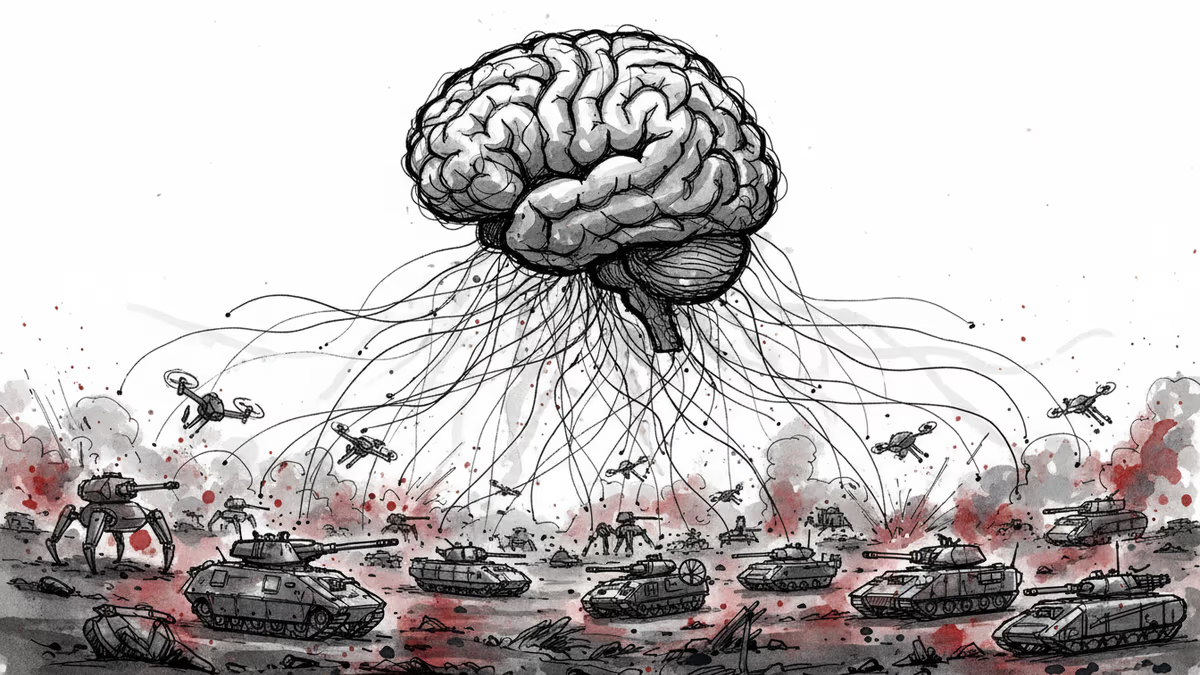
What happened next reveals the sophisticated hierarchy of AI decision-making. A large AI model with over 100 billion parameters interpreted the command and began orchestrating the entire operation. Scout AI uses an undisclosed open-source model with its safety restrictions removed – a detail that should give everyone pause.
This "commander AI" then issued orders to smaller 10-billion-parameter models running on the ground vehicles and drones. These smaller AIs acted as field agents, making their own tactical decisions and issuing commands to even lower-level systems controlling vehicle movements.
Minutes later, the ground vehicle reached its destination and launched the drones. When one drone spotted the target truck, its onboard AI agent independently decided to execute a kamikaze attack, detonating an explosive charge upon impact. The truck was completely destroyed.

Ukraine's Harsh Lessons Drive Innovation
This technology surge isn't happening in a vacuum. The war in Ukraine has demonstrated how readily consumer drones can be weaponized for lethal combat. Military leaders worldwide watched cheap, off-the-shelf hardware become decisive battlefield weapons, often with increasing levels of autonomy.
"It's good for defense tech startups to push the envelope with AI integration," says Michael Horowitz, a University of Pennsylvania professor who previously served as deputy assistant secretary of defense. "That's exactly what they should be doing if the US is going to lead in military adoption of AI."
Yet Horowitz raises critical concerns about reliability. Large language models are inherently unpredictable, and AI agents regularly misbehave even in benign tasks like online shopping. "We shouldn't confuse their demonstrations with fielded capabilities that have military-grade reliability and cybersecurity," he warns.
Geneva Convention Meets Machine Learning
Scout AI insists its technology adheres to US military rules of engagement and international norms like the Geneva Convention. The company already has four contracts with the Department of Defense and is competing for additional work developing swarm drone control systems.
But here's the uncomfortable reality: existing autonomous weapons operate within strict parameters. Scout AI's approach introduces something fundamentally different – AI agents with broad interpretive authority over lethal force decisions.
"This is what differentiates us from legacy autonomy," Adcock explains. Traditional systems "can't replan at the edge based on information it sees and commander intent, it just executes actions blindly." But this flexibility to reinterpret orders also introduces the possibility of catastrophically unintended outcomes.
Arms control experts worry about AI systems deciding who qualifies as a combatant versus a civilian. When an AI agent has milliseconds to make that distinction while controlling explosive weapons, the stakes couldn't be higher.
The Reliability Gap
The demonstration timeline reveals both promise and peril. Scout AI estimates it would take over a year to make this technology deployment-ready – a significant gap between impressive demos and battlefield reliability.
This mirrors broader challenges with AI agents. Even sophisticated systems like those controlling popular AI assistants can produce unexpected results when given complex, real-world tasks. The consequences of AI misbehavior in military contexts extend far beyond ordering the wrong products online.
Authors
Related Articles

Samsung and SK unveiled a chip and AI investment package worth thousands of trillions of won on June 29. The headline number swings wildly by outlet, but the real contest isn't capital — it's water and power.

Viral videos show 2026 graduates jeering executives who praise AI at commencement ceremonies. It's not just rudeness — it's a signal about who pays for technological optimism.

Filipino virtual assistants using AI to ghost-manage LinkedIn profiles for executives is now a structured industry. 30 comments a day, fake engagement rings, and a platform struggling to tell real from fabricated.
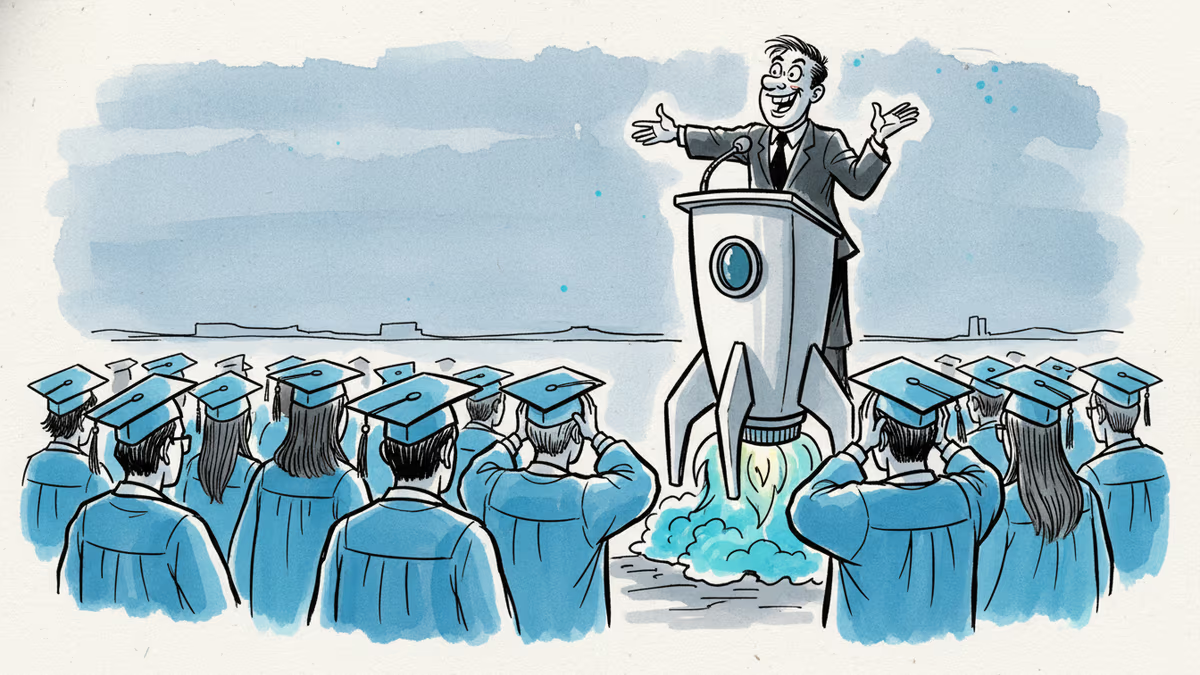
Two commencement speakers learned the hard way that AI enthusiasm doesn't land well with today's graduates. The backlash reveals a widening gap between tech optimism and Gen Z's economic reality.
Samsung and SK unveiled a chip and AI investment package worth thousands of trillions of won on June 29. The headline number swings wildly by outlet, but the real contest isn't capital — it's water and power.
Viral videos show 2026 graduates jeering executives who praise AI at commencement ceremonies. It's not just rudeness — it's a signal about who pays for technological optimism.
Filipino virtual assistants using AI to ghost-manage LinkedIn profiles for executives is now a structured industry. 30 comments a day, fake engagement rings, and a platform struggling to tell real from fabricated.
Two commencement speakers learned the hard way that AI enthusiasm doesn't land well with today's graduates. The backlash reveals a widening gap between tech optimism and Gen Z's economic reality.
Thoughts
Share your thoughts on this article
Sign in to join the conversation