
60,000 AI Songs Per Day: Deezer's Battle Against Musical Fraud
Deezer opens AI music detection tool to other platforms as 85% of AI-generated tracks prove fraudulent. Daily uploads surge from 20,000 to 60,000 tracks.
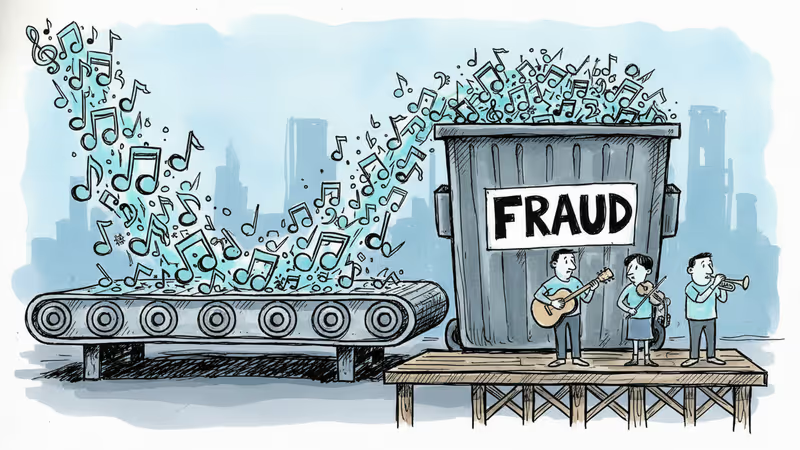
60,000 tracks. That's how many AI-generated songs Deezer receives every single day. The more startling reality? 85% of them are fraudulent streams designed to game the system and steal royalties from real artists.
The French streaming service, which introduced AI detection technology last year, announced Thursday it's making this tool available to other platforms. It's a move that signals the music industry's growing alarm over AI-generated content flooding streaming ecosystems and manipulating revenue streams.
The Explosion of Artificial Music
The numbers tell a dramatic story of exponential growth. Just last June, fully AI-generated music represented 18% of daily uploads to Deezer, totaling around 20,000 tracks. In less than a year, that figure has tripled. The platform has now detected 13.4 million AI-generated songs in total.
Deezer's detection system claims 99.8% accuracy in identifying tracks from major generative models like Suno and Udio. Once flagged, these tracks face a triple penalty: removal from algorithmic recommendations, demonetization, and exclusion from royalty pools that compensate legitimate musicians and songwriters.
The tool has already attracted "great interest" from industry players, according to CEO Alexis Lanternier. Sacem, the French rights management organization representing over 300,000 creators including David Guetta and DJ Snake, has successfully tested the technology.
When AI Meets Criminal Intent

This isn't just about technological disruption—it's about outright fraud. In 2024, a North Carolina musician faced federal charges for creating AI-generated songs and using bots to stream them billions of times, allegedly stealing over $10 million in streaming royalties. Meanwhile, AI bands like The Velvet Sundown have accumulated millions of legitimate streams, blurring the lines between fraud and innovation.
Different platforms are responding with varying degrees of aggression. Bandcamp has banned AI-generated music entirely, while Spotify updated its policies to explicitly prohibit unauthorized voice clones. The contrast is stark: some platforms are building walls, others are trying to manage the flood.
The Industry's Split Personality
Perhaps most intriguingly, major record labels appear to be embracing what streaming platforms are fighting. Universal Music Group and Warner Music Group recently settled lawsuits with Suno and Udio, striking licensing deals that ensure artists and songwriters receive compensation when their work trains AI models.
This creates a fascinating paradox: the same industry simultaneously licensing its catalogs for AI training while developing tools to detect and remove AI-generated content. It suggests a future where AI music might be acceptable if properly licensed and attributed, but fraudulent if created without permission or compensation.
The Broader Implications
Beyond fraud prevention, Deezer's move raises fundamental questions about the music ecosystem. If AI can generate 60,000 tracks daily from a single source, what happens to discovery algorithms designed for human-paced creation? How do streaming platforms maintain the balance between technological innovation and protecting human creativity?
The company's decision to share its detection technology could establish a new industry standard, similar to how email providers share spam detection methods. But it also highlights a troubling reality: the music industry may need technological arms races just to maintain basic integrity.
Deezer became the first streaming platform to sign a global statement on AI training in 2024, joining actors like Kate McKinnon and Kevin Bacon in advocating for creator protection. This latest move extends that philosophy into practical action.
Authors
Related Articles
From a niche experiment in 2018 to a mainstream disruption in 2026, AI-generated music is forcing the industry to rethink creativity, copyright, and compensation.

Apple Music introduces optional AI transparency tags for music content, sparking debate about self-regulation versus detection in the streaming era.
Czech figure skaters used AI-generated music at Olympics, sparking debate about creativity, authenticity, and the future of artistic expression in competitive sports.
Samsung Electronics' union branch revealed that 84% of survey respondents oppose the government's roughly $290 billion (₩400 trillion) semiconductor megaproject in Gwangju. Government, management, the union and shareholders are all reading the same national project in sharply different ways.
From a niche experiment in 2018 to a mainstream disruption in 2026, AI-generated music is forcing the industry to rethink creativity, copyright, and compensation.
Apple Music introduces optional AI transparency tags for music content, sparking debate about self-regulation versus detection in the streaming era.
Czech figure skaters used AI-generated music at Olympics, sparking debate about creativity, authenticity, and the future of artistic expression in competitive sports.
Samsung Electronics' union branch revealed that 84% of survey respondents oppose the government's roughly $290 billion (₩400 trillion) semiconductor megaproject in Gwangju. Government, management, the union and shareholders are all reading the same national project in sharply different ways.
Thoughts
Share your thoughts on this article
Sign in to join the conversation