
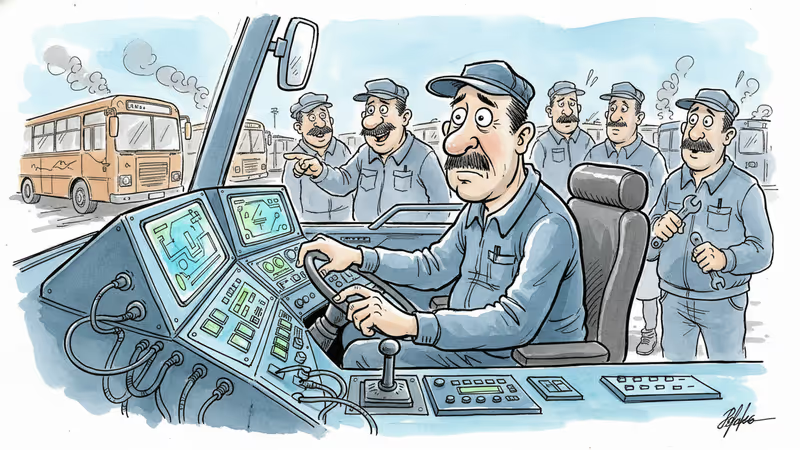
India's Electric Bus Accidents Surge: It's Not the Tech, It's the Training
Electric buses in India's major cities caused multiple fatal accidents, but technology isn't to blame. Driver training gaps reveal deeper systemic issues in rapid EV adoption.
In Bengaluru, electric buses caused 18 accidents in 15 months, with six proving fatal. Mumbai saw 12 deaths from just two electric bus crashes between December 2024 and January 2025. The pattern extends beyond major metros—a speeding electric bus killed four in Gujarat, another crushed an auto-rickshaw in Odisha.
Yet the technology isn't failing. The drivers are.
The Real Culprit: Training, Not Tech
Driver error accounts for roughly 60% of all bus accidents—electric and conventional combined, according to Pawan Mulukutla from the World Resources Institute India. Vehicle defects have been ruled out in most incidents involving electric buses.
"It's easy to blame the technology, but it's difficult to believe that six or seven manufacturers don't know how a bus should be designed," says Ravi Gadepalli, founder of Transit Intelligence. Companies like Olectra, PMI, and Solaris operate buses in China and Poland without incident. These same buses are tested and certified by the Indian government.
The numbers tell the expansion story: over 10,000 electric buses already operate across 50 Indian cities, with 20,000 more in procurement. The rapid rollout is outpacing efforts to train drivers on the distinct challenges of electric vehicles—sudden acceleration, regenerative braking, and completely different drivetrain behavior.
A Tale of Two Training Systems
The gap between diesel and electric bus operation is stark. "With electric buses, there's not a lot of exposure to the technology, exposure to the drivetrain," explains Amegh Gopinath from Innpact Solutions, who documented this in an 18-month study for the German Agency for International Cooperation.
Private contractors conduct brief interviews, check for heavy-duty vehicle licenses, and hire drivers with minimal electric bus-specific onboarding. Compare this to European and U.S. markets, where drivers undergo rigorous initial training, attend refresher courses, and have their driving behavior monitored via simulators and real-world tracking.

"There's a lot of push for defensive driving abroad—that you don't accelerate at junctions, intersections, and crossings," Gopinath notes. "But these things aren't given importance in India at this point."
The Economics of Corner-Cutting
Aggressive bidding created a race to the bottom on driver pay. BMTC-hired drivers earn ₹30,000 monthly ($328), while private operators pay around ₹22,000 ($240). Low salaries and poor working conditions drive high attrition, with drivers opting for ride-hailing services instead.
"In recent years, accidents were reported due to extended duty hours and driver fatigue," Mulukutla observes. The pressure to generate revenue adds stress to ground staff, creating a vicious cycle where safety takes a backseat to operational metrics.
State transport authorities contract private operators but do little to enforce training and safety standards. Oversight remains largely manual and inconsistent, according to Gadepalli, who helped Bengaluru Metropolitan Transport Corporation set up a digital contract management system in 2025.
Systemic Reforms on the Horizon
India's road transport ministry updated EV driver training guidelines in January 2025 to be more rigorous. Mumbai and Bengaluru governments now mandate license reviews and refresher courses for privately hired drivers.
But experts argue for a deeper philosophical shift—viewing public transport as a public service rather than a revenue-generating model. "The focus has been about revenue generation, kilometers operated, fuel savings," Gopinath explains. "If that shift happens, a lot of stress is taken off ground staff, especially drivers."
Shivanand Swamy from the Centre of Excellence in Urban Transport remains optimistic that these growing pains will subside. "This is a transition phase. Options are limited in terms of driver availability. It will settle down soon."
Global Implications
India's electric bus challenges mirror broader questions facing rapid EV adoption worldwide. Cities from London to Los Angeles are scaling electric public transport, but are they investing equally in human capital? The technology may be ready, but are the people operating it?
The contrast with established markets is telling. European cities didn't just buy electric buses—they rebuilt entire training ecosystems, updated safety protocols, and reimagined driver careers. India's experience suggests that hardware transitions require equally robust software upgrades.
Authors
Related Articles

The Department of Transportation wants Google Gemini to draft airplane, car, and pipeline safety regulations in 30 minutes. What could go wrong with AI hallucinations in safety rules?

Five stories from late September, traced to where the paper trail stops: Korea's export record, Nvidia's Hugging Face 8-K, a US-China AI channel, the UN on AI, and rising births.
Huawei's CANN is open source under a license barring software for non-Ascend chips. Inside China's second CUDA, and the two links still outside it: pre-training compute and 5nm capacity.
Samsung Electronics' union branch revealed that 84% of survey respondents oppose the government's roughly $290 billion (₩400 trillion) semiconductor megaproject in Gwangju. Government, management, the union and shareholders are all reading the same national project in sharply different ways.
The Department of Transportation wants Google Gemini to draft airplane, car, and pipeline safety regulations in 30 minutes. What could go wrong with AI hallucinations in safety rules?
Five stories from late September, traced to where the paper trail stops: Korea's export record, Nvidia's Hugging Face 8-K, a US-China AI channel, the UN on AI, and rising births.
Huawei's CANN is open source under a license barring software for non-Ascend chips. Inside China's second CUDA, and the two links still outside it: pre-training compute and 5nm capacity.
Samsung Electronics' union branch revealed that 84% of survey respondents oppose the government's roughly $290 billion (₩400 trillion) semiconductor megaproject in Gwangju. Government, management, the union and shareholders are all reading the same national project in sharply different ways.
Thoughts
1 thoughts
Share your thoughts on this article
Sign in to join the conversation