
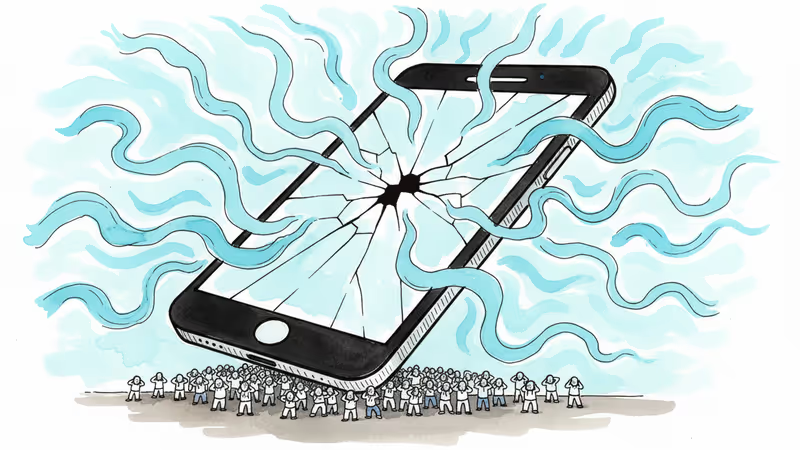
Google Kills Pixel Features After Privacy Bug Exposed Private Calls
Google disables Take a Message and Call Screen features on older Pixels after microphone bug leaked audio to callers. What this means for Android privacy.
Your phone was supposed to screen calls for you. Instead, it might have been screening your private conversations for strangers.
Google has pulled the plug on several Phone app features for Pixel 4 and Pixel 5 owners after discovering a bug that inadvertently transmitted audio from users' environments to incoming callers. The issue centered on the Take a Message feature, which was designed to automatically answer missed calls and transcribe voicemails—but ended up doing much more than advertised.
When Smart Features Get Too Smart
The problem emerged when users reported their microphones activating unexpectedly during incoming calls. Instead of simply recording voicemails, the Take a Message feature was transmitting live audio from users' surroundings directly to callers. Imagine a stranger calling your phone and suddenly hearing your private conversation, your TV show, or your family dinner discussion.
Google community manager Siri Tejaswini acknowledged the issue affects "a very small subset of Pixel 4 and 5 devices under very specific and rare circumstances." The company's response was swift but drastic: completely disabling both Take a Message and next-generation Call Screen features on affected devices.
The bug represents a fundamental breach of user expectations. When you decline a call, you assume that's the end of the interaction. The idea that your phone might continue transmitting audio to the very person you chose not to speak with turns the concept of call screening on its head.
The Trust Equation in Smart Devices

This incident highlights the delicate balance between convenience and privacy in modern smartphones. Google'sPhone app features were genuinely useful—Take a Message could handle calls when you're in meetings, while advanced Call Screen could filter out spam more effectively. But their implementation created an unexpected vulnerability.
For Android enthusiasts who chose Pixel devices partly for their cutting-edge AI features, this represents a significant step backward. These users are now left with older, less capable call management tools, essentially paying a premium for features they can no longer access.
The timing is particularly awkward for Google, which has been positioning itself as a privacy-conscious alternative to competitors. The company's recent emphasis on on-device processing and user control over data seems at odds with a bug that literally broadcasts private moments to strangers.
The Broader Implications
This isn't just about two discontinued features—it's about the fundamental challenge of AI-powered smartphone capabilities. As devices become more proactive in handling our communications, the potential for unintended consequences grows exponentially.
Consider the precedent this sets. If a relatively simple call screening feature can malfunction so dramatically, what about more complex AI systems being integrated into smartphones? Voice assistants, camera features, and messaging tools all rely on similar permissions and processing capabilities.
The incident also raises questions about quality control in software updates. How does a feature that fundamentally changes user privacy expectations ship without catching such a critical flaw? The fact that it affected multiple device generations suggests this wasn't an isolated coding error but a more systemic oversight.
Authors
Related Articles
Google's Project Zero proved Pixel modem firmware can be remotely exploited. The fix for Pixel 10? Rust. Here's why that matters—and why the rest of the industry is watching.

Google's AI-powered security systems prevented 1.75M policy-violating apps in 2025, down 26% from 2024. But malicious apps outside Play Store doubled, revealing a strategic shift by bad actors.

Time is running out for Christmas gifts. Grab last-minute tech deals including Beats Studio Pro for $149.99 (57% off), Google Pixel 10 at its lowest price ever, and more.

Samsung Electronics' union branch revealed that 84% of survey respondents oppose the government's roughly $290 billion (₩400 trillion) semiconductor megaproject in Gwangju. Government, management, the union and shareholders are all reading the same national project in sharply different ways.
Google's Project Zero proved Pixel modem firmware can be remotely exploited. The fix for Pixel 10? Rust. Here's why that matters—and why the rest of the industry is watching.
Google's AI-powered security systems prevented 1.75M policy-violating apps in 2025, down 26% from 2024. But malicious apps outside Play Store doubled, revealing a strategic shift by bad actors.
Time is running out for Christmas gifts. Grab last-minute tech deals including Beats Studio Pro for $149.99 (57% off), Google Pixel 10 at its lowest price ever, and more.
Samsung Electronics' union branch revealed that 84% of survey respondents oppose the government's roughly $290 billion (₩400 trillion) semiconductor megaproject in Gwangju. Government, management, the union and shareholders are all reading the same national project in sharply different ways.
Thoughts
Share your thoughts on this article
Sign in to join the conversation