
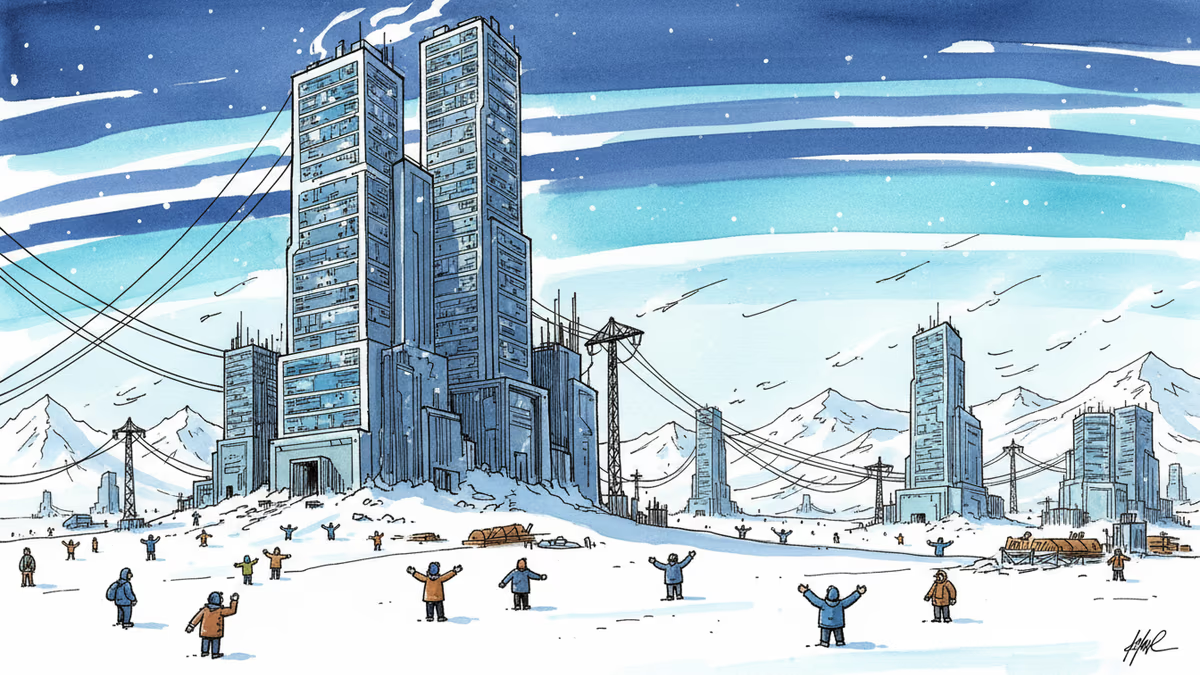
Why AI Giants Are Racing to Build in the Arctic Circle
As Europe faces a power crisis, the Nordic countries have become the unexpected hotbed for AI data centers. What's driving this Arctic gold rush?
On the banks of a Swedish river, where paper mills once churned out newsprint, something entirely different is taking shape. As construction crews break ground on a sprawling data center in Borlänge, CEO Peter Michelson captures the moment: "This facility once produced paper, the raw material of the newspaper information age. Now, Borlänge will produce the raw material for AI and the next information age."
It's a poetic way to describe what's actually a $1.4 billion infrastructure land grab.
50+ Projects and Counting
The Borlänge facility represents just one piece of an unprecedented building boom. Across the Nordic region—Norway, Sweden, Finland, Denmark, and Iceland—more than 50 data centers are currently under construction or in development. According to consulting firm CBRE, nowhere else in Europe is data center capacity growing faster.
The recent announcements read like a tech industry migration manifest. OpenAI deployed 100,000 GPUs in a tiny Norwegian fjord town inside the Arctic Circle. Microsoft followed suit. In just the past few weeks, French AI lab Mistral committed to leasing infrastructure worth $1.4 billion at Borlänge, while data center operator atNorth announced plans for an enormous Swedish facility.
Europe's Power Crisis Meets Nordic Opportunity
This Arctic rush isn't driven by romantic notions of Scandinavian innovation. It's about cold, hard infrastructure reality: Europe is running out of power.
"There's an extraordinary amount of demand out there, but servicing that demand is increasingly an issue across Europe," says Kevin Restivo, CBRE's director of data center research. "Power is an increasingly precious commodity, and there's a scarcity of it."
Traditionally, European data centers clustered around financial hubs—Frankfurt, London, Amsterdam, Paris, Dublin. When nanoseconds matter for algorithmic trading, proximity trumps everything. But AI workloads have different priorities.
The ChatGPT Inflection Point
The shift began in summer 2023, six months after ChatGPT's breakout success. Nordic government agencies started fielding calls from eager developers.
"There was a clear change," says Jouni Salonen, a data center specialist at Business Finland. "Now, power—and quick access to power—is clearly the main criteria. They are looking for sites where they can get access to the market quickly."

This coincided with the emergence of "neoclouds"—specialist companies that sell access to massive GPU fleets. Unlike traditional cloud providers serving latency-sensitive applications, neoclouds can establish facilities anywhere. Even the Arctic Circle.
CBRE found that neoclouds account for the majority of Nordic data center capacity growth.
The Nordic Value Proposition
For AI infrastructure developers, the Nordics offer a rare combination: abundant land, cheap renewable energy, and cool climates that reduce cooling costs. It's a compelling pitch for meeting stringent EU emissions targets.
"You're not really trading away much by locating there, but you're gaining an enormous amount," explains Phillipe Sachs, chief business officer at neocloud firm Nscale, which operates the Norway site where OpenAI and Microsoft lease space. "When you're thinking about trying to build very, very large, giga-factory-style compute clusters, it's far and away the best place to do it in Europe, if not the world."
Rural Renaissance or Land Speculation?
The data center boom is transforming rural Nordic economies where traditional industries like mining, lumber, and paper have declined. Land prices are surging even in remote areas.
"The value of forest land soon to be zoned for data center use is currently 4 to 9 times higher than normal forest land in the region," Salonen notes. Local municipalities are "very anxious for investment."
But there's skepticism about whether all these projects will materialize. Restivo suggests some hyperscale operators are hoarding suitable sites without immediate development plans. "They don't need all the power they have contracted today, but they think they'll need it," he claims. "And they certainly want to keep it away from competitors."
The Geopolitical Dimension
This Nordic surge represents more than real estate arbitrage—it's a geopolitical shift. As the US and China compete for AI dominance, smaller nations are positioning themselves as neutral ground for digital infrastructure.
For American tech giants, Nordic data centers offer political stability and regulatory predictability that's increasingly valuable. For European policymakers concerned about digital sovereignty, it keeps critical AI infrastructure within EU borders while reducing dependence on US-based cloud providers.
The Sustainability Question
The environmental angle deserves scrutiny. While Nordic renewable energy sounds green, the scale of AI power consumption raises questions. Training large language models can consume as much electricity as entire cities. Even with hydropower and wind, the aggregate energy demand could strain regional grids.
Yet proponents argue this beats the alternative. "It's driving pretty much everything," says Andrew Jay, head of data center solutions EMEA at CBRE, referring to energy scarcity elsewhere in Europe.
Authors
Related Articles

Samsung and SK unveiled a chip and AI investment package worth thousands of trillions of won on June 29. The headline number swings wildly by outlet, but the real contest isn't capital — it's water and power.

Viral videos show 2026 graduates jeering executives who praise AI at commencement ceremonies. It's not just rudeness — it's a signal about who pays for technological optimism.
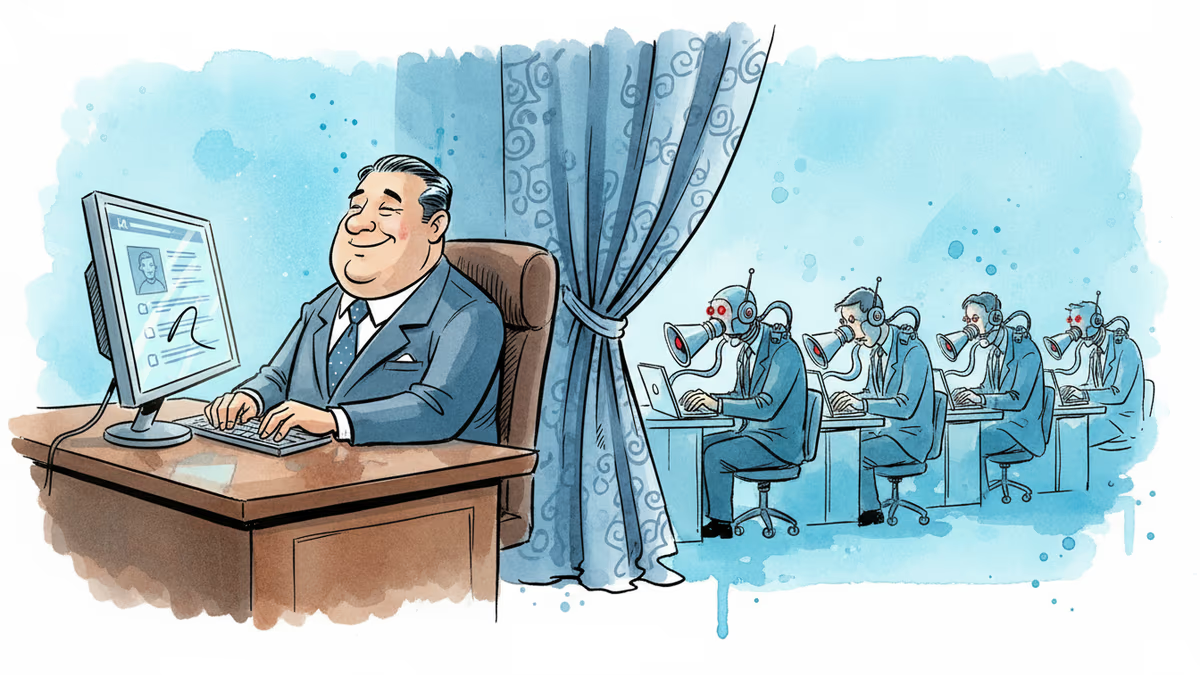
Filipino virtual assistants using AI to ghost-manage LinkedIn profiles for executives is now a structured industry. 30 comments a day, fake engagement rings, and a platform struggling to tell real from fabricated.
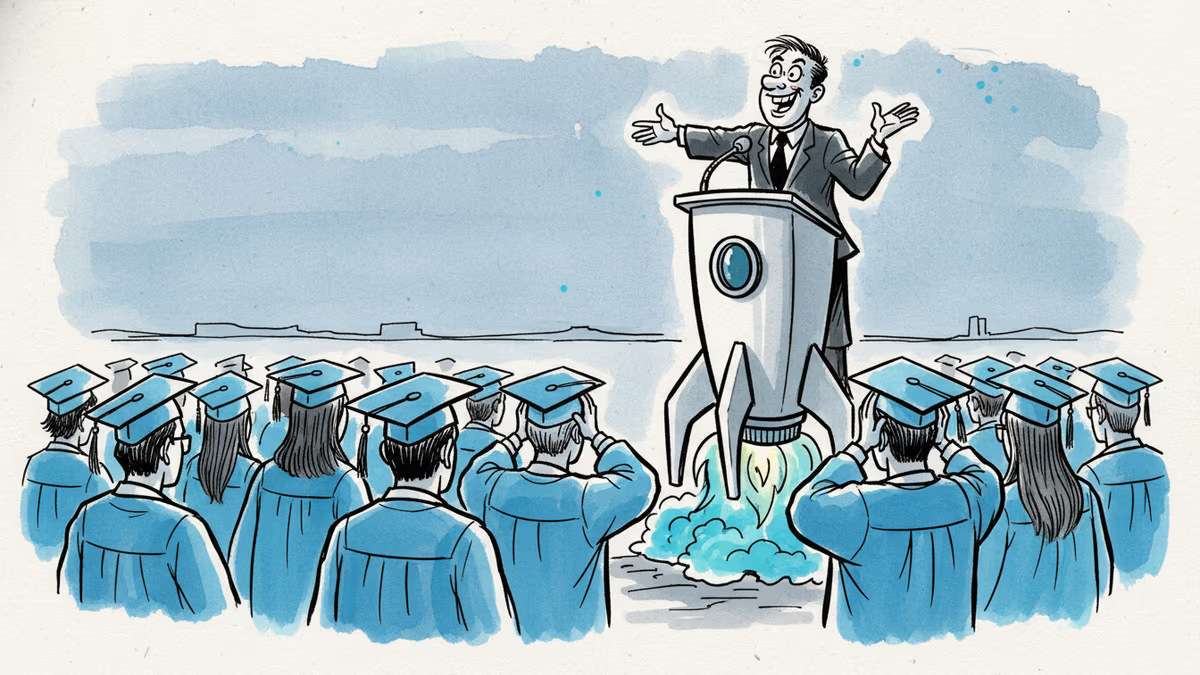
Two commencement speakers learned the hard way that AI enthusiasm doesn't land well with today's graduates. The backlash reveals a widening gap between tech optimism and Gen Z's economic reality.
Samsung and SK unveiled a chip and AI investment package worth thousands of trillions of won on June 29. The headline number swings wildly by outlet, but the real contest isn't capital — it's water and power.
Viral videos show 2026 graduates jeering executives who praise AI at commencement ceremonies. It's not just rudeness — it's a signal about who pays for technological optimism.
Filipino virtual assistants using AI to ghost-manage LinkedIn profiles for executives is now a structured industry. 30 comments a day, fake engagement rings, and a platform struggling to tell real from fabricated.
Two commencement speakers learned the hard way that AI enthusiasm doesn't land well with today's graduates. The backlash reveals a widening gap between tech optimism and Gen Z's economic reality.
Thoughts
Share your thoughts on this article
Sign in to join the conversation