
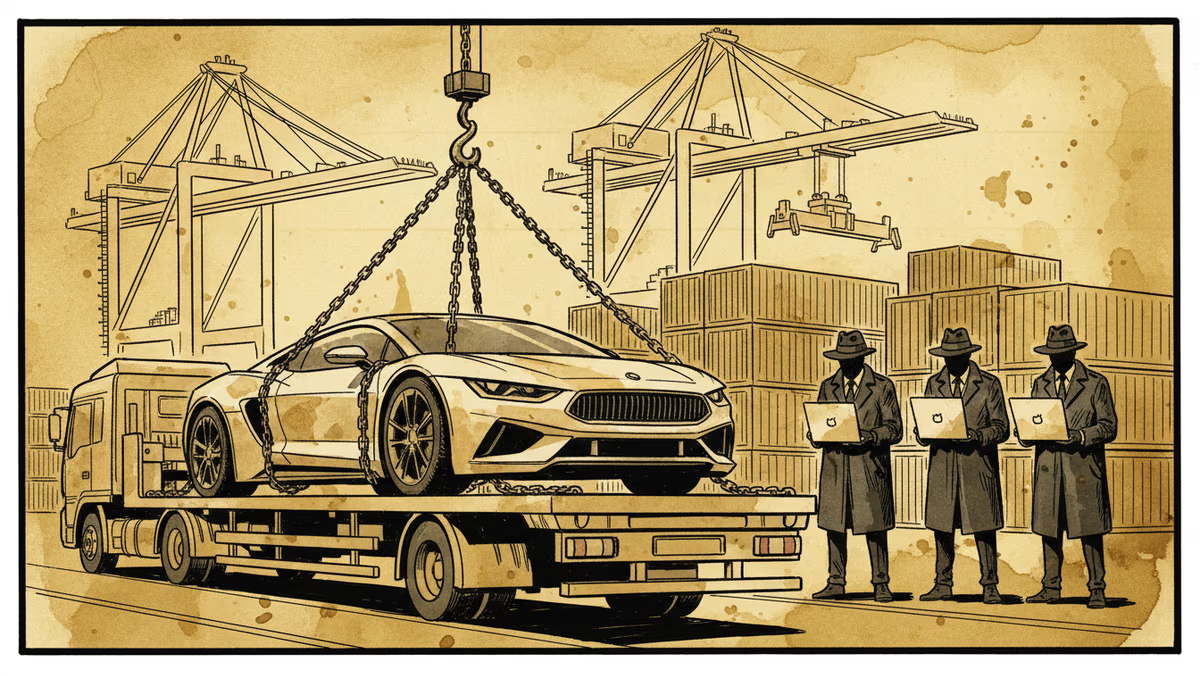
The $1 Billion Car Heist Hiding in Plain Sight
How organized criminals are stealing luxury vehicles through legitimate transport platforms, exploiting regulatory gaps to make billions while authorities struggle to keep pace.
Sam Zahr watched his $300,000 gray Rolls-Royce Dawn convertible disappear into an enclosed trailer on January 17, 2025. The luxury rental company owner expected the car to arrive in Detroit within days. Instead, it vanished into what investigators now recognize as a sophisticated criminal enterprise that's stolen an estimated 8,000 high-end vehicles worth over $1 billion in less than two years.
The orange-trimmed convertible never made it to Michigan. Instead, it became another casualty in an organized fraud scheme that's exploiting America's digitized vehicle transport industry—turning legitimate shipping platforms into criminal marketplaces where Lamborghinis, Bentleys, and Rolls-Royces disappear with alarming regularity.
The Digital Highway Robbery
What happened to Zahr's Rolls-Royce reveals a criminal innovation that law enforcement calls "transport fraud"—a scheme where crooks impersonate legitimate shipping companies to steal luxury vehicles in transit. The method is devastatingly simple: criminals hack or create fake accounts on vehicle transport platforms, claim high-value shipping jobs, then redirect the cars to accomplices who can re-VIN, retitle, and resell them before owners even realize they're missing.
Central Dispatch, the industry's largest vehicle shipping marketplace owned by automotive giant Cox Automotive, has become ground zero for this criminal activity. The platform, which processes thousands of vehicle shipments daily, operates like a digital bulletin board where car dealers, manufacturers, and owners post shipping needs—and where criminals now hunt for their next score.
"Criminals have learned that stealing cars via the web portals has become extremely easy, and when I say easy—it's become seamless," explains Steven Yariv, CEO of Dealers Choice Auto Transport. His West Palm Beach company has watched the industry transform from phone-based relationships to digital platforms that prioritize efficiency over security.
The numbers tell a stark story. While traditional car theft has declined post-pandemic, cargo theft—which includes vehicles stolen during transport—has exploded to an estimated $35 billion annually, with projections showing a 22% increase in 2025.
The Flip-Flop Mafia
Industry insiders have coined a term for these criminals: the "flip-flop mafia." The nickname captures both their casual appearance—often showing up in flip-flops and slides to collect stolen vehicles—and their method of constantly "flipping" between fraudulent company registrations to stay ahead of authorities.
The criminal process exploits multiple vulnerabilities in America's transportation regulatory system. Fraudsters obtain legitimate US Department of Transportation numbers by registering sham companies, hack existing carrier accounts through phishing emails, or simply tape fake identification numbers to truck doors. The Federal Motor Carrier Safety Administration, which regulates commercial vehicles, has proven unable to keep pace with the sophisticated fraud schemes.
"FMCSA [is] authorizing people that are fraudulent companies—people that are not who they say they are," explains Bek Abdullayev, founder of Super Dispatch, a major competitor to Central Dispatch. The regulatory gaps allow criminals to "game the system and obtain paperwork that makes [them] look like a legitimate company."
Once criminals secure a shipping job, they often employ "double-brokering"—reposting the vehicle on load boards under different accounts to find unwitting drivers who deliver stolen cars to criminal accomplices. The practice creates layers of deniability while moving high-value vehicles toward chop shops, overseas shipping containers, or fraudulent resale operations.
Caught in the Act

The scope of this criminal enterprise became clear during a dramatic sting operation at a Florida shopping mall. After Zahr's Rolls-Royce disappeared, Miami Police Detective Ryan Chin tracked the pattern to other stolen vehicles—a black Lamborghini Urus, a white Audi R8, and an orange Lamborghini Urus worth $250,000.
On January 31, 2025, more than a dozen officers surrounded the Waterways Shoppes mall in Aventura as criminals arrived to collect their latest prize. The scene was surreal: a transport driver delivered the stolen Lamborghini while three men in a $400,000 green Rolls-Royce Cullinan conducted countersurveillance, counting cash on the vehicle's tailgate.
When a Bentley Continental GT arrived to complete the transaction—$700 in cash exchanged for luxury car keys—police moved in. The arrests of Arman Gevorgyan, Hrant Nazarian, and Yuriy Korotovskyy exposed an organized operation that law enforcement sources describe as "cartel operated."
Among the evidence seized: $10,796 in cash and GPS jammers—sophisticated technology that disables vehicle tracking systems and has become standard equipment for modern car thieves. "Once they get the vehicles, they usually park them somewhere [and] put a signal jammer in there or cut out the GPS," explains a law enforcement source involved in the investigation.
The VIN Shell Game
The technology behind these thefts reveals criminal sophistication that matches legitimate automotive innovation. Stolen vehicles undergo rapid transformation: GPS systems are jammed, Vehicle Identification Numbers are swapped, car computers are wiped, and key fobs are reprogrammed to erase ownership traces.
"If you know what you're doing, and you steal the car at one o'clock today, you can have it completely done at two o'clock today," says Bill Woolf, a regional director for the National Insurance Crime Bureau. The speed allows criminals to re-VIN, retitle, and sometimes resell vehicles before owners file police reports.
This technological arms race plays out across the country. When Colorado Rockies third baseman Kris Bryant's$250,000 Lamborghini Huracán disappeared en route to Las Vegas, police tracked it using Flock traffic cameras to a sophisticated operation run by Dat Viet Tieu. Surveillance footage captured Tieu and an accomplice reprogramming key fobs in a casino parking garage, using laptops and jumper cables to unlock stolen vehicles.
The bust revealed the criminal ecosystem's breadth: multiple fraudulent VIN stickers, key fobs to other stolen high-end vehicles, and a stolen Jeep Wrangler that had been re-VINed and retitled to Tieu's wife. Yet Tieu received just one year of probation—a sentence that industry experts say fails to deter organized criminal enterprises making millions from vehicle theft.
Industry Under Siege
The transport fraud epidemic has fractured trust within the automotive shipping industry. Legitimate brokers report losing millions in stolen inventory, while insurance companies face mounting claims for vehicles that disappear in transit. Some high-profile victims—including NBA Hall of Famer Shaquille O'Neal, whose $180,000 custom Range Rover was stolen when his transport company was hacked—have brought media attention to the crisis.
"You're talking 30 cars a day [on] average is gone," Yariv estimates, describing an industry under siege. His company has abandoned digital load boards entirely, returning to phone-based operations despite the efficiency costs. "The only way it goes away is the dispatch boards have to be shut down—and that'll never happen."
Central Dispatch has implemented security measures including two-factor authentication and real-time tracking, while removing over 500 fraudulent accounts in 2025 alone. Yet industry critics argue the company, as part of automotive giant Cox Automotive, bears insufficient liability for the criminal activity on its platform.
"If the crap hits the fan, it's on us as a broker, or it's on the trucking company, or the clients' insurance, [which means] that they have no liability in the whole transaction process," complains Fred Mills, owner of Advantage Auto Transport. The regulatory structure leaves platform operators largely immune from the financial consequences of fraud conducted through their systems.
Global Criminal Networks
The international scope of vehicle transport fraud extends far beyond American borders. Stolen luxury vehicles often end up in overseas markets, loaded into shipping containers and bound for buyers in the Middle East, Africa, or Latin America. The Port of Baltimore alone experienced a 200% increase in recovered stolen vehicles from 2023 to 2024, with agents recently discovering $1 million worth of stolen cars in a single shipping container.
"A lot of this is cartel operated," explains J.D. Decker, chief of the Nevada Department of Motor Vehicles police division. "There's so much money in it that it rivals selling drugs." The criminal networks display sophisticated logistics capabilities, often having buyers lined up before vehicles are stolen.
Atlanta exotic-car dealer Travis Payne discovered this global reach when his stolen Rolls-Royce turned up in the Instagram feed of a Mexican pop star. Despite months of investigation, he never recovered the vehicle. "When they steal them, they have a plan," Payne explains. The criminals "make a couple phone calls, make a couple email accounts, and they get a $400,000 car for free."
Authors
Related Articles
Exploring the used EV market at $15,000 budget point. BMW i3 and Chevrolet Bolt options compared with lower mileage, newer features, and better value propositions.
Swedish startup Einride raises $113M ahead of NYSE debut, deploying 200 autonomous trucks for major brands. The logistics revolution accelerates.
German study reveals shocking truth about plug-in hybrids - most owners rarely charge them. Porsche drivers averaged just 0.8% electric usage over two years.
Average new car price hits $48,576 in the US, up a third since 2019. Even with tariff rollbacks, affordable cars aren't coming back. Here's why the auto industry's cost structure has fundamentally shifted.
Exploring the used EV market at $15,000 budget point. BMW i3 and Chevrolet Bolt options compared with lower mileage, newer features, and better value propositions.
Swedish startup Einride raises $113M ahead of NYSE debut, deploying 200 autonomous trucks for major brands. The logistics revolution accelerates.
German study reveals shocking truth about plug-in hybrids - most owners rarely charge them. Porsche drivers averaged just 0.8% electric usage over two years.
Average new car price hits $48,576 in the US, up a third since 2019. Even with tariff rollbacks, affordable cars aren't coming back. Here's why the auto industry's cost structure has fundamentally shifted.
Thoughts
Share your thoughts on this article
Sign in to join the conversation