
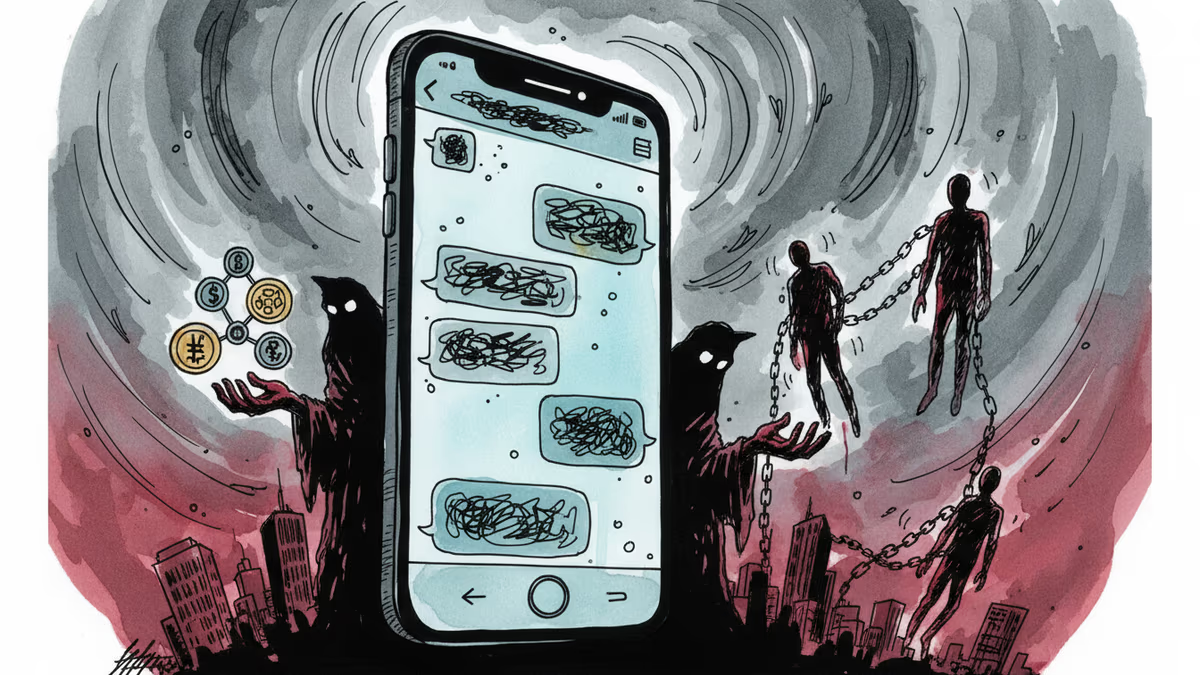
Humans for Sale: How Crypto Fueled an 85% Surge in Trafficking
Southeast Asian scam compounds and sex trafficking rings are industrializing human trade through cryptocurrency. Chainalysis exposes a multi-billion dollar shadow economy.
The $100 Million Question Nobody's Asking
Cryptocurrency transactions for human trafficking exploded 85% in 2025. That's not a typo. Blockchain analytics firm Chainalysis just dropped the most disturbing crypto report you'll read this year: humans are now being bought and sold with digital currency on an industrial scale, generating hundreds of millions of dollars annually.
Crypto's promise of frictionless, borderless payments has found its darkest application. What was supposed to democratize finance is now enabling the commodification of human beings—in broad daylight, on public platforms, with shocking efficiency.
The Telegram Marketplace of Misery
Here's what should terrify you: these transactions aren't happening in some dark corner of the internet. They're conducted openly on Telegram channels, advertised like any other service.
Chinese-speaking criminal organizations post detailed listings on "guarantee" markets like Xinbi Guarantee and Tudou Guarantee—escrow services that hold cryptocurrency to prevent fraud. The irony is staggering: they're worried about being scammed while literally trading human lives.
"Compound No. 7 is making a strong entry into the market. All agents are welcome to compare prices and inquire" reads one translated message recruiting workers for a Cambodian scam compound.
The pricing is brutally specific: $8,888 to $22,000 per person. Requirements? Typing skills, good health, standard Mandarin. No falsified documents, no mental problems. It reads like a job posting from hell.
Two Industries, One Currency
Chainalysis identified two primary trafficking operations, both powered by stablecoins like Tether and USDC:
Scam Compound Labor: Across Myanmar, Cambodia, and Laos, hundreds of thousands of workers—lured from South Asia and Africa with fake job offers—are forced into 15-16 hour shifts running text-based scams targeting Western victims. Their passports are confiscated. Miss your quota? Face beatings and electrocution.

Sex Trafficking Networks: This sector showed the most measurable growth. Telegram ads detail services by the hour, long-term arrangements, and international "flights" to Macau, Taiwan, and Hong Kong. Some advertisements reference suspected trafficking of minors with terms like "Lolitas" and "real high schoolers."
The scale is industrial. While typical prostitution networks see 62% of transactions between $1,000-$10,000, international sex trafficking operations see nearly half of all transactions exceed $10,000.
"We're not talking about a sex trafficker or pimp with three, five, 10 victims," says Chainalysis analyst Tom McLouth. "We're talking about hundreds of victims."
The Platform Problem
Two companies could significantly disrupt this trade tomorrow: Telegram and Tether. They choose not to.
Telegram could ban accounts. Tether—unlike decentralized Bitcoin—could freeze assets. Both companies know exactly what's happening on their platforms.
"Why are Telegram and Tether OK with making money from the exploitation of humans?" asks Erin West, former Santa Clara County prosecutor who now leads anti-scam organization Operation Shamrock. "They know this is happening. This money's being moved on their platform, and the discussions are in open forums."
Telegram's response? A corporate statement about terms of service violations and AI moderation tools. Meanwhile, banned channels simply rebrand and rebuild within months.
The Child Exploitation Economy
The darkest corner involves child sexual abuse materials (CSAM). About half of these transactions are under $100—highlighting how cheap and accessible such content has become, including AI-generated materials.
Unlike other trafficking operations that use stablecoins, CSAM transactions still largely use Bitcoin, though profits are laundered through Monero, a privacy coin designed to be untraceable.
The Regulatory Void
Here's the uncomfortable truth: traditional financial systems would have flagged these patterns immediately. Banks have compliance officers, transaction monitoring, and regulatory oversight. Crypto exchanges? Not so much.
The same features that make cryptocurrency appealing for legitimate cross-border payments—low fees, minimal oversight, pseudonymity—make it perfect for human traffickers.
Authors
Related Articles
South Korean police accidentally revealed recovery phrases in a press release photo, leading to the theft of seized cryptocurrency assets worth $5.6 million. A costly lesson in digital evidence handling.
Newly released Jeffrey Epstein files reveal deep ties to cryptocurrency leaders. How the convicted trafficker leveraged crypto's early promise for dark purposes, and what it means for the industry today.
Stripe's valuation soars 74% to $159 billion in one year, driven by explosive stablecoin growth and crypto infrastructure investments. Is this the new fintech playbook?

THORChain's frozen funds expose the dark side of crypto's permissionless promise. When decentralized isn't really decentralized.
South Korean police accidentally revealed recovery phrases in a press release photo, leading to the theft of seized cryptocurrency assets worth $5.6 million. A costly lesson in digital evidence handling.
Newly released Jeffrey Epstein files reveal deep ties to cryptocurrency leaders. How the convicted trafficker leveraged crypto's early promise for dark purposes, and what it means for the industry today.
Stripe's valuation soars 74% to $159 billion in one year, driven by explosive stablecoin growth and crypto infrastructure investments. Is this the new fintech playbook?
THORChain's frozen funds expose the dark side of crypto's permissionless promise. When decentralized isn't really decentralized.
Thoughts
Share your thoughts on this article
Sign in to join the conversation