
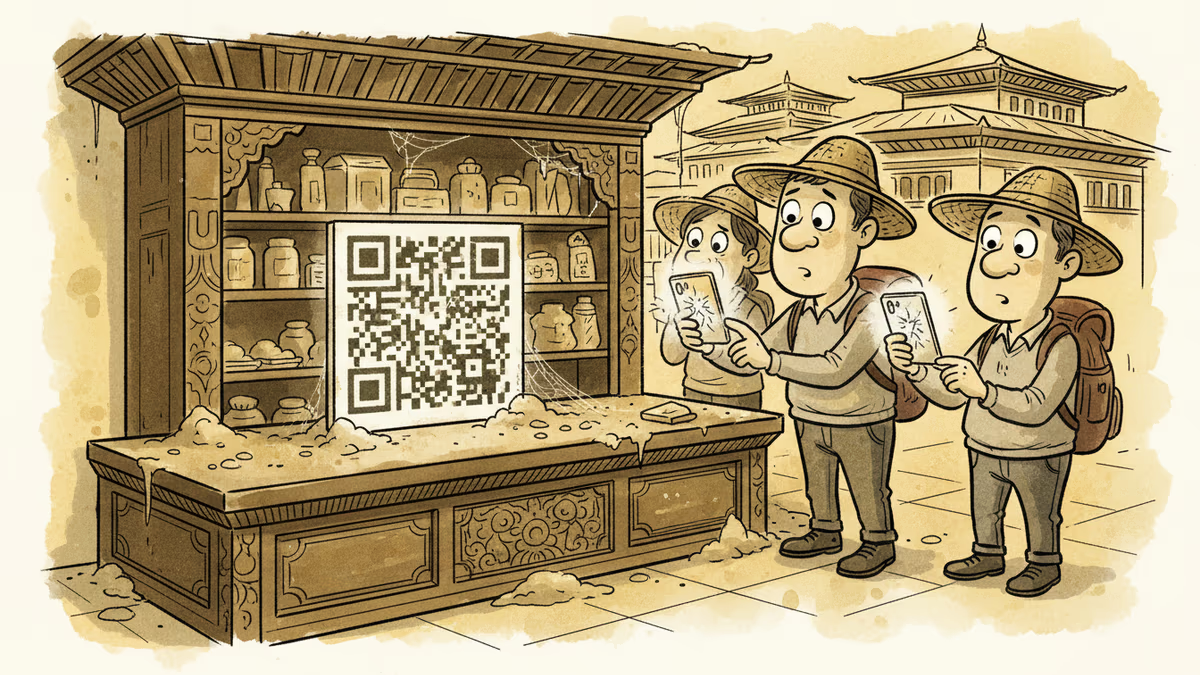
Bhutan's Crypto Experiment: A Year Later, Reality Check
Bhutan launched the world's first nationwide crypto payment system for tourists. Nearly a year later, QR codes gather dust and merchants report zero crypto transactions. What went wrong?
$1.4 Billion in Bitcoin, Zero Tourist Transactions
Nine months ago, Bhutan made headlines as the first country to launch a nationwide crypto payment network for tourists. Over 1,000 merchants signed up within the first month, ready to accept payments in 100+ cryptocurrencies via Binance. Today, those QR codes are gathering dust.
"It's been four to five months, but no customer has used it," says Sonam Dorji, who works at a handicraft store in Thimphu's Le Meridien hotel. "No one knows we accept cryptocurrency."
This isn't just one merchant's story—it's the reality across Bhutan's capital.
The Government's Bitcoin Gamble
Bhutan's crypto push isn't random. The kingdom has been mining bitcoin since 2019, leveraging its abundant hydroelectric power to build the world's largest state-backed green-mined bitcoin reserve—worth $1.4 billion as of October 2024.
"Mining bitcoin gives Bhutan a currency to purchase imports that it didn't have before," explains Jay Zagorsky, professor at Boston University's Questrom School of Business. "I understand why the political establishment wants digital payments. But just because the central bank is pushing doesn't make it sensible."

The infrastructure reality tells a different story:
- One-third of Bhutanese people are illiterate
- Power cuts occur 19 times per year for the average customer
- One-fifth of businesses need backup generators
Following El Salvador's Footsteps?
El Salvador made bitcoin legal tender in 2021, only to reverse course in 2025 when the IMF had to bail out its tanking economy. The Central African Republic also abandoned its bitcoin experiment within a year after pressure from international financial institutions.
Bhutan's approach differs slightly—crypto payments convert instantly to ngultrum, the local currency, acting more as a gateway than a store of value. This reduces volatility risk but doesn't solve the adoption problem.
At Ambient Cafe, one of Thimphu's oldest eateries, owner Junnu Chhetri says some foreign guests have used crypto payments, but she doesn't track daily usage.
The Gray Zone Reality
"There's nothing clearly written or formalized on paper regarding crypto laws in Bhutan," says Ugyen Dendup, co-founder of NoMindBhutan, the country's first AI startup. "It exists in a gray area: Some people push for it, some are cautious, and guidance isn't clear."
The conversation remains limited to tourism, with no significant expansion to other sectors nearly a year later.
Authors
Related Articles
South Korean police accidentally revealed recovery phrases in a press release photo, leading to the theft of seized cryptocurrency assets worth $5.6 million. A costly lesson in digital evidence handling.
Newly released Jeffrey Epstein files reveal deep ties to cryptocurrency leaders. How the convicted trafficker leveraged crypto's early promise for dark purposes, and what it means for the industry today.

THORChain's frozen funds expose the dark side of crypto's permissionless promise. When decentralized isn't really decentralized.
THORChain founder's contradictions expose the illusion of decentralization in crypto. When one person can freeze $200M with a single key, is anything truly decentralized?
South Korean police accidentally revealed recovery phrases in a press release photo, leading to the theft of seized cryptocurrency assets worth $5.6 million. A costly lesson in digital evidence handling.
Newly released Jeffrey Epstein files reveal deep ties to cryptocurrency leaders. How the convicted trafficker leveraged crypto's early promise for dark purposes, and what it means for the industry today.
THORChain's frozen funds expose the dark side of crypto's permissionless promise. When decentralized isn't really decentralized.
THORChain founder's contradictions expose the illusion of decentralization in crypto. When one person can freeze $200M with a single key, is anything truly decentralized?
Thoughts
Share your thoughts on this article
Sign in to join the conversation