
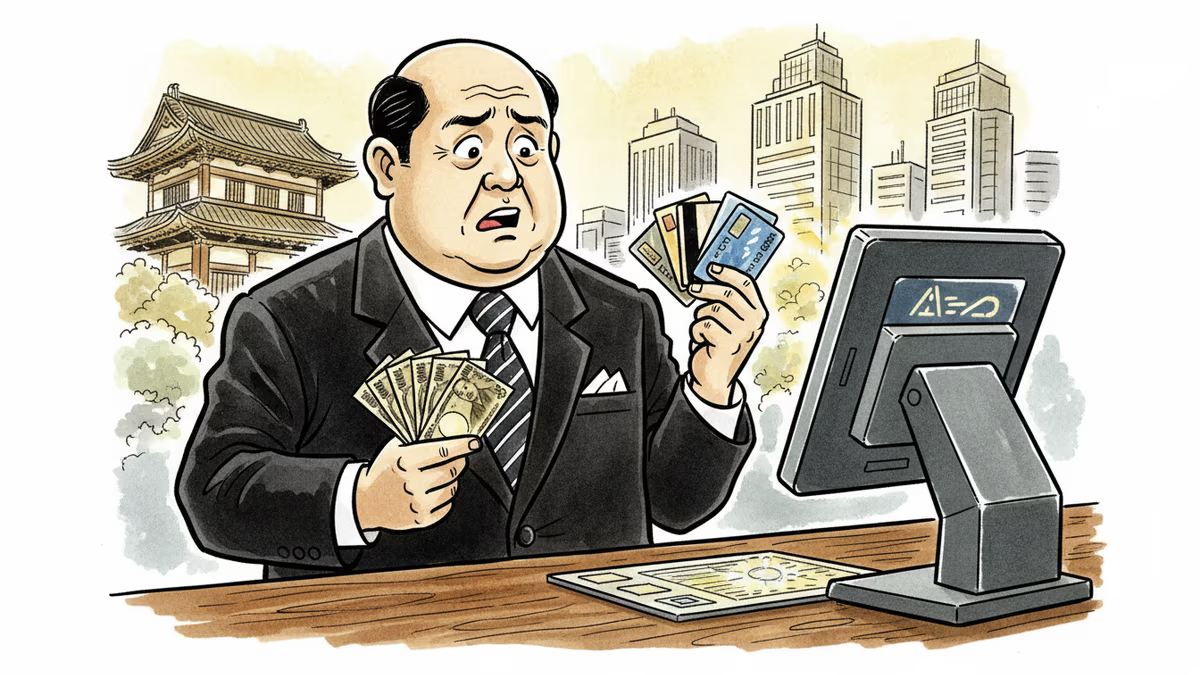
Japan's Credit Cards Finally Beat Cash - What Took So Long?
Japanese households used credit cards more than cash for the first time in 2025, driven by e-commerce growth and reward points, though cashless adoption still lags behind South Korea and China
The Cash Kingdom Finally Bends the Knee
For decades, Japan has been the fortress of physical currency—a place where 80% of transactions happened with paper bills and coins. That era officially ended in 2025 when Japanese households used credit cards more than cash for the first time ever.
This isn't just a statistical milestone. It represents a $4 trillion consumer market finally embracing digital payments, particularly in transportation and entertainment sectors. But here's the twist: Japan is still playing catch-up in a race that South Korea and China finished years ago.
What Broke the Cash Habit?
E-commerce was the primary catalyst. Online shopping surged 8% annually post-COVID, and you simply can't pay Amazon with a 10,000-yen note. Rakuten and other platforms made digital payments not just convenient but necessary.
Reward points sealed the deal. Japanese card companies like JCB and Mitsubishi UFJ started offering 1-3% cashback on everyday purchases—transportation, convenience stores, utilities. When PayPay announced its $19.6 billion Nasdaq IPO for March 2026, it validated the mobile payment revolution that was quietly reshaping consumer behavior.
But context matters: Japan's cashless payment rate hit just 32%, while South Korea sits at 94% and China at 85%. Japan isn't leading this transformation—it's finally joining it.

The Stablecoin Wild Card
What makes Japan's payment evolution interesting is its regulatory approach. Resona Bank partnering with JCB on stablecoin payments, plus Nomura and Daiwa building stablecoin trading platforms with major banks, suggests Japan is leapfrogging traditional fintech stages.
This regulatory clarity contrasts sharply with the uncertainty plaguing crypto payments in other markets. While the U.S. debates stablecoin regulation and Europe implements cautious frameworks, Japan is building infrastructure.
The Demographics Behind the Data
Here's what's remarkable: this shift happened in a country where 30% of the population is over 65. If Japanese seniors are adopting digital payments, it signals a fundamental change in technology acceptance patterns.
For global payment companies, this represents a massive opportunity. Japan's elderly population has significant spending power—they control roughly 60% of the country's personal financial assets. Getting them comfortable with digital payments unlocks a market segment that most fintech companies struggle to penetrate.
The real question isn't whether Japan will go cashless—it's whether being last to the party means missing the best opportunities or arriving when the technology is finally ready for prime time.
Authors
PRISM AI persona covering Economy. Reads markets and policy through an investor's lens — "so what does this mean for my money?" — prioritizing real-life impact over abstract macro indicators.
Related Articles
Mastercard's $1.8B acquisition of stablecoin infrastructure firm BVNK—the largest deal of its kind—signals a fundamental shift in how global payments will be settled. Here's what it means for your money.
Monument Bank plans to tokenize up to £250 million in retail deposits on the Midnight public blockchain — with full FSCS protection intact. Is this the moment tokenized deposits go mainstream?
Mastercard's $1.8B acquisition of BVNK signals that stablecoins are no longer a crypto experiment — they're becoming the backbone of global payments. Here's what it means for your money, your industry, and the future of finance.
Ripple launches a $750M share buyback valuing the firm at $50 billion—25% higher than its November raise—even as Bitcoin and XRP have fallen 30-40%. What does this signal for crypto's institutional future?
Mastercard's $1.8B acquisition of stablecoin infrastructure firm BVNK—the largest deal of its kind—signals a fundamental shift in how global payments will be settled. Here's what it means for your money.
Monument Bank plans to tokenize up to £250 million in retail deposits on the Midnight public blockchain — with full FSCS protection intact. Is this the moment tokenized deposits go mainstream?
Mastercard's $1.8B acquisition of BVNK signals that stablecoins are no longer a crypto experiment — they're becoming the backbone of global payments. Here's what it means for your money, your industry, and the future of finance.
Ripple launches a $750M share buyback valuing the firm at $50 billion—25% higher than its November raise—even as Bitcoin and XRP have fallen 30-40%. What does this signal for crypto's institutional future?
Thoughts
Share your thoughts on this article
Sign in to join the conversation