
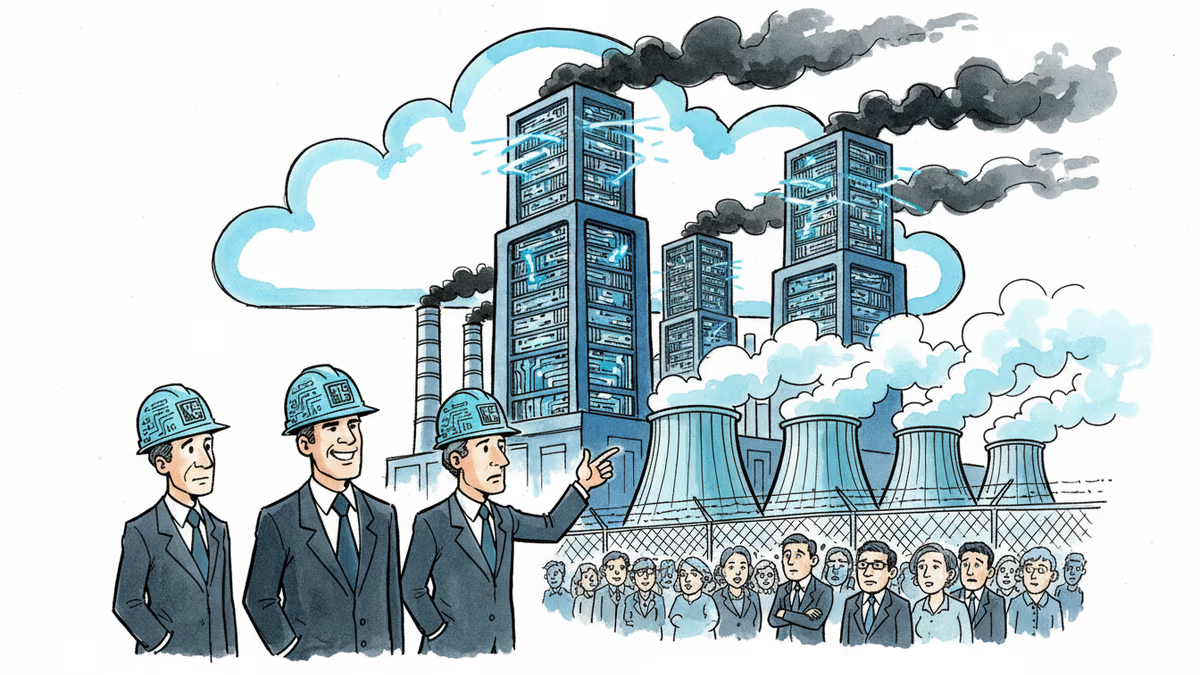
Big Tech's Power Plant Promise Faces Reality Check
Trump administration's pledge for Big Tech to build own power plants may not shield consumers from rising electricity costs. Technical and economic barriers analyzed
$100 Billion Energy Bet That May Not Pay Off
Seven of the world's largest tech companies will gather at the White House Wednesday to make a promise that sounds too good to be true: we'll power our own data centers and your electricity bills won't go up.
Amazon, Google, Meta, Microsoft, xAI, Oracle, and OpenAI are set to sign a pledge to build their own power plants instead of drawing from the electrical grid. President Trump touted the plan in his State of the Union, declaring that "no one's prices will go up" due to "energy demand from AI data centers."
But energy experts are raising red flags. Can Big Tech really deliver on this ambitious promise?
The Stakes: AI's Massive Power Appetite
The numbers behind this pledge are staggering. A single ChatGPT query consumes 10 times more electricity than a Google search. Data center power consumption is projected to triple by 2030, driven by the AI boom.
Goldman Sachs estimates that data centers will account for 8% of total U.S. electricity demand by 2030, up from 3% today. That's equivalent to adding 160 million new homes to the grid.
The current power grid simply can't handle this surge. Building new transmission lines takes 10-15 years and costs billions—expenses that typically get passed to consumers through higher rates. For tech giants burning through cash on AI development, self-generated power seems like the obvious solution.
Reality Check: The Engineering Nightmare
Here's where the promise hits physics. Building power plants isn't like deploying software—it's a massive logistical undertaking with daunting obstacles.
Time is the first enemy. Nuclear plants take 10-15 years to build. Natural gas facilities need 3-5 years minimum. Meanwhile, the AI race is happening now. Google alone plans to spend $40 billion on data centers this year.
Location creates the second hurdle. Power plants need water for cooling, fuel supply chains, and transmission infrastructure. You can't just plop a nuclear reactor next to a data center in Virginia. The power still needs to travel through transmission lines—often the same grid these companies claim they'll abandon.

Economics present the third challenge. Self-generated power isn't automatically cheaper. Small-scale plants can't achieve the economies of scale that utility-grade facilities enjoy. A 500-megawatt corporate plant might cost 30% more per kilowatt-hour than grid power.
The Consumer Protection Myth
Despite Trump's assurances, energy policy experts doubt this plan will protect consumers from rising electricity costs.
"Complete grid independence is a fantasy," says Dr. Sarah Chen, director of the Energy Policy Institute. "These companies will still need backup power, peak demand support, and grid connections for redundancy."
The bigger issue is cost allocation. The electrical grid has massive fixed costs—transmission lines, substations, maintenance—that exist regardless of usage. When large consumers like data centers reduce their grid dependence, these fixed costs get spread among remaining customers.
This phenomenon is already playing out in California, where rooftop solar adoption has shifted grid maintenance costs to non-solar households, effectively creating a regressive subsidy.
Three Scenarios: How This Could Play Out
Scenario 1: Partial Success Tech companies build some on-site generation—solar arrays, small gas turbines—but remain grid-connected for 60-70% of their power needs. Consumer impact: minimal.
Scenario 2: Nuclear Ambitions Major players like Microsoft and Amazon invest in small modular reactors (SMRs). Timeline: 2035-2040. Consumer impact: potentially positive if excess power gets sold back to grid.
Scenario 3: Green Washing Companies sign power purchase agreements with renewable developers, claiming "energy independence" while remaining fully grid-dependent. Consumer impact: rates continue rising as planned.
The Real Winners and Losers
If this pledge succeeds, the beneficiaries won't necessarily be everyday consumers.
Winners: Power plant construction companies, nuclear technology firms like NuScale, and rural communities hosting new facilities. Tech companies gain energy security and potentially lower long-term costs.
Losers: Traditional utilities facing reduced revenue, communities near new power plants dealing with environmental impacts, and potentially consumers who end up subsidizing grid maintenance for fewer users.
The irony? The tech companies most capable of building their own power plants—those with the deepest pockets and longest time horizons—are also the ones least likely to need consumer protection from rising rates.
Authors
Related Articles
Google's Gmail Live lets you ask your inbox questions out loud. Announced at I/O 2026, it's AI's pitch to skeptics — and a reminder of how much Google already knows about you.

OpenAI has reorganized for the second time in a month, merging ChatGPT and Codex into a single agentic platform under president Greg Brockman's unified product leadership.
AI sustainability researcher Sasha Luccioni is launching a new venture to push for energy transparency in AI. Here's why Big Tech keeps the numbers hidden—and what's starting to change.
Emails revealed in the Musk v. Altman trial show Microsoft executives were deeply skeptical of OpenAI in 2017–2018. What actually changed their minds?
Google's Gmail Live lets you ask your inbox questions out loud. Announced at I/O 2026, it's AI's pitch to skeptics — and a reminder of how much Google already knows about you.
OpenAI has reorganized for the second time in a month, merging ChatGPT and Codex into a single agentic platform under president Greg Brockman's unified product leadership.
AI sustainability researcher Sasha Luccioni is launching a new venture to push for energy transparency in AI. Here's why Big Tech keeps the numbers hidden—and what's starting to change.
Emails revealed in the Musk v. Altman trial show Microsoft executives were deeply skeptical of OpenAI in 2017–2018. What actually changed their minds?
Thoughts
Share your thoughts on this article
Sign in to join the conversation