
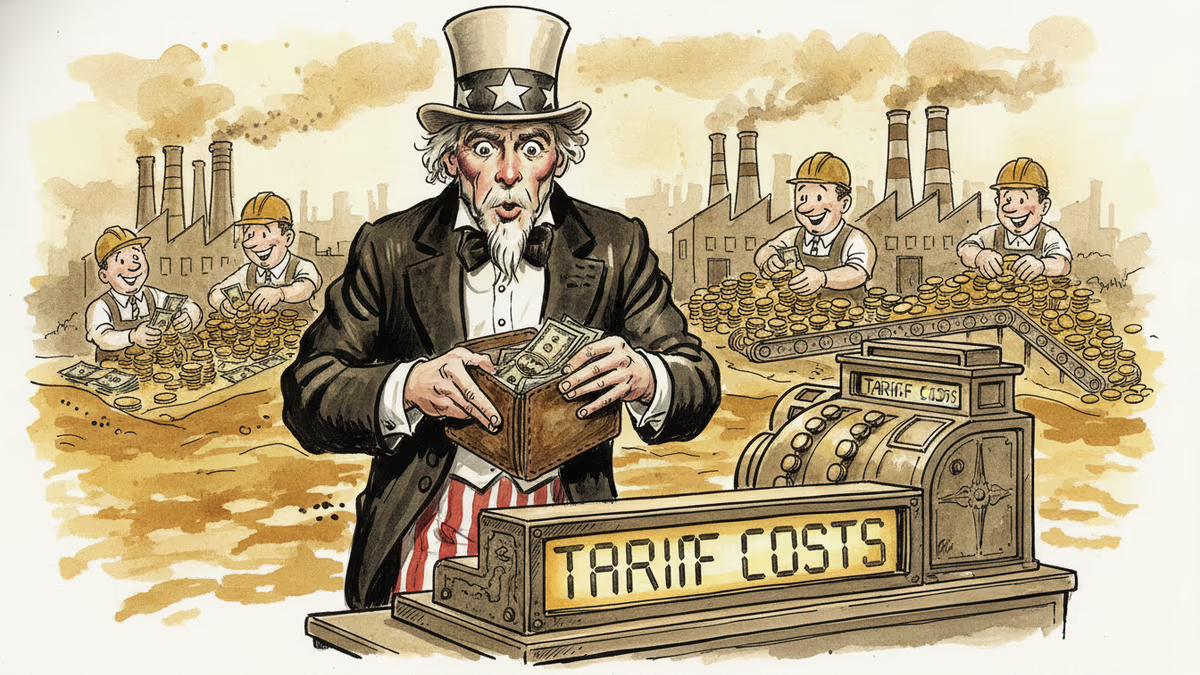
Americans Paid 90% of Trump's Tariff Costs, Fed Study Reveals
Federal Reserve research shows US businesses and consumers bore nearly 90% of Trump's tariff costs in 2025, contradicting claims that foreign companies would pay.
The $200 Billion Question: Who Really Paid?
Donald Trump promised foreign companies would foot the bill for his tariffs. "China will pay," he declared repeatedly. But new Federal Reserve research tells a starkly different story: American businesses and consumers shouldered nearly 90% of tariff costs during the first 11 months of 2025.
The New York Fed study, published Thursday, directly challenges the core economic argument behind Trump's trade policy. "Our results show that the bulk of the tariff incidence continues to fall on US firms and consumers," researchers wrote—a finding that turns campaign promises on their head.
The Timeline That Changed Everything
Here's where it gets interesting: the burden wasn't static. Early in 2025, Americans absorbed almost the entire cost. But as months passed, foreign exporters began shouldering an increasing share—a pattern that reveals how global supply chains actually adapt to trade disruptions.
This gradual shift reflects economic reality. Initially, US importers simply passed tariff costs to consumers through higher prices. But over time, foreign suppliers started absorbing some costs to maintain market share, creating a more complex picture than either side of the political debate typically acknowledges.
What Retailers and Manufacturers Actually Experienced

Talk to any US importer, and you'll hear the same story. Take electronics retailers: they faced an impossible choice between raising prices (and losing customers) or accepting thinner margins (and disappointing shareholders). Most chose a hybrid approach—absorbing some costs while passing others along.
Manufacturing sectors felt the squeeze differently. Auto parts suppliers, for instance, couldn't easily switch suppliers mid-production cycle, leaving them particularly vulnerable to tariff impacts. Meanwhile, consumer goods companies had more flexibility to source from alternative countries.
The Global Supply Chain Chess Game
The Fed's findings illuminate a broader trend: supply chain diversification. Companies didn't just absorb costs—they restructured. Vietnam, Mexico, and India became alternative sourcing hubs as businesses sought to minimize tariff exposure.
This "China+1" strategy created winners and losers across the global economy. Some developing nations gained manufacturing capacity, while established trade relationships faced disruption. The question now: are these changes permanent, or will they reverse if trade policies shift?
Beyond the Numbers: What This Means for Policy
The research raises uncomfortable questions about trade policy communication. If tariffs are essentially taxes on imports—paid by importers and passed to consumers—why do politicians consistently frame them as foreign-paid penalties?
Economists have long understood this dynamic, but political rhetoric often ignores economic mechanics. The Fed study provides empirical evidence for what textbooks have taught for decades: tariff incidence typically falls on the importing country's economy.
Authors
Related Articles
Consumer SSD prices have surged up to 400% since late 2025. WD, Samsung, SanDisk all affected. We unpack the NAND supply crunch, tariff effects, and what comes next.
Apple announces US manufacturing for Mac mini in Houston facility, part of $600B domestic expansion amid Trump tariff threats. Analysis of the political and economic implications.
After Supreme Court blocked his tariffs, Trump finds new legal pathway to impose 10% duties. Analysis of the 150-day gambit and what it means for global trade.
Average new car price hits $48,576 in the US, up a third since 2019. Even with tariff rollbacks, affordable cars aren't coming back. Here's why the auto industry's cost structure has fundamentally shifted.
Consumer SSD prices have surged up to 400% since late 2025. WD, Samsung, SanDisk all affected. We unpack the NAND supply crunch, tariff effects, and what comes next.
Apple announces US manufacturing for Mac mini in Houston facility, part of $600B domestic expansion amid Trump tariff threats. Analysis of the political and economic implications.
After Supreme Court blocked his tariffs, Trump finds new legal pathway to impose 10% duties. Analysis of the 150-day gambit and what it means for global trade.
Average new car price hits $48,576 in the US, up a third since 2019. Even with tariff rollbacks, affordable cars aren't coming back. Here's why the auto industry's cost structure has fundamentally shifted.
Thoughts
Share your thoughts on this article
Sign in to join the conversation