
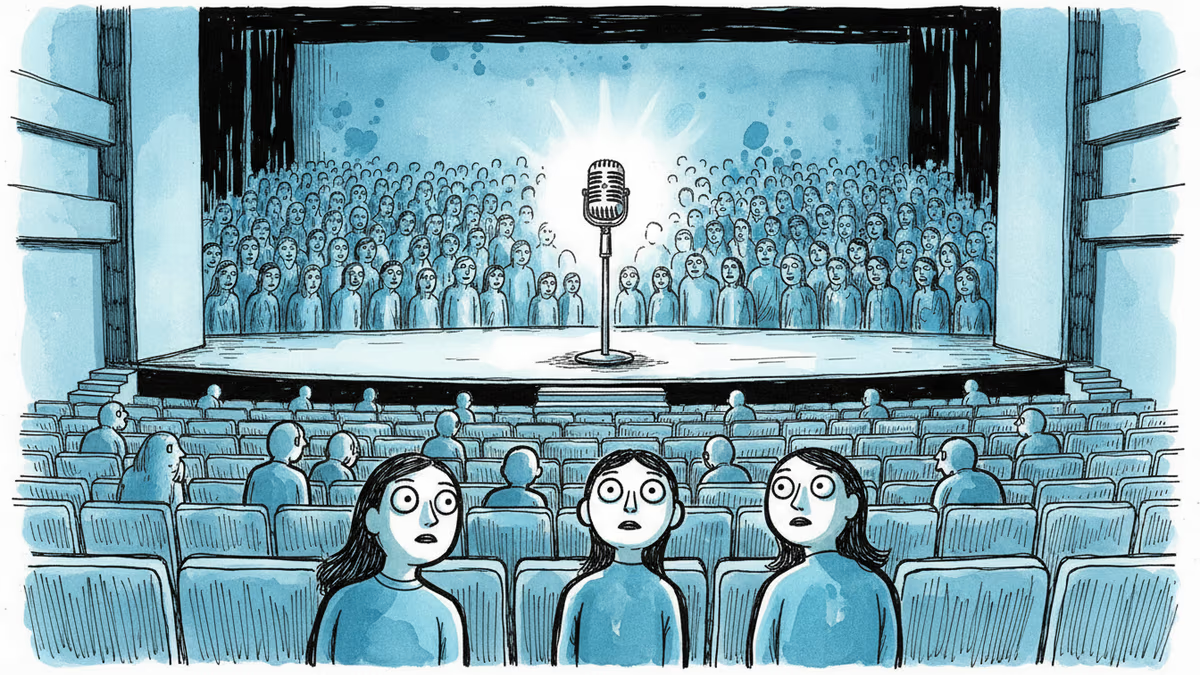
Clubhouse Had the World's Attention. Then What?
In 2021, Clubhouse was the hottest app on earth. Invite codes sold for hundreds of dollars. Then it nearly vanished. The story reveals how social media hype actually works.
In early 2021, an invite code to a social media app was selling on eBay for over $100. The app didn't even have an Android version yet.
That app was Clubhouse. And for a brief, strange window in time, it felt like the future of how humans would talk to each other online. Elon Musk dropped in. Venture capitalists dealmaking in real time. A valuation that hit $4 billion before most people had even heard of it. Then, almost as fast as it arrived, it was gone — or close enough.
So what actually happened?
The Perfect Storm That Built It
Clubhouse launched in April 2020, which, in retrospect, was almost unfairly good timing. The world had just locked down. Zoom fatigue was setting in. People were desperate for connection that didn't require putting on a shirt and staring into a webcam.
Founders Paul Davison and Rohan Seth had a deceptively simple idea: live audio rooms where listeners could raise their hand and join the conversation. No video. No text. Just voices. Andreessen Horowitz backed it early, and the hype compounded fast. The iOS-only, invite-only model created artificial scarcity that made people want in precisely because they couldn't get in.
At its peak in February 2021, Clubhouse had roughly 10 million weekly active users. For an app barely a year old with no Android support, that was a staggering number.
Where the Cracks Appeared
The same features that made Clubhouse feel electric also made it structurally fragile.

Live audio is ephemeral by design — miss the room, miss the conversation forever. Early on, that urgency drove engagement. Over time, it became exhausting. Users couldn't clip a great moment, share it, or revisit it. The format demanded your full attention, right now, on someone else's schedule.
Then the copycats arrived, and they arrived fast. Twitter launched Spaces within 8 months. Facebook, Spotify, LinkedIn, and Reddit all rolled out audio features within the year. The difference: these platforms already had hundreds of millions of users. They didn't need to convince anyone to download a new app.
When Clubhouse dropped its invite requirement and launched on Android in May 2021, the scarcity that had fueled its mystique evaporated overnight. By the end of 2021, third-party analytics suggested monthly downloads had fallen by more than 70% from their peak.
Three Ways to Read This Story
For entrepreneurs, Clubhouse is a cautionary tale about moats. A feature is not a product. When your core innovation can be replicated by a platform with 2 billion users in under a year, you don't have a defensible business — you have a proof of concept someone else will monetize. TikTok survived because its recommendation algorithm is genuinely hard to copy. Clubhouse's rooms were not.
For investors, the story raises uncomfortable questions about valuation timing. Andreessen Horowitz invested at a moment when pandemic conditions were artificially inflating demand for exactly this kind of product. How much of the $4 billion valuation reflected genuine long-term behavior change versus a temporary response to lockdowns? The question applies to dozens of pandemic-era bets.
For users, the Clubhouse arc is a reminder that we're not always great at distinguishing between a new behavior and a new context forcing an old behavior. We weren't suddenly craving live audio — we were craving human connection, and Clubhouse was the most available vessel at the time.
The Longer Pattern
This isn't the first time the tech world called something the future of social media and was wrong on the timeline, if not the concept. Vine pioneered short-form video and was shut down in 2016. Periscope made live-streaming feel inevitable, then Twitter quietly killed it in 2021 — the same year Clubhouse peaked. The graveyard of "next big things" is well-populated.
What's interesting is that the ideas rarely die. Short-form video didn't die with Vine — it became TikTok and Reels. Live audio didn't die with Clubhouse — it lives on in Twitter Spaces and podcast live shows, just at a lower temperature than the hype suggested.
The question is never whether an idea has merit. It's whether the company that first popularized it can survive long enough to own it.
Authors
Related Articles
Two court losses in two days mark a turning point for Meta's legal exposure on child safety. The tobacco playbook is working — and thousands more cases are waiting.
Two US juries held Meta liable for hundreds of millions in damages for harming minors. The verdicts challenge Big Tech's long-standing legal shields—and could redraw the rules for every platform on earth.
A New Mexico jury found Meta willfully violated consumer protection laws, awarding $375M in fines. What this landmark verdict means for Big Tech, parents, and platform accountability.
The vocoder was built to compress phone calls. It ended up encrypting Churchill's war dispatches—and eventually defining the sound of Daft Punk, Auto-Tune, and K-pop. The story of technology's most unexpected detour.
Two court losses in two days mark a turning point for Meta's legal exposure on child safety. The tobacco playbook is working — and thousands more cases are waiting.
Two US juries held Meta liable for hundreds of millions in damages for harming minors. The verdicts challenge Big Tech's long-standing legal shields—and could redraw the rules for every platform on earth.
A New Mexico jury found Meta willfully violated consumer protection laws, awarding $375M in fines. What this landmark verdict means for Big Tech, parents, and platform accountability.
The vocoder was built to compress phone calls. It ended up encrypting Churchill's war dispatches—and eventually defining the sound of Daft Punk, Auto-Tune, and K-pop. The story of technology's most unexpected detour.
Thoughts
Share your thoughts on this article
Sign in to join the conversation