
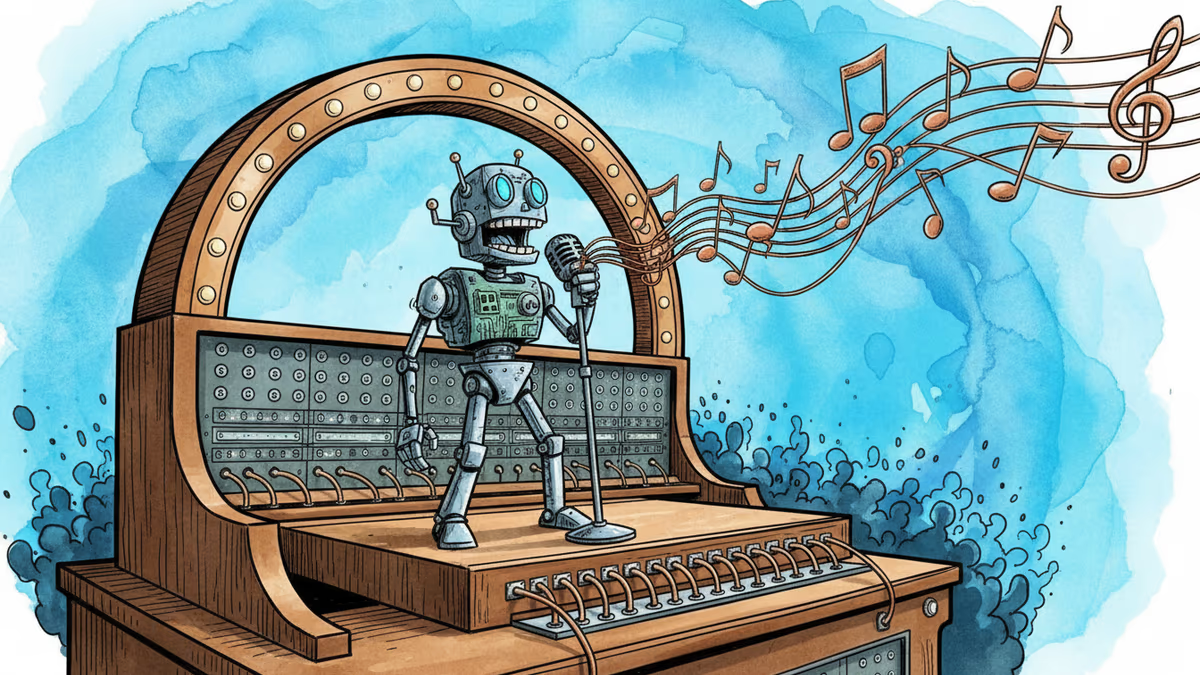
The Phone Engineer Who Accidentally Invented Modern Music
The vocoder was built to compress phone calls. It ended up encrypting Churchill's war dispatches—and eventually defining the sound of Daft Punk, Auto-Tune, and K-pop. The story of technology's most unexpected detour.
A Bell Labs Engineer Had No Idea What He Was Starting
In the late 1920s, Homer Dudley had a very specific, very unglamorous problem to solve. Copper telephone lines were expensive. Bandwidth was scarce. If you could strip a human voice down to its mathematical skeleton—transmit only the essential data, then reconstruct it on the other end—you could pack far more calls onto a single wire.
The device Dudley built to do this, which he called the vocoder (voice coder), worked by slicing the voice into frequency bands, tracking the energy changes in each band, and using those patterns to drive a synthetic sound source at the receiving end. The result was recognizable as speech, but eerie—flattened, mechanical, unmistakably artificial. When Dudley demonstrated it at the 1939 New York World's Fair, audiences were unsettled. A machine that could replicate—and reconstruct—the human voice felt like science fiction made real.
Dudley filed his patents and moved on. He was an engineer solving an engineering problem. What happened next was entirely out of his hands.
The War Classified It. Music Liberated It.
When World War II began, the vocoder didn't stay in the telephone lab for long. Military planners recognized immediately that a technology capable of decomposing and recomposing the human voice could also make voice communications uninterpretable to eavesdroppers. The result was SIGSALY—a 30-ton encryption system that scrambled voice signals using vocoder principles and one-time pads.
Winston Churchill and Franklin Roosevelt used it to speak across the Atlantic. The Germans knew the calls were happening. They had no idea what was being said. For the duration of the war, the vocoder was one of the most tightly held secrets in Allied communications.
When the war ended and the technology was declassified, it landed in the hands of a very different kind of person: the experimental musician. The vocoder's defining quality—that uncanny, mechanical voice quality that made it bad at sounding natural—was precisely what made it interesting to composers probing the edges of what music could be.

From Kraftwerk to Daft Punk to Your Spotify Playlist
The path from wartime encryption to pop radio took roughly three decades, and it ran through some of the most deliberately strange music ever recorded. German electronic pioneers Kraftwerk built their entire aesthetic around the vocoder's dehumanizing effect in the 1970s—the voice as machine, the machine as voice, the line between them deliberately erased.
By the late 1970s and '80s, the sound had migrated into mainstream R&B and funk. Earth, Wind & Fire. Zapp & Roger. The robot-voice aesthetic that had once seemed avant-garde became, improbably, danceable. Then Daft Punk made it iconic for a new generation, and the underlying technology quietly evolved into what most people now know as Auto-Tune—the pitch-correction software that has become so ubiquitous in contemporary pop that its absence is now the exception worth noting.
The straight line from Dudley's bandwidth problem to the processed vocals on virtually every major-label release today is not a metaphor. It is a literal engineering genealogy.
The Pattern That Keeps Repeating
What makes the vocoder's story worth telling in 2026 isn't nostalgia. It's the pattern it represents—one that keeps reasserting itself every time a genuinely new technology enters the world.
The internet was designed for military communications redundancy. GPS was a navigation system for nuclear submarines. Bluetooth was an industrial wireless protocol. In each case, the technology's most consequential uses were discovered not by its creators but by people who were never supposed to be in the room.
Right now, the same dynamic is playing out with generative AI. The engineers building large language models and image generators have specific applications in mind. But the history of the vocoder suggests that the uses that actually matter—culturally, economically, socially—may be ones nobody has thought of yet. The teenager with a laptop and a free API account may be closer to the next unexpected breakthrough than the product roadmap.
For music producers and tech investors alike, that's either an exciting or deeply unsettling thought, depending on your position in the current order.
Authors
Related Articles
Apple turns 50. From a garage in 1976 to the world's most valuable company, the real story isn't about products — it's about how Apple made technology feel like identity.
The original Macintosh had too little memory, almost no software, and helped get Steve Jobs fired. Forty years later, it's considered one of the most important computers ever made. What gives?
In 2021, Clubhouse was the hottest app on earth. Invite codes sold for hundreds of dollars. Then it nearly vanished. The story reveals how social media hype actually works.
TechCrunch Startup Battlefield 200 2026 applications open in mid-February. Join the elite cohort of early-stage startups for a chance to win $100,000.
Apple turns 50. From a garage in 1976 to the world's most valuable company, the real story isn't about products — it's about how Apple made technology feel like identity.
The original Macintosh had too little memory, almost no software, and helped get Steve Jobs fired. Forty years later, it's considered one of the most important computers ever made. What gives?
In 2021, Clubhouse was the hottest app on earth. Invite codes sold for hundreds of dollars. Then it nearly vanished. The story reveals how social media hype actually works.
TechCrunch Startup Battlefield 200 2026 applications open in mid-February. Join the elite cohort of early-stage startups for a chance to win $100,000.
Thoughts
Share your thoughts on this article
Sign in to join the conversation