
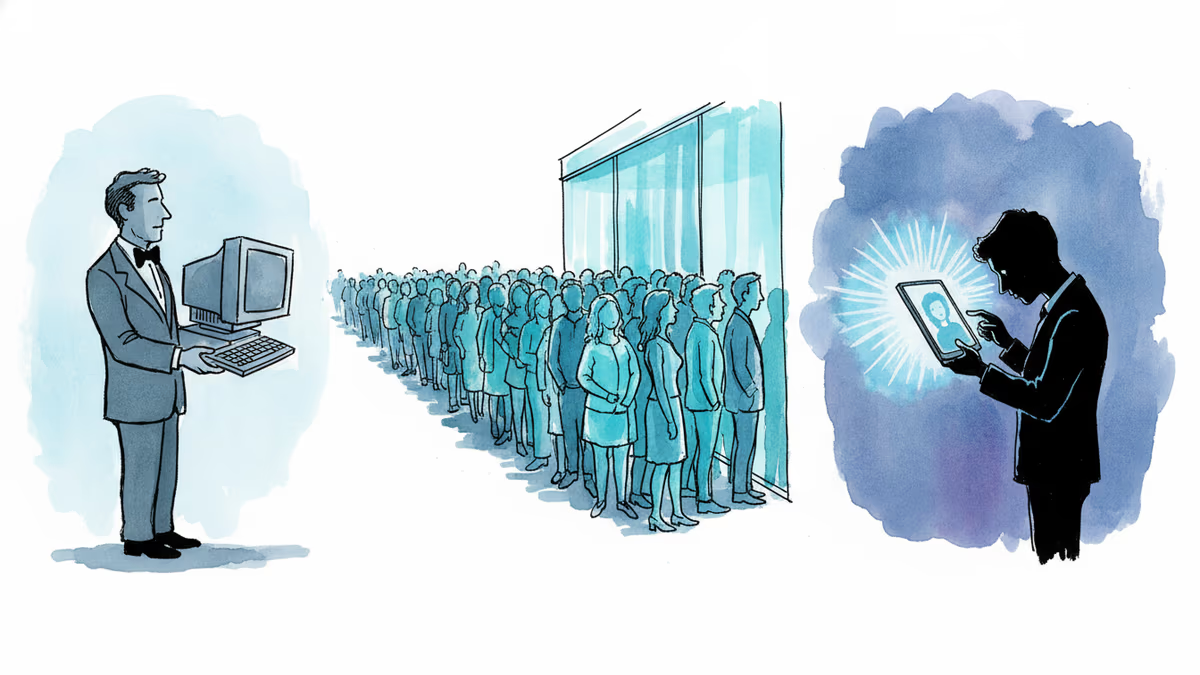
Apple at 50: The Company That Sold You a Mirror
Apple turns 50. From a garage in 1976 to the world's most valuable company, the real story isn't about products — it's about how Apple made technology feel like identity.
The Company That Arrived Before You Knew You Needed It
The iPhone turned 19 this year. Yet Apple itself turns 50. That gap — three decades of existence before its most defining product — is easy to forget, and worth remembering.
On April 1, 1976, Steve Jobs and Steve Wozniak incorporated a company in a California garage. There was no product roadmap, no venture capital deck, no talk of ecosystems. There was just a belief, radical for its time, that a computer could belong to a person — not a corporation, not a university, not a government. That belief became the throughline of everything Apple has done since.
Fifty years later, Apple's market capitalization has hovered around $3 trillion. It is the most profitable consumer electronics company in history. And yet the most interesting question about Apple at 50 isn't how big it got. It's why it got there — and what that tells us about where technology and culture are headed next.
From Bow Ties to Sledgehammers: The Early Years
The Apple of the late 1970s and early 1980s looks almost unrecognizable today. Jobs wore bow ties on stage. The Apple II was a beige box that sat on desks in schools and small businesses. Functional, but not yet iconic.
That changed in January 1984. During the Super Bowl, Apple aired a 60-second commercial directed by Ridley Scott. A woman sprints through a dystopian hall, hurls a sledgehammer at a screen broadcasting an IBM-like figure, and the screen explodes. The tagline: "On January 24th, Apple Computer will introduce Macintosh. And you'll see why 1984 won't be like 1984." It remains one of the most analyzed advertisements ever made — not because it sold computers, but because it sold a side to be on.
The Macintosh itself introduced the mouse and a graphical interface to mainstream consumers. The idea that you could point at something on a screen and click it — rather than typing commands — seems obvious now. In 1984, it was genuinely strange. Apple didn't invent the concept (that credit goes to Xerox PARC), but it made it feel inevitable.
The Exile, the Return, and the Reinvention

No honest account of Apple at 50 skips the 12-year wilderness. In 1985, Jobs was pushed out of the company he founded, following a power struggle with then-CEO John Sculley. Without him, Apple drifted. Market share collapsed. By 1997, the company had roughly 90 days of cash left.
Jobs returned that year through Apple's acquisition of his startup NeXT. What followed was one of the more dramatic corporate turnarounds on record. He cut the product line from dozens of models to four. He brought in Jony Ive to rethink design. The 1998iMac — translucent, colorful, shaped like something from a different planet — announced that Apple was back, and that it intended to compete on aesthetics as much as specs.
Then came the run. iPod in 2001 dismantled the music industry's distribution model. iPhone in 2007 made every phone manufacturer rethink their existence. iPad in 2010 created a category that didn't previously exist. Each product didn't just enter a market — it restructured one.
What Apple Actually Sells
Here's the part that gets underreported in anniversary pieces: Apple has rarely been the first. It wasn't the first MP3 player, the first smartphone, or the first tablet. What it consistently did was arrive second — and make everything before it feel like a prototype.
The reason comes down to something harder to copy than hardware specs. Apple products have always been designed around a question: How will using this make you feel about yourself? The MacBook isn't just a laptop. The AirPods aren't just earbuds. They are, in some sense, accessories to an identity. Analysts at Counterpoint Research note that in the premium smartphone segment (above $800), Apple consistently holds over 60% global market share — not because the hardware is categorically superior, but because the brand carries a social signal that competitors haven't cracked.
This is Apple's deepest competitive moat, and also its most uncomfortable one. It raises real questions about how much of consumer technology is utility and how much is performance of self.
The Skeptics Aren't Wrong
No 50th anniversary piece should ignore the critiques — and there are serious ones.
Apple's walled garden, the App Store ecosystem that takes up to 30% commission on digital sales, is currently under regulatory scrutiny in the EU, the US, and South Korea. Critics argue the company has used its platform dominance to disadvantage competitors and extract rents from developers. The 2024Epic v. Apple legal saga and the EU's Digital Markets Act forcing Apple to allow third-party app stores in Europe are not footnotes — they're signals that the next chapter of Apple's story will be shaped as much by regulators as by engineers.
There's also the question of what comes next. Apple Intelligence, the company's AI platform rolled out in 2024 and 2025, has received a more muted reception than past launches. In a landscape where OpenAI, Google, and Anthropic are moving fast, Apple's traditionally closed, hardware-tethered approach to AI may be a structural disadvantage — or it may prove to be the privacy-first differentiator that a growing number of users want. That question is genuinely open.
Authors
Related Articles
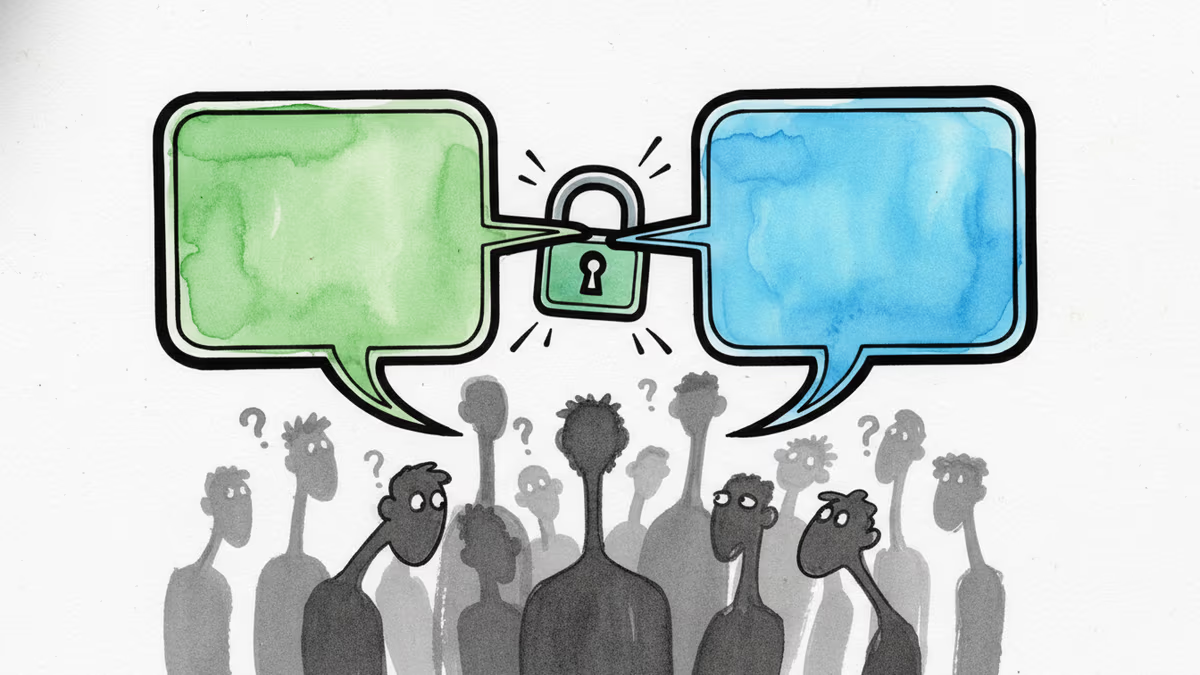
After 15 years of fragmented mobile messaging, Apple and Google are rolling out end-to-end encrypted RCS messaging between iPhones and Android devices. Here's what changed, why it took so long, and what it means for your privacy.
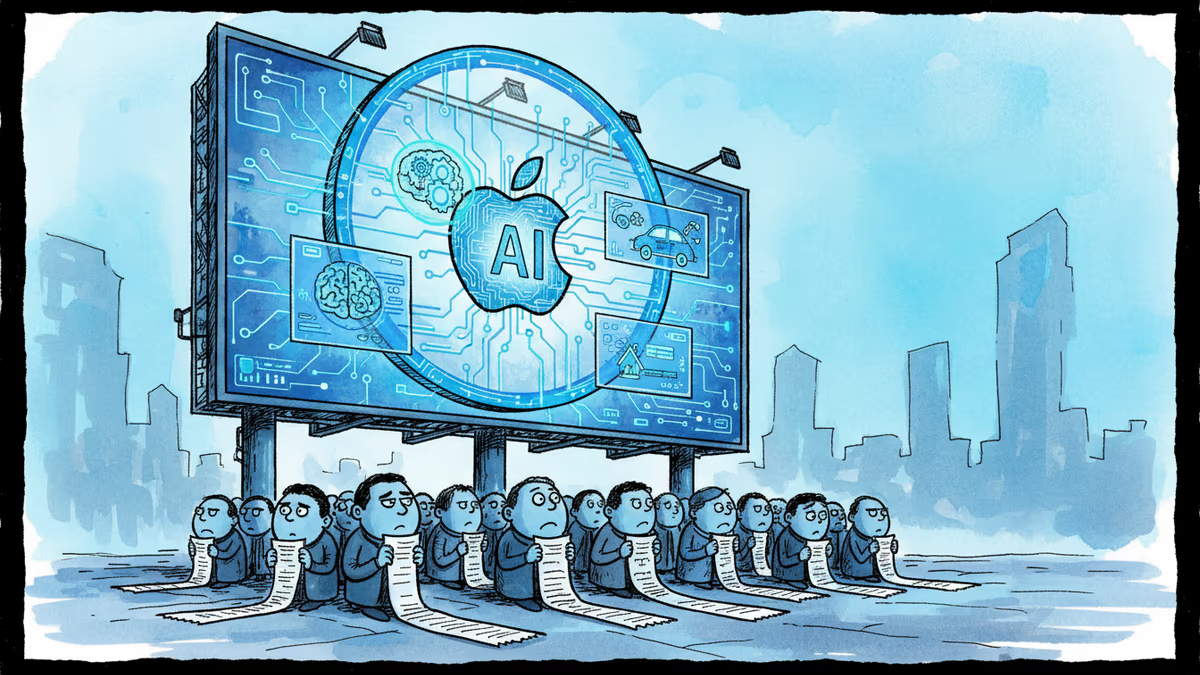
Apple agreed to pay $250 million to settle claims it misled iPhone 16 buyers about Apple Intelligence features. What this means for consumers, Big Tech marketing, and the AI industry.
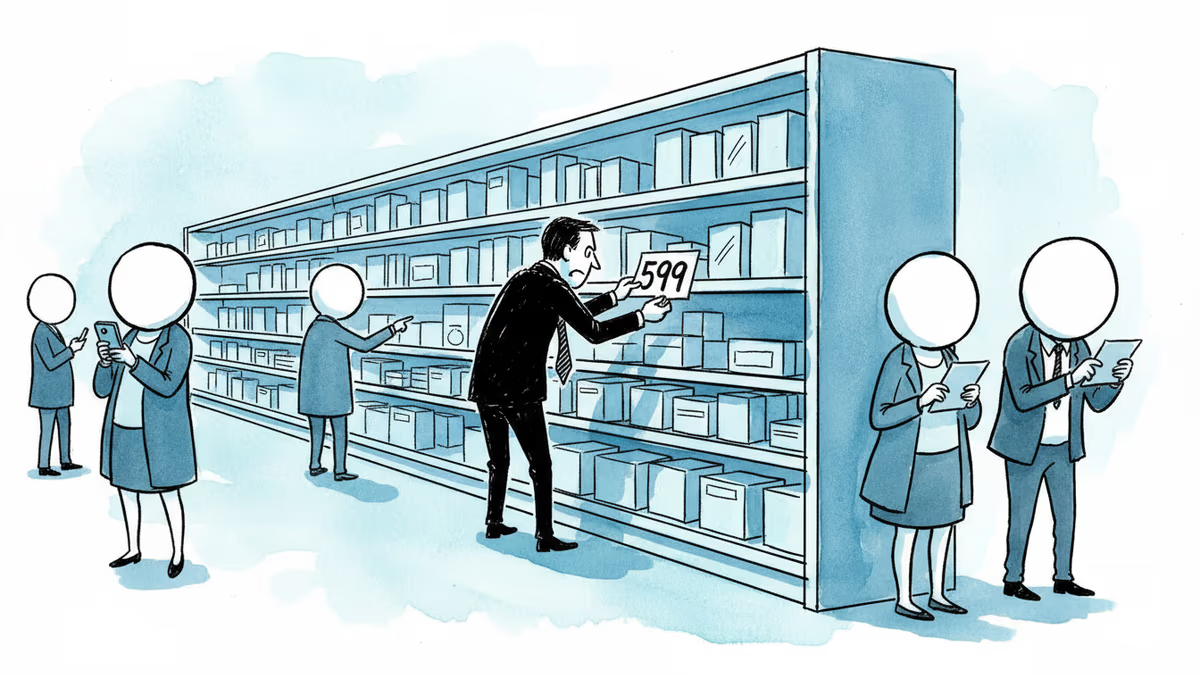
Apple quietly removed the entry-level $599 Mac Mini, raising the starting price to $799 — just one day after Tim Cook warned of chip supply constraints on the earnings call.
Apple names John Ternus, its hardware engineering chief, as the next CEO. The shift from operator to product person signals where Apple thinks its next decade of growth will come from — and raises real questions about what comes next.
After 15 years of fragmented mobile messaging, Apple and Google are rolling out end-to-end encrypted RCS messaging between iPhones and Android devices. Here's what changed, why it took so long, and what it means for your privacy.
Apple agreed to pay $250 million to settle claims it misled iPhone 16 buyers about Apple Intelligence features. What this means for consumers, Big Tech marketing, and the AI industry.
Apple quietly removed the entry-level $599 Mac Mini, raising the starting price to $799 — just one day after Tim Cook warned of chip supply constraints on the earnings call.
Apple names John Ternus, its hardware engineering chief, as the next CEO. The shift from operator to product person signals where Apple thinks its next decade of growth will come from — and raises real questions about what comes next.
Thoughts
Share your thoughts on this article
Sign in to join the conversation