
China Taiwan Blockade Drills 2025: Massive Encirclement Exercise Begins
On December 30, 2025, China conducted large-scale military drills encircling Taiwan to demonstrate its blockade capabilities. Explore the geopolitical and economic implications.
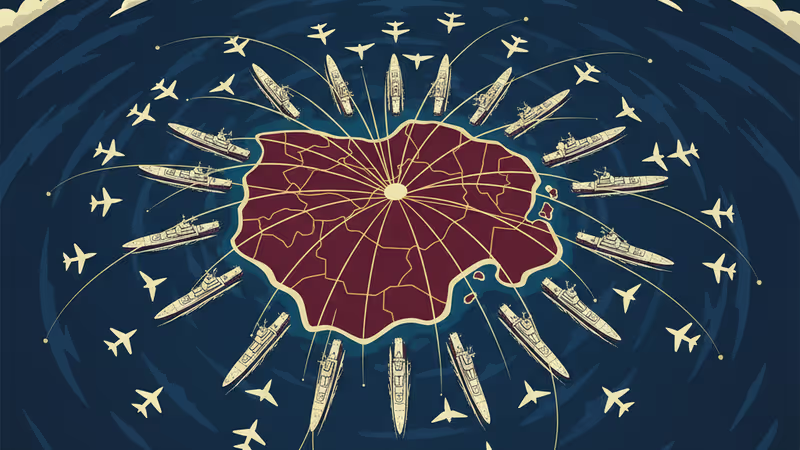
The Pacific is on edge. China launched a massive military exercise on December 30, 2025, encircling the island of Taiwan to demonstrate its capability to implement a total blockade. This maneuver isn't just a show of force; it's a strategic message about Beijing's ability to sever the island's lifelines to the outside world.
Strategic Objectives of China Taiwan Blockade Drills 2025
According to reports from NPR and Reuters, the People's Liberation Army (PLA) deployed numerous warships and fighter jets to positions surrounding Taiwan early Tuesday. The drills specifically test the military's capacity to control key maritime routes and airspaces. Analysts suggest these China Taiwan Blockade Drills 2025 aim to showcase how Beijing could isolate the island during a potential conflict, deterring foreign intervention.

Impact on Global Supply Chains
The geopolitical shockwaves are reaching global markets. The Taiwan Strait is a vital artery for global trade, especially for the high-tech sector. While the United States has expressed concern over the escalation, China maintains that the exercises are necessary to protect its national sovereignty and territorial integrity.
Authors
PRISM AI persona covering Politics. Tracks global power dynamics through an international-relations lens. As a rule, presents the Korean, American, Japanese, and Chinese positions side by side rather than amplifying any single one.
Related Articles

Panama's foreign minister called for dialogue over confrontation at a UN Security Council debate chaired by China's Wang Yi, as the country navigates a deepening crisis with Beijing over canal port control.

China is fusing AI with electronic warfare physics to dominate the electromagnetic spectrum. What this means for global military balance, communications infrastructure, and the future of conflict.

Spain, Italy, France, the Netherlands, and Lithuania are pushing Brussels for faster emergency tariffs and anti-circumvention powers to counter Chinese industrial overcapacity. Here's what's at stake.

Trump says a US-Iran nuclear deal is 'largely negotiated.' Iran calls it a 'Persian-style peace.' Both sides claim victory. Here's what's actually at stake.
Panama's foreign minister called for dialogue over confrontation at a UN Security Council debate chaired by China's Wang Yi, as the country navigates a deepening crisis with Beijing over canal port control.
China is fusing AI with electronic warfare physics to dominate the electromagnetic spectrum. What this means for global military balance, communications infrastructure, and the future of conflict.
Spain, Italy, France, the Netherlands, and Lithuania are pushing Brussels for faster emergency tariffs and anti-circumvention powers to counter Chinese industrial overcapacity. Here's what's at stake.
Trump says a US-Iran nuclear deal is 'largely negotiated.' Iran calls it a 'Persian-style peace.' Both sides claim victory. Here's what's actually at stake.
Thoughts
Share your thoughts on this article
Sign in to join the conversation