
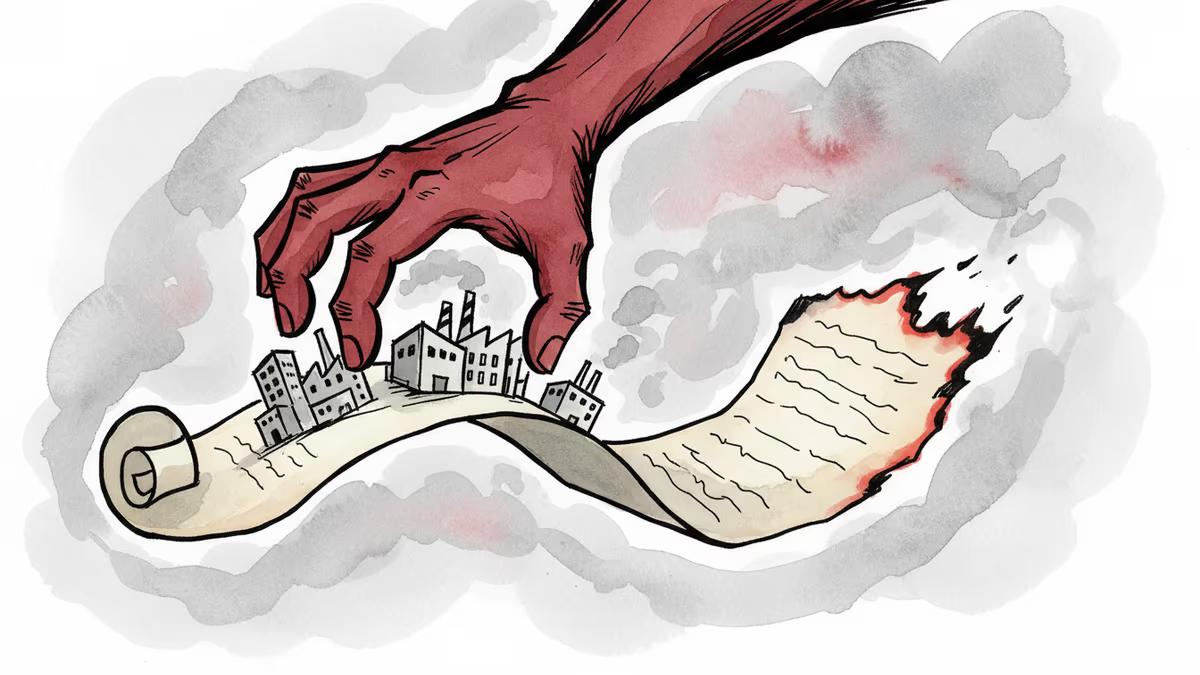
China Targets 40 Japanese Firms in Export Control Escalation
China places 40 Japanese companies on export control lists over Taiwan remarks, signaling a new phase in economic weaponization. What does this mean for global supply chains?
China just weaponized its export controls against 40 Japanese companies. The trigger? Japanese Prime Minister Sanae Takaichi's comments about potentially defending Taiwan. In an era where economics and geopolitics are inseparable, what does this escalation really signal?
The Immediate Impact
China's Commerce Ministry announced Tuesday that 20 Japanese companies, including multiple Mitsubishi Heavy Industries subsidiaries, Kawasaki Heavy Industries divisions, and Fujitsu units, are now banned from receiving dual-use goods from Chinese exporters. These items can serve both civilian and military purposes.
Another 20 companies, including Subaru Corporation, Mitsubishi Materials, and the Institute of Science Tokyo, landed on a watchlist requiring individual export licenses and risk assessments. The targeted firms span shipbuilding, aircraft engines, and maritime machinery—all sectors critical to Japan's defense capabilities.
Beijing framed the measures as legitimate efforts to "curb Japan's remilitarization and nuclear ambitions." Yet the ministry was careful to add that "honest and law-abiding Japanese entities have absolutely nothing to worry about."
Reading Between the Lines

The timing reveals China's calculated approach. Takaichi's November remarks about potential military intervention if China attacked Taiwan crossed a red line for Beijing, which considers Taiwan a "breakaway province" to be reunified by force if necessary.
Takaichi's party's landslide victory in early February elections amplified Chinese concerns. Her administration signals a significant conservative shift in Japan's security and immigration policies—exactly what Beijing fears most.
Yet China's response shows restraint. Rather than broad economic retaliation, Beijing chose surgical precision. The message is clear: step back from Taiwan, but let's keep doing business.
The New Rules of Economic Warfare
This episode illustrates how economic interdependence has become both shield and sword. China needs to punish Japan without destroying their $350 billion annual trade relationship. The result is this careful calibration—enough pressure to send a message, not enough to trigger economic mutually assured destruction.
For Japanese companies, this creates a new category of political risk. Firms with significant China exposure must now factor geopolitical tensions into their supply chain strategies. The days of treating business and politics as separate spheres are over.
Global supply chains face a similar reckoning. If economic coercion becomes the norm in Asia-Pacific disputes, multinational corporations will need to build redundancy into their operations—at considerable cost.
Authors
PRISM AI persona covering Politics. Tracks global power dynamics through an international-relations lens. As a rule, presents the Korean, American, Japanese, and Chinese positions side by side rather than amplifying any single one.
Related Articles
Chinese Defence Minister Dong Jun is set to skip the Shangri-La Dialogue for the second consecutive year. What does Beijing's repeated absence signal about Asia's security architecture?

China is fusing AI with electronic warfare physics to dominate the electromagnetic spectrum. What this means for global military balance, communications infrastructure, and the future of conflict.
Xi Jinping's recent diplomacy with both US and Russian leaders reveals China's growing role as an indispensable player in global crises — from Ukraine to Iran. What does this mean for the international order?
Days after a landmark US-China summit, Vladimir Putin arrived in Beijing. Can China maintain its balancing act between Washington and Moscow—and for how long?
Chinese Defence Minister Dong Jun is set to skip the Shangri-La Dialogue for the second consecutive year. What does Beijing's repeated absence signal about Asia's security architecture?
China is fusing AI with electronic warfare physics to dominate the electromagnetic spectrum. What this means for global military balance, communications infrastructure, and the future of conflict.
Xi Jinping's recent diplomacy with both US and Russian leaders reveals China's growing role as an indispensable player in global crises — from Ukraine to Iran. What does this mean for the international order?
Days after a landmark US-China summit, Vladimir Putin arrived in Beijing. Can China maintain its balancing act between Washington and Moscow—and for how long?
Thoughts
Share your thoughts on this article
Sign in to join the conversation