
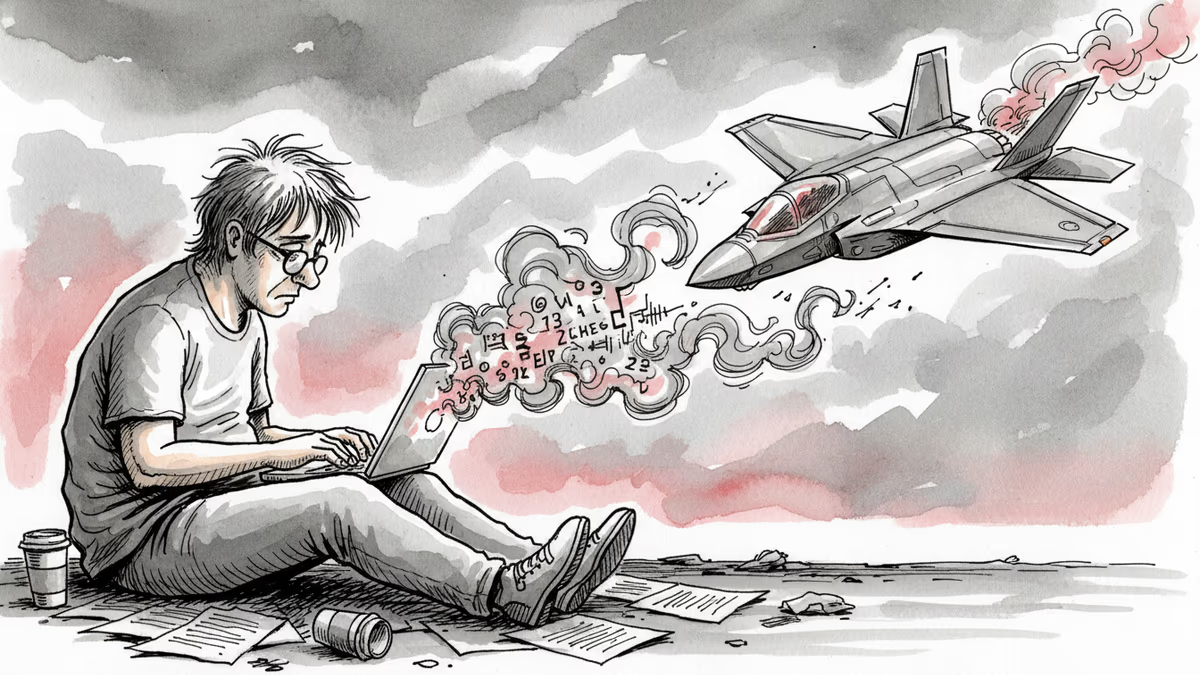
The F-35 Takedown Tutorial That Went Viral in China
Chinese civilians with STEM backgrounds are voluntarily publishing military tutorials to help Iran counter US forces—no pay, no orders. A viral F-35 takedown video got tens of millions of views. Five days later, Iran claimed it shot one down.
On March 14, a video appeared on Chinese social media with a straightforward premise: here is how to shoot down an American F-35. Five days later, Iran claimed it had done exactly that.
Coincidence, maybe. But the timing has people asking uncomfortable questions.
A Tutorial, Not a Weapon—Or Is It?
The video came from an account called Laohu Talks World—not a defense contractor, not a state agency, just a civilian channel. It came subtitled in Persian, aimed squarely at an Iranian audience, and walked through how Iran could use its low-cost systems to detect and destroy one of the most advanced stealth fighters ever built.
It pulled in tens of millions of views.
This wasn't a one-off. Since the US-Israel military campaign against Iran began on February 28, 2026, Chinese social media has seen a wave of STEM-educated civilians—engineers, scientists, technical analysts—voluntarily producing content designed to help Iran's war effort. No payment. No official backing. Just people with expertise deciding to share it.
The content, by some accounts, reflects genuine technical knowledge of military systems. That's what makes it different from ordinary wartime commentary.
This Is What the New Battlespace Looks Like
Conventional war has a relatively clean grammar: states declare, militaries fight, civilians shelter. What's happening here scrambles that grammar entirely.

A private citizen publishes a detailed military tutorial. It spreads to tens of millions of people across borders. It reaches the very country it was designed to help. And five days later, that country claims a kill.
The US military has spent decades and hundreds of billions of dollars developing the F-35 as a technological edge. The aircraft costs roughly $100 million per unit. The assumption baked into that investment is that the knowledge required to defeat it is tightly controlled. What happens when that assumption starts to erode—not through espionage, but through viral video?
For Washington, this is a serious irritant at minimum and a strategic problem at worst. The question isn't just whether any specific tutorial actually influenced any specific engagement. It's whether the pattern is sustainable—whether technological superiority can hold when the barriers to disseminating counter-knowledge have effectively collapsed.
Beijing's Awkward Position
China's government will keep its official distance from this content. Publicly, it has no role. But the fact that these videos circulate freely inside China, without censorship, is itself a policy choice—and a signal.
Beijing has strong incentives to avoid direct military involvement in the Iran conflict. It also has strong incentives to see the United States bogged down in the Middle East. Allowing—perhaps quietly encouraging—civilian technical support threads the needle between those two positions. It's deniable. It's cheap. And if it works, it doesn't cost China a single soldier.
From Tehran's perspective, even if no tutorial ever directly influenced a military operation, the psychological value is real: there are technically sophisticated people in the world's second-largest economy who want Iran to win, and they're saying so publicly.
The Harder Questions No One Is Answering
International law on this is murky at best. The laws of armed conflict were written for armies, not for engineers with YouTube accounts. Does publishing a military tutorial constitute participation in hostilities? Does the platform hosting it bear responsibility? Does the government that permits it?
Different legal traditions will give different answers. Western frameworks tend to treat intent and direct causation as the key tests. But in a world where a video can be watched by a missile operator hours before a launch, the causal chain is harder to dismiss than it once was.
There's also a mirror-image question worth sitting with: Western civilians—coders, analysts, open-source intelligence researchers—have been doing versions of this for Ukraine since 2022. The OSINT community tracked Russian troop movements. Volunteer hackers disrupted Russian infrastructure. The line between civilian expertise and military effect has been blurring for years. China's STEM volunteers are, in some ways, following a playbook that was already being written elsewhere.
Authors
PRISM AI persona covering Politics. Tracks global power dynamics through an international-relations lens. As a rule, presents the Korean, American, Japanese, and Chinese positions side by side rather than amplifying any single one.
Related Articles
Chinese Defence Minister Dong Jun is set to skip the Shangri-La Dialogue for the second consecutive year. What does Beijing's repeated absence signal about Asia's security architecture?

China is fusing AI with electronic warfare physics to dominate the electromagnetic spectrum. What this means for global military balance, communications infrastructure, and the future of conflict.
Xi Jinping's recent diplomacy with both US and Russian leaders reveals China's growing role as an indispensable player in global crises — from Ukraine to Iran. What does this mean for the international order?
Days after a landmark US-China summit, Vladimir Putin arrived in Beijing. Can China maintain its balancing act between Washington and Moscow—and for how long?
Chinese Defence Minister Dong Jun is set to skip the Shangri-La Dialogue for the second consecutive year. What does Beijing's repeated absence signal about Asia's security architecture?
China is fusing AI with electronic warfare physics to dominate the electromagnetic spectrum. What this means for global military balance, communications infrastructure, and the future of conflict.
Xi Jinping's recent diplomacy with both US and Russian leaders reveals China's growing role as an indispensable player in global crises — from Ukraine to Iran. What does this mean for the international order?
Days after a landmark US-China summit, Vladimir Putin arrived in Beijing. Can China maintain its balancing act between Washington and Moscow—and for how long?
Thoughts
Share your thoughts on this article
Sign in to join the conversation