

Chicago's Digital Dragnet Caught a Killer in 90 Minutes
Chicago's 45,000-camera surveillance network nabbed a mass shooter in 90 minutes. But at what cost to privacy and civil liberties?
90 Minutes. That's How Long It Took Chicago's Eyes to Find a Killer
September 2, 2024, early morning. A mass shooter executes four people on a Chicago Transit Authority train. By the time police cuffed the suspect at another station, just 90 minutes had passed. The secret weapon? A digital dragnet of 45,000 surveillance cameras blanketing the city.
The process was almost algorithmic in its precision. Transit cameras captured the execution-style shooting. Real-time footage tracked the suspect across the rail system. Images circulated to thousands of officers. A cop in suburban Riverdale recognized him from a previous arrest. At capture: name, address, criminal history—all ready.
For Chicagoans, this wasn't shocking. They live in one of America's most surveilled cities, with among the highest per-capita camera counts in the US.
The Panopticon Paradox: Safety vs. Scrutiny
Chicago's surveillance web extends far beyond CCTV. License plate readers, school security systems, park district cameras, even Ring doorbells—all feeding into a centralized monitoring system. Law enforcement calls it effective public safety infrastructure.
Critics call it something else: a "surveillance panopticon" that creates chilling effects on behavior while violating privacy and free speech guarantees.
The burden falls disproportionately on Black and Latino communities, says Lance Williams, an urban violence scholar at Northeastern Illinois University. "You have to deal with structural problems"—jobs, housing, mental health services—"not just surveillance," he argues.
Victory Against the Acoustic Web
Until recently, Chicago was the largest customer of ShotSpotter acoustic sensors—devices that detect gunfire and alert police. The system grew from a small South Side area in 2012 to covering 60% of the city by 2018, spanning 136 square miles.
But March 2021 changed everything. Police responding to a ShotSpotter alert fatally shot 13-year-old Adam Toledo. The tragedy became the touchstone of the #StopShotSpotter movement and a central issue in Brandon Johnson's successful mayoral campaign.
Johnson kept his promise, ending the contract with SoundThinking. Total cost to taxpayers: over $53 million.
SoundThinking defended its technology, saying ShotSpotter enables law enforcement to "reach the scene faster, render aid to victims, and locate evidence more effectively." The company added that "communities experiencing the highest levels of gun violence deserve the same rapid emergency response as any other neighborhood."
The New Frontier: Drones as First Responders

Even as activists scored victories, surveillance evolved. Oak Brook, a wealthy Chicago suburb, became Illinois' first municipality to deploy "drone as first responder" technology.
Police Chief Brian Strockis champions the program as a way to reduce dangerous high-speed chases. The autonomous drone launches from the police station roof, responding to 10-12 service calls daily at speeds up to 45 mph. It arrives before patrol officers in 9 out of 10 cases.
In early December, when retail theft crews hit the luxury Oakbrook Center mall, the drone identified the suspect vehicle using license plate recognition and texted high-definition photos to ground officers. The suspect was later arrested in Chicago.
"It's a force multiplier," says Strockis, whose department's real-time crime center integrates feeds from drones, traffic cameras, license plate readers, and about 1,000 private security cameras.
Citizen Resistance: The FOIA Warriors
Chicago-based nonprofit Lucy Parsons Labs has become a thorn in surveillance advocates' side. Led by first-generation Mexican-Americans Alejandro Ruizesparza and Freddy Martinez, the group weaponizes Freedom of Information Act requests to expose surveillance overreach.
Their Oak Park victory exemplifies their approach. Working with local group Freedom to Thrive, they revealed that eight Flock Safety license plate readers scanned 3 million plates in 10 months but generated only 42 alerts—a success rate of 0.000014%.
Worse: while Oak Park's population is 19% Black, 85% of drivers flagged by Flock cameras were Black, amplifying existing racial disparities in traffic stops.
"Most surveillance technologies are largely extensions of the plantation systems," says Ruizesparza, drawing parallels to historical systems requiring enslaved persons to carry signed documents and wear numbered badges.
In August, Oak Park trustees voted 5-2 to terminate their Flock Safety contract.
Legal Victories and Limitations
Northwestern law professor Jonathan Manes, senior counsel at the MacArthur Justice Center, has been fighting surveillance overreach in court. His target: ShotSpotter's impact on civil liberties.
Manes discovered a disturbing pattern: thousands of Chicagoans questioned, detained, or arrested simply for being near ShotSpotter alerts—often resulting in charges unrelated to guns. The system directed "a massive number of police deployments" to the South and West Sides, where 80% of Chicago's Black population but only 30% of its white population lived in covered districts.
In late 2025, Manes reached a settlement prohibiting police from stopping or searching people simply because they're near gunshot detection alerts. The agreement covers any future gunshot detection systems Chicago might deploy.
But Manes wants more: "There is a need for much broader structural change to how the city chooses to use surveillance technology and then deploys it."
The Transparency Gap
More than two dozen jurisdictions nationwide have adopted surveillance transparency laws—San Francisco, Seattle, Boston, New York City. Chicago isn't on that list.
As the city issues requests for proposals for new gun violence detection technology, the push and pull between safety and surveillance continues. The 90-minute success story becomes a case study in both surveillance effectiveness and the price of digital omnipresence.
Authors
Related Articles

After Super Bowl ad backlash and AI surveillance features, Ring's founder explains himself. But the real issue isn't the ads—it's the technology itself.
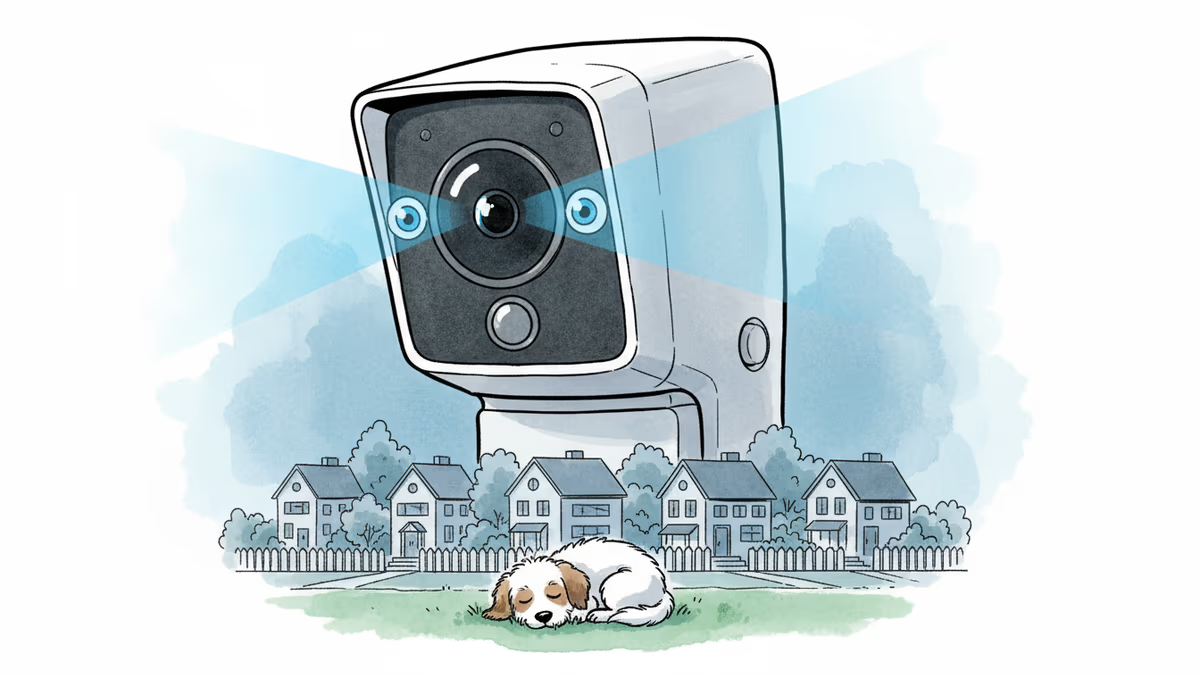
Ring's Super Bowl ad sparked fresh privacy debates about AI surveillance. From finding lost dogs to tracking humans - where do we draw the line?
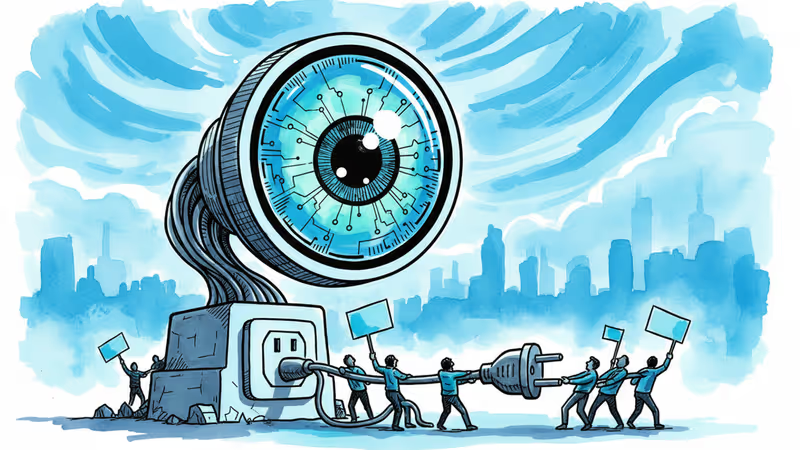
New bill would prohibit ICE and CBP from using facial recognition technology, delete existing data, and allow citizens to sue for damages. The privacy vs security debate intensifies.
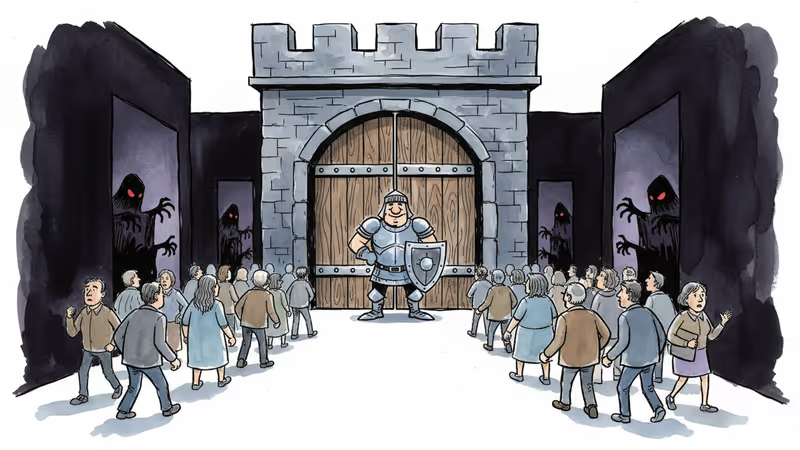
Pornhub's UK exit reveals deeper tensions between child safety laws and privacy rights, as major platforms choose withdrawal over age verification compliance.
After Super Bowl ad backlash and AI surveillance features, Ring's founder explains himself. But the real issue isn't the ads—it's the technology itself.
Ring's Super Bowl ad sparked fresh privacy debates about AI surveillance. From finding lost dogs to tracking humans - where do we draw the line?
New bill would prohibit ICE and CBP from using facial recognition technology, delete existing data, and allow citizens to sue for damages. The privacy vs security debate intensifies.
Pornhub's UK exit reveals deeper tensions between child safety laws and privacy rights, as major platforms choose withdrawal over age verification compliance.
Thoughts
Share your thoughts on this article
Sign in to join the conversation