
From 3 to 300: Why Anti-AI Protests Are Growing Fast
London's King's Cross saw hundreds march against AI development. What started as fringe activism is becoming mainstream concern. The protesters' diverse backgrounds reveal something bigger at play.
When King's Cross Echoed With Warning Calls
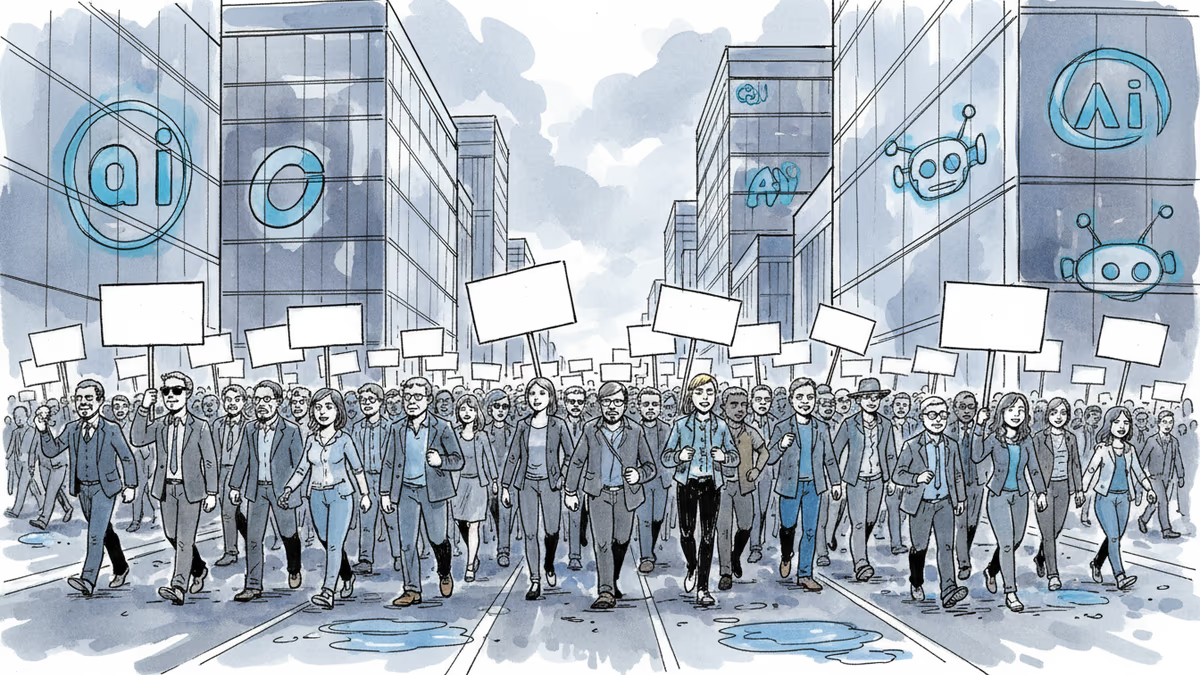
"Pull the plug! Stop the slop!" The chants bounced off glass towers in London's King's Cross tech hub last Saturday, as hundreds of protesters marched past the UK headquarters of OpenAI, Meta, and Google DeepMind. Signs ranged from the philosophical ("WHO WILL BE WHOSE TOOL?") to the blunt ("AI? Over my dead body").
This wasn't just another weekend demonstration. Organizers called it the largest anti-AI protest yet—a significant escalation from the 2-3 hecklers who showed up at Sam Altman's London lecture in May 2023, or even the few dozen who gathered outside Google DeepMind's office last June.
The rapid growth mirrors something the protesters themselves noted: their movement is expanding at roughly the same exponential rate as AI development itself.
The Oxford PhD Student Leading the Charge
Joseph Miller, who co-organized Saturday's march and heads Pause AI's UK branch, studies mechanistic interpretability at Oxford University—a field focused on understanding exactly what happens inside large language models when they process information. Ironically, this research has convinced him that AI may forever remain beyond human control.
"It doesn't have to be a rogue superintelligence," Miller explained. "You just need someone to put AI in charge of nuclear weapons. The more silly decisions humanity makes, the less powerful the AI has to be before things go bad."
His concerns seemed less abstract after last week's news that the US government pressured Anthropic to allow military use of its Claude model for any "legal" purposes. While Anthropic refused, OpenAI signed a deal with the Department of Defense instead.
'The Last Problem Humanity Will Face'

For co-organizer Matilda da Rui, AI represents humanity's final challenge. She believes the technology will either solve all our problems permanently or eliminate us entirely—leaving no one left to have problems.
"It's a mystery to me that anyone would focus on anything else if they actually understood the problem," she said.
Yet despite such existential stakes, the march felt surprisingly pleasant, even fun. The broad coalition brought wildly different concerns: one chemistry researcher worried about data centers emitting infrasound below human hearing thresholds (allegedly inducing paranoia in nearby residents) alongside more mainstream complaints about AI-generated content making it harder to find reliable academic sources.
His solution? "If you couldn't make money from AI, it wouldn't be such a problem."
Beyond Corporate Pressure: A Different Strategy
Most protesters acknowledged that tech companies probably won't respond to street demonstrations. Maxime Fournes, Pause AI's global head who worked in the AI industry for 12 years, was blunt: "They are optimized to just not care about this problem."
Instead, he outlined alternative tactics: "We can slow down the race by creating protection for whistleblowers or showing the public that working in AI is not a sexy job—that actually it's a terrible job. You can dry up the talent pipeline."
The real target isn't OpenAI or Google—it's government regulators. The strategy involves building public awareness to create political pressure for AI oversight.
The Casual Protester Phenomenon
Perhaps most telling was meeting protesters who weren't AI experts or dedicated activists. One finance worker tagged along with his roommate, explaining: "Sometimes you don't have that much to do on a Saturday anyway. If you can see the logic of the argument, it makes sense, so it's like 'Yeah, sure, I'll come along.'"
He noted something crucial about AI concerns: "It's very hard for someone to totally oppose what you're marching for." Unlike divisive political protests, anti-AI sentiment cuts across traditional lines—making it potentially more powerful as a social movement.
The march ended in a Bloomsbury church hall, where protesters stuck name tags on their chests and made awkward introductions. They were there, as one organizer put it, "to figure out how to save the world."
Authors
Related Articles

Samsung and SK unveiled a chip and AI investment package worth thousands of trillions of won on June 29. The headline number swings wildly by outlet, but the real contest isn't capital — it's water and power.
Viral videos show 2026 graduates jeering executives who praise AI at commencement ceremonies. It's not just rudeness — it's a signal about who pays for technological optimism.

Filipino virtual assistants using AI to ghost-manage LinkedIn profiles for executives is now a structured industry. 30 comments a day, fake engagement rings, and a platform struggling to tell real from fabricated.
Two commencement speakers learned the hard way that AI enthusiasm doesn't land well with today's graduates. The backlash reveals a widening gap between tech optimism and Gen Z's economic reality.
Samsung and SK unveiled a chip and AI investment package worth thousands of trillions of won on June 29. The headline number swings wildly by outlet, but the real contest isn't capital — it's water and power.
Viral videos show 2026 graduates jeering executives who praise AI at commencement ceremonies. It's not just rudeness — it's a signal about who pays for technological optimism.
Filipino virtual assistants using AI to ghost-manage LinkedIn profiles for executives is now a structured industry. 30 comments a day, fake engagement rings, and a platform struggling to tell real from fabricated.
Two commencement speakers learned the hard way that AI enthusiasm doesn't land well with today's graduates. The backlash reveals a widening gap between tech optimism and Gen Z's economic reality.
Thoughts
Share your thoughts on this article
Sign in to join the conversation