
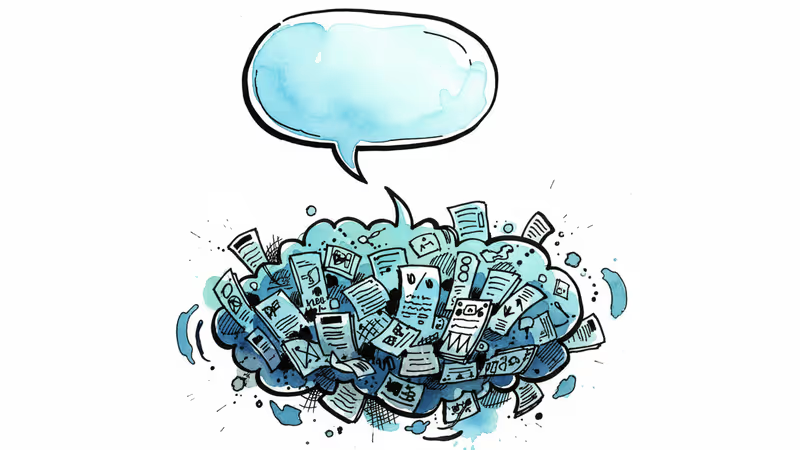
Claude Says No to Ads While ChatGPT Tests Them
Anthropic declares Claude will remain ad-free, contrasting with OpenAI's ChatGPT ad testing. The company argues ads would compromise Claude's role as a genuine thinking partner.
Just one month after OpenAI began testing ads in ChatGPT, rival Anthropic has drawn a line in the digital sand. On Wednesday, the company announced that Claude, its AI chatbot, will remain completely ad-free—a stark philosophical departure from the industry's rush toward advertising revenue.
"There are many good places for advertising. A conversation with Claude is not one of them," Anthropic stated bluntly in its blog post. The company argues that injecting ads into AI conversations would fundamentally compromise Claude's mission as "a genuinely helpful assistant for work and for deep thinking."
Two Paths Diverge in AI Woods
OpenAI's approach represents the conventional wisdom of digital platforms: leverage massive user bases for advertising revenue. With over 300 millionChatGPT users globally, the advertising potential is enormous. The company's January announcement introduced banner ads for free users and ChatGPT Go subscribers in the US, appearing at the bottom of responses without influencing the actual answers. Paid subscribers on higher tiers remain ad-free.
Anthropic, meanwhile, has doubled down on purity. The company even launched a Super Bowl ad campaign that mocks AI assistants interrupting personal conversations with product pitches. It's a bold bet that users will value uninterrupted AI interactions over free access subsidized by advertising.
The Economics of Attention
This divergence reveals a fundamental tension in AI development: monetization versus user experience. OpenAI's ad model follows the playbook of Google, Facebook, and countless digital platforms—capture attention, then sell it to advertisers. It's proven, scalable, and potentially lucrative.

Anthropic's ad-free stance, however, positions Claude as a premium thinking tool. For professionals using AI for complex reasoning, strategic planning, or creative work, advertising interruptions could break the flow of deep engagement. The company is betting that this uncompromised experience justifies higher subscription costs.
The Broader Implications
This isn't just about advertising preferences—it's about the future relationship between humans and AI. Will AI assistants become another marketing channel, subtly influenced by advertiser interests? Or will they remain neutral thinking partners, focused solely on helping users achieve their goals?
The stakes extend beyond individual user experience. As AI becomes integrated into education, healthcare, and critical decision-making, the presence of advertising could raise questions about bias and influence. Would you trust medical advice from an AI that shows pharmaceutical ads? Would you rely on financial guidance from a system displaying investment product promotions?
Market Dynamics at Play
Anthropic's strategy also reflects its position as a challenger brand. While OpenAI dominates market share and can afford to experiment with revenue models, Anthropic needs differentiation. The "no ads" pledge becomes a competitive moat—a clear reason for users to switch or stay loyal.
This positioning could particularly appeal to enterprise customers, who often prefer predictable subscription costs over ad-supported models that might compromise data privacy or professional workflows. For businesses using AI for sensitive operations, an ad-free environment offers both practical and psychological benefits.
Authors
Related Articles
Anthropic shipped Claude Sonnet 5, its mid-tier agent model, on June 30. Behind the 'Opus-class power, budget price' headline sits a tokenizer catch and a three-horse race that's only half real. Here's what developers should actually run the numbers on.
Samsung and SK unveiled a chip and AI investment package worth thousands of trillions of won on June 29. The headline number swings wildly by outlet, but the real contest isn't capital — it's water and power.

A small but growing group of developers has gone all-in on AI coding agents like Claude Code and OpenClaw. History suggests the rest of us won't be far behind.
Viral videos show 2026 graduates jeering executives who praise AI at commencement ceremonies. It's not just rudeness — it's a signal about who pays for technological optimism.
Anthropic shipped Claude Sonnet 5, its mid-tier agent model, on June 30. Behind the 'Opus-class power, budget price' headline sits a tokenizer catch and a three-horse race that's only half real. Here's what developers should actually run the numbers on.
Samsung and SK unveiled a chip and AI investment package worth thousands of trillions of won on June 29. The headline number swings wildly by outlet, but the real contest isn't capital — it's water and power.
A small but growing group of developers has gone all-in on AI coding agents like Claude Code and OpenClaw. History suggests the rest of us won't be far behind.
Viral videos show 2026 graduates jeering executives who praise AI at commencement ceremonies. It's not just rudeness — it's a signal about who pays for technological optimism.
Thoughts
Share your thoughts on this article
Sign in to join the conversation