
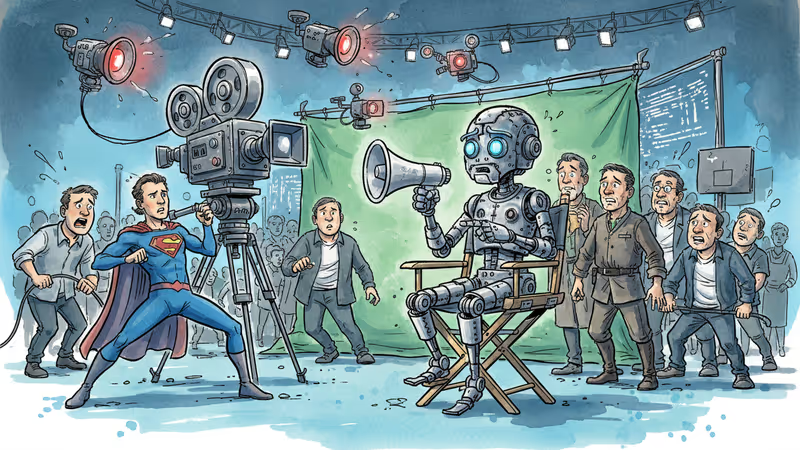
Amazon's AI Studio Goes Public: Hollywood's Next Chapter or Creative Crisis?
Amazon opens its AI film production tools to industry partners in March, promising efficiency gains while sparking debates about creativity and jobs in Hollywood.
350 AI-generated shots. That's how many artificial intelligence created for just one season of Amazon's "House of David" series. Now, the tech giant is ready to share these tools with the rest of Hollywood.
Amazon MGM Studios announced it will launch a closed beta program in March, inviting industry partners to test AI tools developed by its dedicated AI Studio. The program, launching nearly a year after the studio's establishment, promises to deliver initial results by May.
From Internal Experiment to Industry Standard
The AI Studio represents Amazon's systematic approach to integrating artificial intelligence into entertainment production. Unlike rushed AI implementations elsewhere, Amazon has spent months collaborating with established industry figures including Robert Stromberg (known for "Maleficent"), Kunal Nayyar from "The Big Bang Theory," and former Pixar animator Colin Brady.
These partnerships aren't just celebrity endorsements. They represent Amazon's strategy to understand how AI can genuinely support rather than disrupt existing creative workflows. The focus areas include character consistency across shots, pre-production planning, and post-production efficiency—technical challenges that have long plagued film and TV production.
Albert Cheng, who leads the AI Studios initiative, has been clear about the mission: support creative teams, don't replace them. The emphasis on protecting intellectual property and preventing AI-generated content from being absorbed into other AI models suggests Amazon understands the industry's deepest concerns.
The Broader Hollywood AI Rush

Amazon isn't alone in this race. Netflix has already deployed generative AI for complex scenes, with Co-CEO Ted Sarandos revealing that "The Eternaut" used AI to create a building collapse sequence. This isn't just about cutting costs—it's about achieving shots that would be prohibitively expensive or dangerous with traditional methods.
But the timing raises questions. Amazon's recent layoffs—16,000 jobs in January following 14,000 in October—have been partially attributed to AI efficiency gains. This creates an uncomfortable tension between the promise of "supporting" creative teams and the reality of workforce reduction.
The industry's response has been mixed. While some see AI as a tool for democratizing high-end production techniques, others worry about the erosion of traditional craftsmanship and employment opportunities. The ongoing debates echo similar concerns across tech-adjacent industries.
The Economics of Creative Automation
What makes Amazon's approach particularly significant is its integration with Amazon Web Services and multiple LLM providers. This suggests a platform play rather than just internal tooling—Amazon could become the infrastructure provider for AI-powered entertainment production across the industry.
For independent filmmakers and smaller studios, this could level the playing field. Complex visual effects and post-production work that once required major studio budgets might become accessible through AI tools. But for specialized technicians and effects artists, the implications are less clear.
The 350 AI shots in "House of David" weren't just a technical achievement—they were a proof of concept for industrial-scale AI integration. If these tools prove successful in the beta program, they could reshape how entertainment content is produced, distributed, and priced.
Authors
Related Articles

Samsung and SK unveiled a chip and AI investment package worth thousands of trillions of won on June 29. The headline number swings wildly by outlet, but the real contest isn't capital — it's water and power.

Viral videos show 2026 graduates jeering executives who praise AI at commencement ceremonies. It's not just rudeness — it's a signal about who pays for technological optimism.

Filipino virtual assistants using AI to ghost-manage LinkedIn profiles for executives is now a structured industry. 30 comments a day, fake engagement rings, and a platform struggling to tell real from fabricated.
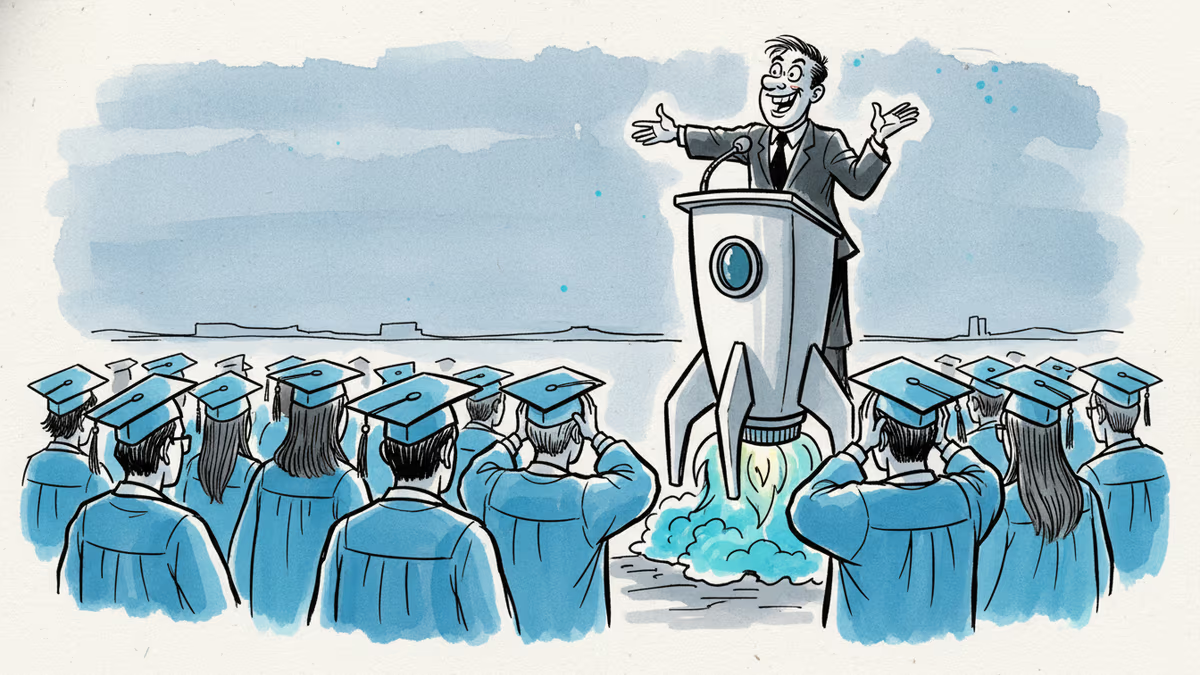
Two commencement speakers learned the hard way that AI enthusiasm doesn't land well with today's graduates. The backlash reveals a widening gap between tech optimism and Gen Z's economic reality.
Samsung and SK unveiled a chip and AI investment package worth thousands of trillions of won on June 29. The headline number swings wildly by outlet, but the real contest isn't capital — it's water and power.
Viral videos show 2026 graduates jeering executives who praise AI at commencement ceremonies. It's not just rudeness — it's a signal about who pays for technological optimism.
Filipino virtual assistants using AI to ghost-manage LinkedIn profiles for executives is now a structured industry. 30 comments a day, fake engagement rings, and a platform struggling to tell real from fabricated.
Two commencement speakers learned the hard way that AI enthusiasm doesn't land well with today's graduates. The backlash reveals a widening gap between tech optimism and Gen Z's economic reality.
Thoughts
Share your thoughts on this article
Sign in to join the conversation