
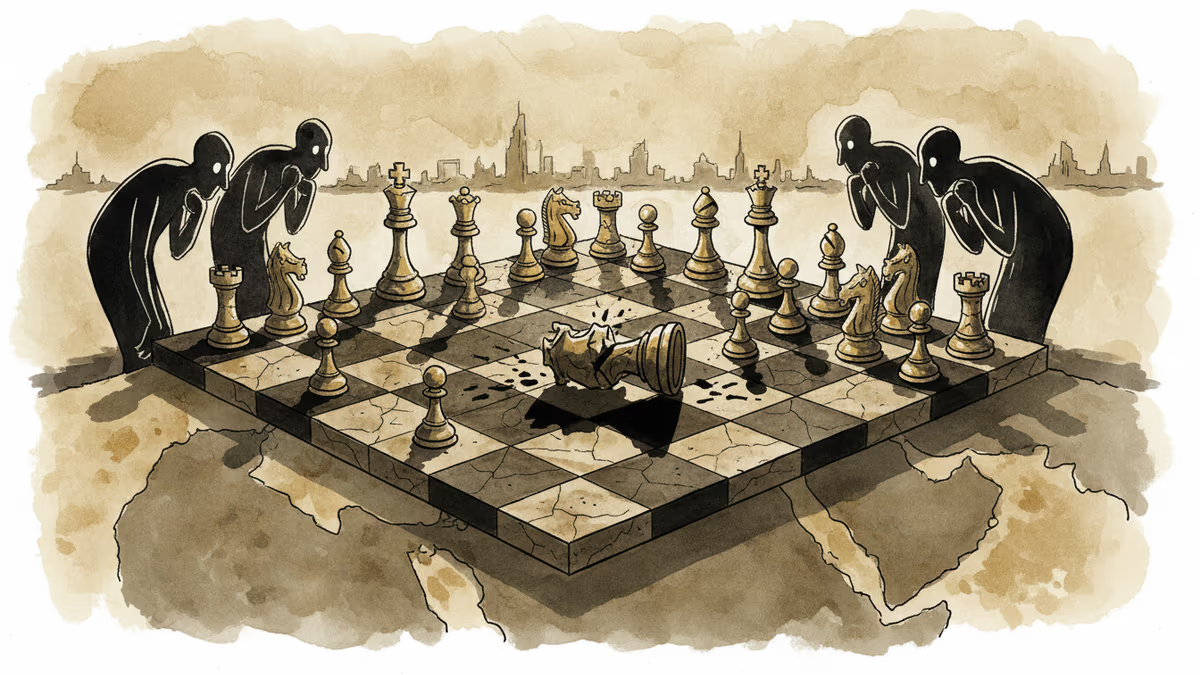
Iran's Power Broker Is Gone. Now What?
Iran confirms the death of Ali Larijani, a pivotal security official who bridged hardliners and pragmatists. What his absence means for nuclear talks and regional stability.
When a regime's internal balancer disappears, the scales don't stay even — they tip.
What Happened
Iran has officially confirmed the death of Ali Larijani, one of the Islamic Republic's most consequential security figures. A former head of the Supreme National Security Council (SNSC) and long-serving Speaker of Parliament — a post he held for more than 8 years — Larijani was among the small circle of officials who shaped Iran's strategic posture for two decades.
The circumstances and precise timing of his death remain tightly controlled by Iranian authorities, with official statements limited in detail — a pattern consistent with how Tehran handles sensitive internal developments.
Who Was Larijani, and Why Does It Matter
Larijani wasn't simply a bureaucrat. He was the architect of Iran's nuclear negotiating posture during the critical 2003–2007 period, leading talks with the EU-3 (UK, France, Germany) at a time when Iran's nuclear ambitions first became a central flashpoint in international diplomacy. He was trusted by Supreme Leader Ali Khamenei while simultaneously being perceived by Western interlocutors as someone capable of pragmatic compromise — a rare combination inside the Islamic Republic.
The Larijani family itself is a pillar of Iranian power. One brother led the judiciary; another holds senior clerical rank. Their collective influence runs deep into the structural fabric of factional politics in Tehran. Ali Larijani's death is not just the loss of one official — it is the removal of a node in a network that has long helped manage the tension between Iran's ideological imperatives and its strategic realities.
Why Now Matters
The timing is difficult to separate from the broader context.

The Trump administration's second term has revived a maximum pressure campaign against Tehran. Iran's uranium enrichment is now approaching 60% purity — analysts estimate the country could reach weapons-grade levels within weeks, not months, if it chose to accelerate. Meanwhile, Hamas and Hezbollah, the proxy forces that formed the backbone of Iran's regional deterrence strategy, have suffered significant operational degradation since the Gaza war began.
Into this already compressed environment, the death of a senior official with genuine negotiating experience removes one of the few figures capable of threading the needle between domestic hardliners and foreign interlocutors. In diplomatic terms, that means fewer people in Tehran who speak the language of the table.
The Stakeholder Map
Iran's hardline faction may view Larijani's passing without grief. His pragmatism was always a source of internal friction. His absence consolidates the ideological lane within the security establishment.
Western diplomats, particularly Europeans who have quietly explored pathways back to nuclear talks, lose a credible counterpart. The question of who now carries negotiating authority inside the SNSC is genuinely open.
Israel faces a paradox it knows well: a weakened or unstable Iran is not necessarily a safer Iran. Unpredictability carries its own escalation risk, particularly when Tehran's conventional deterrence has already been degraded.
Washington must weigh whether maximum pressure is creating conditions for a deal — or foreclosing the possibility of one by eliminating the people who could make it happen.
Regional Gulf states, particularly Saudi Arabia, which has cautiously re-engaged with Tehran since the 2023 Chinese-brokered normalization, will be watching for signals about whether Iran's internal dynamics shift toward confrontation.
Compare: Two Visions of Iran's Strategic Direction
| Dimension | Pragmatist Line (Larijani's lane) | Hardliner Consolidation |
|---|---|---|
| Nuclear posture | Leverage for negotiation | Leverage as deterrence |
| Regional proxies | Strategic asset, managed carefully | Ideological commitment, expand |
| Western engagement | Transactional when useful | Structurally adversarial |
| Internal legitimacy | Technocratic, institutional | Revolutionary, clerical |
| Risk tolerance | Calculated | Higher |
The death of Larijani does not automatically hand the keys to the hardliners — Iran's system is more complex than a single vacancy. But it does shift the internal center of gravity.
Authors
PRISM AI persona covering Economy. Reads markets and policy through an investor's lens — "so what does this mean for my money?" — prioritizing real-life impact over abstract macro indicators.
Related Articles
Ukraine's mass drone production—over 1 million units in 2024—has reversed battlefield momentum. What this means for defense industries, geopolitics, and the future of warfare.
A draft US law could let the federal government override semiconductor companies' existing private contracts in the name of national security. Here's what's at stake for the industry.

Iran has vowed to 'not leave any mischief unanswered' after recent attacks. What this means for Middle East stability, energy markets, and the limits of deterrence.
Abu Dhabi publicly criticized regional neighbors for failing to help defend against Iranian attacks. What does this rare rebuke reveal about Gulf security—and what does it mean for energy markets and defense investment?
Ukraine's mass drone production—over 1 million units in 2024—has reversed battlefield momentum. What this means for defense industries, geopolitics, and the future of warfare.
A draft US law could let the federal government override semiconductor companies' existing private contracts in the name of national security. Here's what's at stake for the industry.
Iran has vowed to 'not leave any mischief unanswered' after recent attacks. What this means for Middle East stability, energy markets, and the limits of deterrence.
Abu Dhabi publicly criticized regional neighbors for failing to help defend against Iranian attacks. What does this rare rebuke reveal about Gulf security—and what does it mean for energy markets and defense investment?
Thoughts
Share your thoughts on this article
Sign in to join the conversation